|
Feature |
WhatsApp Business App |
WhatsApp Business API (The GoKwik Way) |
|
Cost |
Free |
Paid per conversation plus platform fee |
|
Users |
1 Phone and 4 Linked Devices |
Unlimited users and team members |
|
Broadcast Limit |
256 contacts per list |
Unlimited tier-based scaling |
|
Automation |
Basic greeting and away messages |
Advanced chatbots and AI workflows |
|
Checkout |
Manual link sending to the website |
Headless buying inside WhatsApp |
|
Blue Tick Verification |
No |
Yes builds immense trust |
|
Integration |
None |
Connects to Shopify and WooCommerce |
How KwikAds helped Shop Unrush boost ROAS by 37% in 3 months
How KwikAds helped Shop Unrush boost ROAS by 37% in 3 months
How KwikAds helped Shop Unrush boost ROAS by 37% in 3 months
How KwikAds helped Shop Unrush boost ROAS by 37% in 3 months
Kwik Engage
WhatsApp Marketing: A Complete Guide For Ecommerce Success In 2026
 12 Mar 2026
 14 Min Read
Parousia leads product marketing strategies at GoKwik, and she is an expert in driving e-commerce optimisation, conversion growth, and innovative GTM strategies. She crafts compelling messaging and creates content pertaining to D2C commerce.
Read this blog on your favourite platform
When was the last time you opened an email from a brand and thought about how exciting another newsletter is? You probably did not do that. Most marketing emails sit unopened in the promotions tab while brands wonder about engagement.
But when your phone buzzes with that familiar blue tick icon, you likely look immediately. We all look. That immediate attention is the currency of modern commerce. This specific behavior is what makes WhatsApp Marketing the most potent marketing tool available today.
In this guide, we are going to talk about how to turn casual chatters into loyal customers using the WhatsApp app. We will also discuss how to stop carts from getting abandoned and use marketing tools effectively. It is a great way to boost customer engagement and drive real revenue.

What is WhatsApp marketing?
WhatsApp marketing is a direct-to-consumer (D2C) strategy that uses the WhatsApp messaging capabilities to reach customers, promote products, and provide real-time support. Unlike traditional channels, it allows brands to engage in two-way, personalized conversations right where users are most active.
For ecommerce brands, this goes beyond simple texting. They can use Business Solution Providers like Kwik Engage and use the WhatsApp Business API which helps automate transactional alerts, recover abandoned carts, and even enable headless checkout experiences.
Also read:- whatsapp-commerce-6-best-strategies-to-market-sell-products
Also read:- whatsapp-commerce-6-best-strategies-to-market-sell-products
Why should you use WhatsApp marketing?
You might be thinking about whether you really need another marketing channel to manage. The short answer is yes because the digital landscape has shifted significantly. Many reports about WhatsApp marketing metrics show it is a crucial channel offering near guaranteed visibility today.
Let’s understand why WhatsApp for ecommerce is essential for your business:
- High Open Rates: Unlike email marketing campaigns, which struggle to hit 20% open rates, WhatsApp Marketing campaigns consistently achieve open rates of 98%. This means almost every message you send gets seen by your target customer immediately.
- Speed: It is an instant channel where 80%of messages are read within the first 5 minutes. With billions of active users globally, this immediacy allows you to influence purchasing decisions in real-time during flash sales or time-sensitive product launches.
- Personal Connection: It sits right next to chats from family members and best friends. This proximity builds an inherent trust that makes your brand feel less like a corporation and more like a contact in their phone book, significantly strengthening customer relationships.
WhatsApp Business App vs. WhatsApp Business API
While they share the same name, WhatsApp Business App and WhatsApp Business API are fundamentally different tools designed for different stages of business growth. Using the API transforms your WhatsApp Business account from a manual task into an automated revenue engine. Let’s understand how:
1. The WhatsApp Business App
It is a free messaging app designed for small business owners who prefer to guide customers and handle queries personally on their smartphones.
- Best for: Solopreneurs and micro businesses operating with low volume.
- Limitation: It is tied to a single phone and device. If five hundred customers message you during a flash sale, your manual management capacity will suffer significantly.
2. The WhatsApp Business API
This is a powerful messaging platform (formally known as the WhatsApp Business Platform) that connects to third-party platforms and allows you to automate conversations seamlessly. While the WhatsApp marketing cost involves per-conversation fees, the ROI from WhatsApp automation justifies the investment for scaling brands.
- Best for: Growing D2C brands and Enterprise eCommerce scaling operations looking for robust WhatsApp marketing software.
- Advantage: It enables Headless Checkout and automated RTO reduction while supporting multiple agents.
Here is a quick comparison table for you:
How to get started with WhatsApp marketing
Getting started with the WhatsApp Business API is not as simple as downloading an app from the App Store.
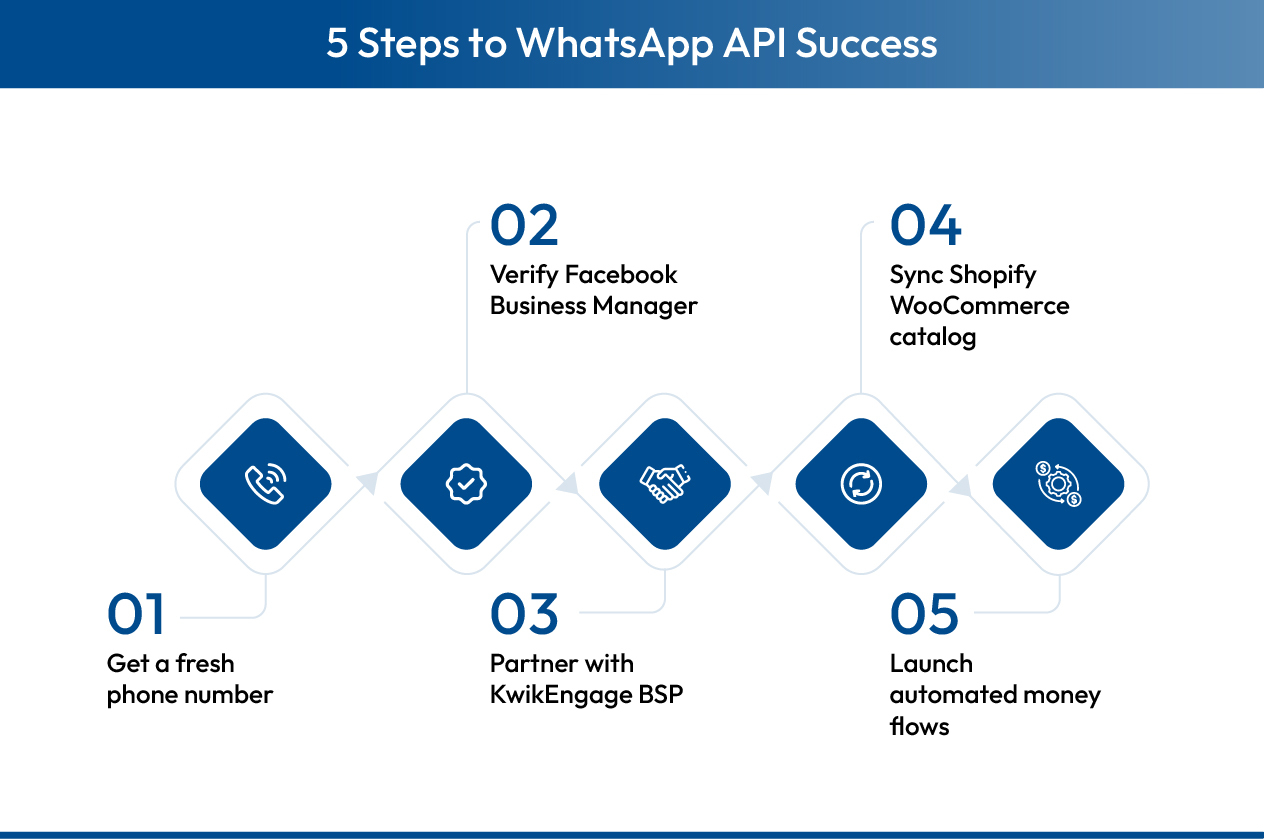
Here is your step-by-step roadmap you must follow for going live:
Phase 1: The Prerequisites
Before you book a demo, the first step is to ensure that you have these three things ready. It will speed up your onboarding by weeks.
- A Fresh Phone Number: You cannot use a number that is currently active on the personal WhatsApp or standard Business App. You need a fresh number to migrate it to the API successfully.
- Meta Business Manager: You need an active Facebook Business Manager account with admin access. This is where your WhatsApp account will technically live and where you manage billing and permissions.
- Website & Legal Docs: Meta needs to know you are a real business. Have your GST certificate and Company PAN card along with a live website URL ready for the verification process.
Phase 2: Partnering with a BSP (Business Solution Provider)
You cannot access the WhatsApp API directly; you need a BSP to act as the bridge.
- The Step: Sign up with a WhatsApp business solution provider like GoKwik’s Kwik Engage.
- Why: We equip you with a comprehensive user interface that turns the technical API into a user-friendly command center. Our interface lets you build campaigns and track revenue seamlessly.
Phase 3: The ‘Blue Tick’ verification
You have seen that little blue checkmark next to big brand names. That is the ultimate trust signal for your customers.
- The Process: Once your API account is active, you can apply for the Official Business Account status directly through your BSP dashboard to gain credibility with your customers.
- The Requirement: Meta grants this to notable businesses. Having high press coverage and a verified Facebook presence significantly increases your chances of approval for this coveted verification status.
Phase 4: Integration & inventory sync
You need to connect WhatsApp to your inventory so users can browse and buy. This setup transforms your simple chat window into a fully functional WhatsApp ecommerce store. This integration also unlocks the power ofhypertargeted marketing campaigns by allowing you to segment audiences based on real-time customer data.
- For Shopify/WooCommerce: Use GoKwik’s one-click plugins to sync your product catalog. This ensures that when a customer asks about product availability, your bot knows the real-time answer.
- Set Up Flows: Do not start with a blank slate. Activate pre-built shopping workflows first, such as abandoned cart checkout and abandoned cart recovery, along with order updates.
Phase 5: The ‘Soft Launch’
You should avoid sending broadcast messages to your entire contact list on ‘Day 1’. A gradual rollout allows you to monitor WhatsApp campaign performance and maintain a healthy sender quality rating effectively.
- Start Small: Send a broadcast to your internal team or a small group of loyal VIP customers to test the flow and ensure everything works perfectly before scaling.
- Check the Health: Monitor your Quality Rating in the dashboard. If users report you as spam, your rating drops. Keep it high to unlock higher messaging limits up to unlimited messages.
Effective WhatsApp marketing strategies
To truly leverage WhatsApp's potential, you need to move beyond basic broadcasts. Here are the WhatsApp marketing strategies you need to follow:
1. Getting customer opt-ins
Rule one of WhatsApp Marketing is that you must not spam; you need consent. If you message people who did not ask for it, you become a nuisance. You can accelerate this process by leveraging ‘click-to-WhatsApp ads’ (social media ads) to acquire high-quality subscribers instantly.
- Pro Tip: Add a Get Updates on WhatsApp checkbox at your checkout, or offer a ten percent discount code that gets delivered only via WhatsApp. Make them want to share their contact details and join.
2. Recovering abandoned carts
Email reminders often get lost in crowded inboxes, but WhatsApp notifications command immediate attention. This high visibility allows you to engage potential buyers while they are still in the purchasing mindset to recover lost sales effectively.
- The Old Way: Sending a link that takes them back to the website, where they have to log in again, which creates friction in the buying process.
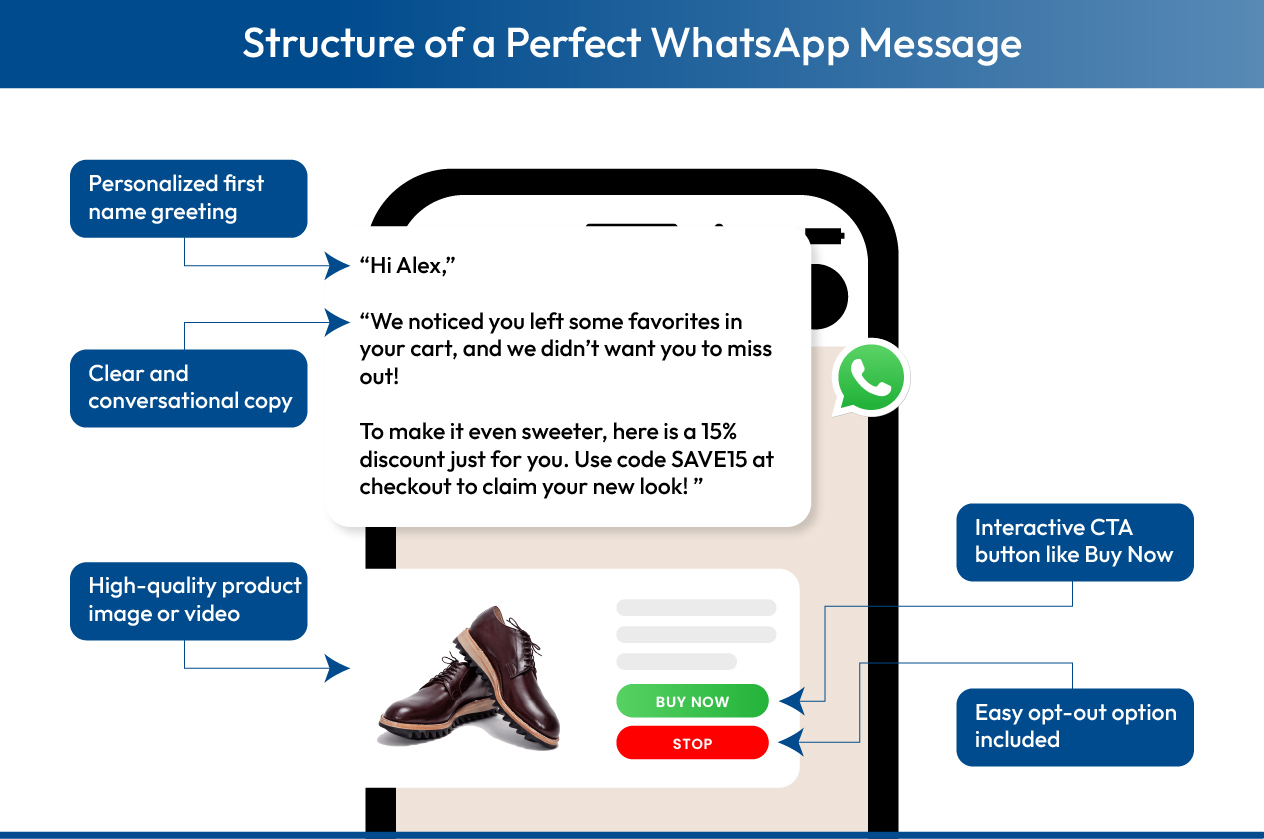
- The GoKwik Way: Send a message with the product photo and a button that says Buy Now. Better yet, let them complete the purchase right inside WhatsApp with zero friction.
3. Reducing RTO (Return-to-origin)
Cash-on-Delivery orders often face high rejection rates because customers change their minds before delivery. You can significantly lower these returns by implementing an automated verification step immediately after the order is placed.
- The Fix: Use WhatsApp to confirm COD orders.
- Why it works: It filters out the impulsive accidental orders and ensures the customer is actually serious about the purchase, which saves you shipping costs.
4. Converting COD to prepaid
Maintaining healthy cash flow is vital for ecommerce success, and prepaid orders offer far greater security than cash-on-delivery. You can use automation to incentivize customers to switch payment methods before their order ships.
- The Strategy: Send an automated message immediately after a COD order is placed, offering a small discount if they switch to a prepaid method right now.
- The Impact: This simple nudge often converts risky COD orders into secured prepaid revenue. It significantly reduces your RTO risk while improving your overall cash flow cycle.
5. Customer retention strategy
Acquiring new customers costs significantly more than retaining existing ones, so focusing on customer loyalty is essential. You should use personalized WhatsApp marketing to re-engage past buyers and encourage repeat purchases through timely new product recommendations or early access to sales.
- The Tactic: Set up win-back flows for customers who have not purchased in sixty days. Send them a personalized catalog of new arrivals based on their previous purchase history.

Best practices for WhatsApp marketing
To maximize ROI and maintain a healthy sender reputation, your strategy must balance aggressive growth with strict compliance. Following these WhatsApp marketing best practices ensures you drive higher Customer Lifetime Value from your WhatsApp marketing campaigns.
1. The Golden Rule of Consent (Opt-in compliance)
Unlike email, where you might get away with cold outreach, WhatsApp requires explicit and active consent.
- Active Opt-In: Users must manually check a box that says I agree to receive order updates and offers on WhatsApp to ensure you stay compliant.
- Easy Opt-Out: Every marketing message should include a clear way to unsubscribe, such as a Stop button or footer text, to respect user preferences.
2. Frequency and timing protocols
Over-messaging is the fastest way to get blocked. A blocked business account cannot be easily recovered. Managing this during peak times is crucial, particularly when scaling your holiday season WhatsApp marketing efforts to avoid user fatigue.
- Frequency Cap: Limit promotional broadcasts to one or two times per week. Segment your audience so they receive only relevant offers that add value.
- The ‘Golden Window’: For B2C brands, engagement peaks between 7 PM and 9 PM and during lunch hours. Avoid sending messages before 9 AM or after 9 PM.
3. Content strategy: Conversational vs. Transactional
Your content must respect the medium. WhatsApp is informal and quick, so your copy should reflect that. Structure your messages using these core principles to maximize engagement and clarity.
- Brevity: Keep core messages under one hundred and fifty characters to ensure they are read quickly on mobile screens.
- Rich Media: Text-only messages have lower conversion rates. Use images or videos and PDFs for catalogues to make your messages visually appealing.
- Interactive Buttons: Instead of asking users to type Yes or No, use Quick Reply buttons or Call-to-action buttons to simplify the user response.
4. Human-in-the-loop automation
Chatbots are essential for scale, but they can frustrate users if not managed correctly. Utilizing unified eCommerce communication strategies allows you to balance speed with empathy effectively. You need to implement specific protocols that prioritize user experience during these automated interactions.
- The Escape Hatch: Always provide a clear option to chat with an Agent. If a user is stuck in a loop, your bot should automatically trigger a handoff.
- Context Preservation: When a human takes over, they should have access to the chat history, so the customer does not have to repeat themselves to the agent.
Key metrics to track WhatsApp marketing performance
You cannot improve what you do not measure. To understand the effectiveness of your WhatsApp Marketing campaigns, you need to look beyond vanity metrics. Here are the KPIs that actually matter.
- Read Rate: This indicates if your brand name is trusted by your audience and if your message timing is right.
- Click-Through Rate (CTR): This measures if your offer and creative content are compelling enough to drive action from the user after opening the message.
- Conversion Rate: This tracks the percentage of users who actually completed a purchase after clicking, which effectively measures the ROI of your campaign creative.
- Block Rate: This is a critical health metric. If this spikes, you must stop your campaigns immediately and reassess your content strategy to avoid bans.
- Abandoned cart recovery rate: This tracks how much lost revenue you are salvaging through automated reminders, which directly impacts your bottom-line revenue.
- Orders placed through WhatsApp: This measures the direct revenue attributable to your WhatsApp Marketing use cases and catalog integration, showing the effectiveness of the sales channel.
Bridge the gap between ‘Just browsing’ and ‘Final sale’ with WhatsApp marketing
If you are ready to stop chasing customers via email and start having real conversations that convert, it is time to upgrade your stack. WhatsApp Marketing is no longer just an option. It is the infrastructure of modern D2C success.
By implementing the strategies outlined in this guide, you move from passive broadcasting to active revenue generation. You create a shopping experience that feels natural and personal while being incredibly convenient for your buyers.
Want to see how headless checkout and RTO protection work in real time?
Book a demo today.
Is WhatsApp marketing legal and compliant with privacy regulations?
Yes, WhatsApp marketing is fully legal, provided you adhere to Meta Commerce policies and local regulations. The most critical requirement is obtaining explicit opt-in consent from users before sending them promotional messages. You must also provide an easy way for them to opt out at any time.
What kind of messages work best for e-commerce on WhatsApp?
Transactional messages, such as order confirmations and shipping updates, generally have the highest engagement. However, for revenue generation, abandoned cart reminders and back-in-stock alerts are most effective. Messages that use rich media images and interactive buttons perform significantly better than plain-text messages at driving sales.
What are some of the key benefits of using WhatsApp for marketing?
The primary benefits include incredibly high open rates and instant delivery. It also offers a personalized channel for customer support and sales. Furthermore, WhatsApp Business marketing supports headless checkout, reducing friction and increasing conversion rates compared to traditional web-based checkout flows.
What is the difference between WhatsApp Business and WhatsApp Business API?
The WhatsApp Business app is a free mobile app designed for small business owners who manage chats manually on a single device. The API is a paid, scalable solution for larger brands that connects to software like Kwik Engage. The API supports unlimited users and advanced automation.
Is WhatsApp marketing better than email?
For immediate engagement and conversion, WhatsApp marketing often outperforms email due to higher open and click-through rates. However, email is still valuable for long-form content and newsletters. The best strategy uses both WhatsApp for urgent alerts and email for educational content.

AUTHOR
Parousia Khan
Senior Product Marketing Manager @GoKwik