How KwikAds helped Shop Unrush boost ROAS by 37% in 3 months
How KwikAds helped Shop Unrush boost ROAS by 37% in 3 months
How KwikAds helped Shop Unrush boost ROAS by 37% in 3 months
How KwikAds helped Shop Unrush boost ROAS by 37% in 3 months
eCommerce
What Is Conversion Rate Optimisation? 5 CRO Strategies To Build A 100Cr Brand
 25 Mar 2026
 12 Min Read
Suhag spearheads D2C growth strategies at GoKwik, focusing on e-commerce optimisation, conversion funnels, and sales enablement. Based in Bengaluru and an MICA alumnus, he excels in crafting GTM playbooks and marketing campaigns tailored for D2C brands.
Read this blog on your favourite platform
One thing that we've learnt working with 1200+ eCommerce brands is that competition is fierce, and success is often measured by a brand's ability to convert visitors into customers. Conversion Rate Optimization or CRO emerges as the beacon guiding online businesses towards this desirable success. It's not just a strategic approach to optimise your website or landing pages, personalise customer experience, rather a smart move to strengthen your conversion funnel boost business conversions.
In this blog, we delve into the depths of conversion rate optimisation, explore its significance, calculation methods, and implementation strategies that can help an eCommerce brand enter the 100 Cr league.
Let's get started.
What is Conversion Rate Optimisation in eCommerce?
Conversion rate optimisation refers to the process of refining your online store in a manner that it encourages more and more visitors to convert into paying customers. To give you an example, let’s consider an eCommerce store that’s visited by 1000 shoppers per month. Out of these shoppers, only 20 of them make a purchase. The conversion rate, in this case, is 2%. In its essence, CRO involves employing a variety of smart and strategic tactics to increase this conversion percentage, thereby maximising business revenue generated from existing traffic.
For instance, a well-executed CRO strategy can involve optimising product pages, streamlining the checkout process, and strategically placing calls-to-action (CTA) buttons to trigger purchases. By enhancing the user journey and reducing friction points, CRO aims to turn a higher percentage of store visitors into paying customers.

Why Is Conversion Rate Optimisation Important For eCommerce Brands?
The importance of conversion rate optimisation cannot be overstated, especially in today’s highly competitive Indian eCommerce landscape. It goes beyond merely boosting the number of transactions. Rather, it's about refining the entire experience of a shopper, from the very moment they land on the website to the final click of the payment’s page. Listed below are some reasons why CRO is increasingly becoming critical for eCommerce brands.
1. Maximising Return On Investment (ROI)
Conversion rate optimisation ensures that every penny spent in marketing activities to drive traffic to the online store must be utilised effectively. By optimising a website in accordance with the needs and wants a shopper, CRO significantly helps increase the chances of higher conversions, thereby improving return on investment (ROI).
2. Enhancing User Experience
An optimised eCommerce website creates a seamless and enjoyable shopping experience for visitors. It addresses user pain points, streamlines navigation, and provides a clear pathway for shoppers to take the desired action. This, in turn, results in increased customer satisfaction, higher repeat purchases, and enhanced customer lifetime value.
3. Competitive Edge
Amidst India’s saturated eCommerce market, standing out has become crucial. An online website that is easy to navigate, loads quickly, and guides users effortlessly through the conversion funnel distinguishes itself from competitors, fostering customer loyalty. Swiss Beauty, Bombay Shaving Company, Noise, and even Attitudist are excellent examples to quote here.
4. Data-Driven Decision Making
The phenomenon of conversion rate optimisation relies heavily on data analysis. By understanding shopper behaviour, their preferences, and interactions with the website, eCommerce brands can make informed decisions. They can invest efforts in building a platform that ensures an improved customer journey every single time.
5. Revenue Growth
Ultimately, the primary goal of CRO is to boost revenue. A small increase in conversion rate can lead to a significant uptick in sales, making it a powerful driver for the financial success of an eCommerce brand.
How to Calculate Conversion Rate?
Calculating conversion rate is a fundamental step in understanding the performance of an eCommerce website. The formula is simple:
Conversion Rate = Number Of Conversions X 100
Number of Visitors
Number of Visitors
For example, if a website has 10,000 visitors in a month and 2600 of them make a purchase, the conversion rate would be 26%.
This metric is a key performance indicator (KPI) that provides insights into the effectiveness of the current website design, content, checkout funnel, and overall user experience. Regularly monitoring and analysing conversion rates can help eCommerce businesses identify areas for improvement and track the impact of CRO strategies over time.
5 CRO Strategies That Can Help You Build A 100 Cr Brand
Building a 100Cr eCommerce brand requires a comprehensive and strategic approach to conversion rate optimisation. Here are five key strategies to elevate your eCommerce business to new heights.
1. Upsell and Cross-Sell to Customers
Did you know that it’s easier to sell to customers who have already purchased from you? The probability of selling to a new customer is just around 5-20%. However, for existing ones, the probability can go as high as 70%. This is where upselling and cross-selling come into play.
Upselling is the act of persuading a customer to upgrade to a high-priced item or a more premium version of a product. If you can give a discount for product upgradation, you basically give customers a better deal and increase the average order value. It’s a win-win!
Here’s a conversion rate optimisation example of this strategy:
_1697116176.png)
Cross-selling, on the other hand, is offering complementary or related products to what the customer is already buying. It makes customers’ lives a lot easier as no one would want to receive their shaving razors only to realize that they don’t have shaving foam or an after-shave cream.
Here’s what an example of conversion rate optimisation with cross-selling looks like:
_1697116176.png)
These strategies do the following:
- Increases the AOV, which also results in higher ROI
- Because customers purchase more products or products of higher value, they increase the revenue
- Increases the CLV because customers are going to come back for more, considering the good experience they had with you
- They increase product awareness by showing products that customers might not have come across otherwise
But there’s a thing you need to keep in mind, upselling and cross-selling only help in conversion rate optimisation when they are meant to improve the customer experience rather than aimed at selling more.
You can improve the experience by providing personalized recommendations based on a customer’s interests, intent, and previous purchases. And when customers receive personalized recommendations that align with their interests and previous purchases, they are more likely to return to the brand for future purchases. This, in turn, can help build a 100 cr brand.
2. Make Purchase Completion Easy
One of the most crucial aspects of conversion rate optimisation is making the purchase completion process as easy as possible. If the checkout process is cumbersome, confusing, or time-consuming, customers are more likely to abandon their carts and leave your website without making a purchase.
According to a report, over 80% of customers abandon a cart after adding a product to it. And the reasons behind this are complex processes, lack of payment options, technical glitches, account creation, etc.
_1697116176.png)
Making the purchase completion process easy is critical for driving revenue growth and taking your eCommerce brand closer to the 100 cr mark. If the checkout process is smooth and streamlined, customers are more likely to complete their purchases, increasing sales and revenue.
Here are some ways to make the purchase completion process easy and seamless for your customers:
- Your eCommerce store should be optimized for both desktop and mobile devices.
- It’s frustrating for customers to have to re-enter their information repeatedly. You can give them a feature to pre-fill their data to save time.
- Offer multiple payment options, such as credit cards, debit cards, PayPal, and UPI, to cater to customers with different preferences.
- Eliminate unnecessary fields, pages, or actions during checkout to reduce the chances of customers abandoning their carts.
With a solution like GoKwik, you can provide a frictionless and fast checkout experience to your customers by giving them multiple payment options, easy CoD, automated address correction, and much more. It’s one of the best conversion rate optimisation tools that eCommerce businesses must have.
3. Enable Ease Of Communication
Two-way communication is crucial for both brands and customers. According to a report, 82% of customers expect immediate responses from brands on purchase-related questions.
Enabling ease of communication not only helps in building trust and loyalty with customers but also in conversion rate optimisation. You can add a widgeton the website to invite questions about products and help shoppers make informed purchase decisions.
Platforms like WhatsApp can be leveraged for two-way communication to provide a personalised shopping experience. This is where GoKwik comes in. You can set automated replies to customers’ queries with WhatsApp business API, send automated reminders, and much more.
With easy communication, you can also offer quick query resolutions to customers and make them feel more comfortable buying from the brand. And, the more comfortable they are with you, the more they’ll purchase.
4. Leverage FOMO At The Right Stages Of The Buyer Journey
When it comes to driving sales, nothing beats FOMO.
More than 60% of millennials make a purchase within 24 hours of experiencing FOMO. In fact, most 100 crore brands are already leveraging it at the right stages of the buyer journey to maximise their profits.
One of the simplest ways to create FOMO is by using live sales notifications on the site, even when someone is just browsing through it. These notifications can encourage people to check out what others are looking at or buying, creating a sense of urgency and excitement, just like how H&M does it.
_1697116176.png)
When a potential customer is in the consideration phase and on the product page, showing how many people are currently viewing the item or have it wishlisted can help nudge them toward making a purchase. Here’s an example from AJIO.
When a potential customer is in the consideration phase and on the product page, showing how many people are currently viewing the item or have it wishlisted can help nudge them toward making a purchase. Here’s an example from AJIO.
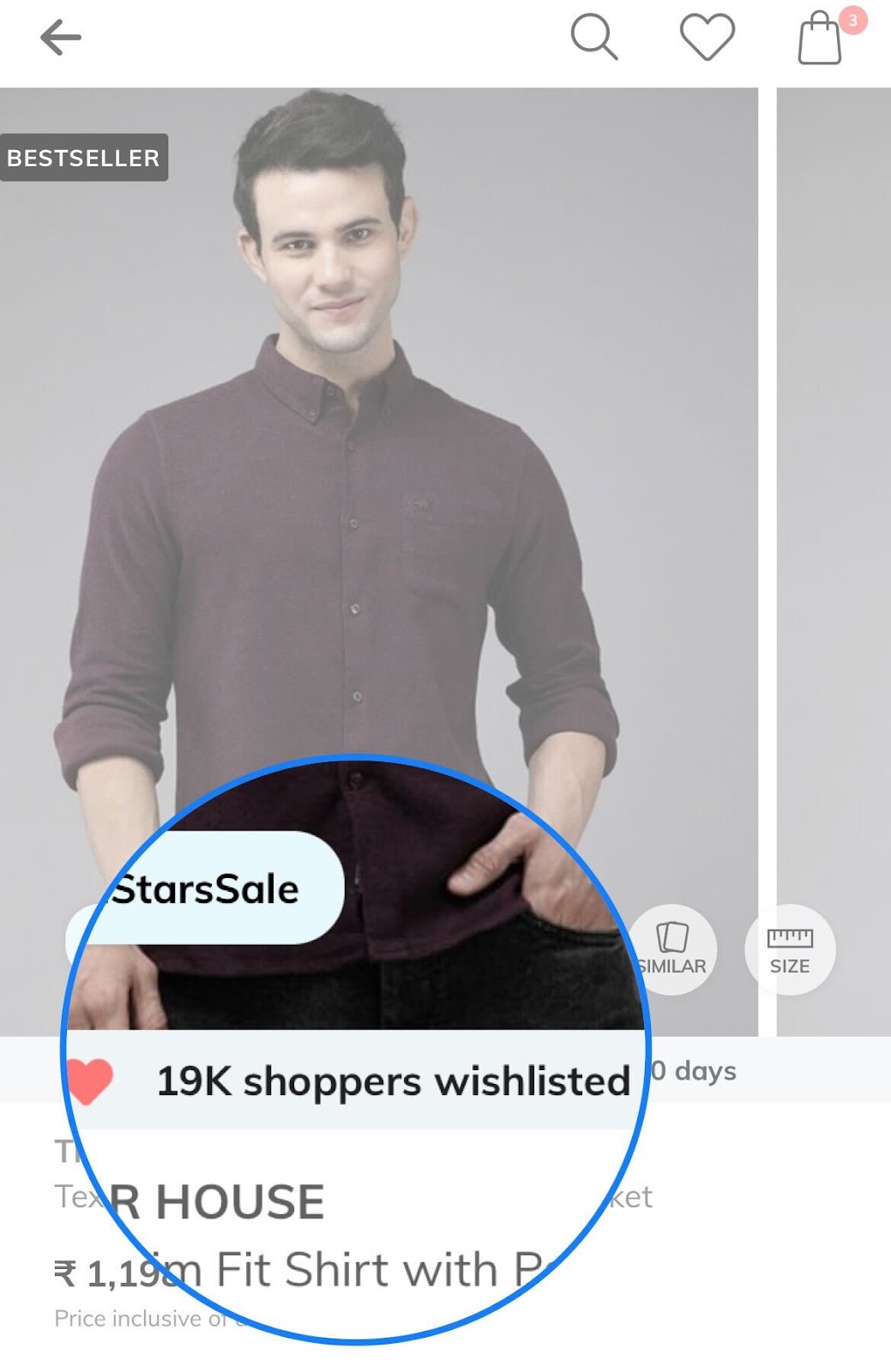
And when they’ve moved the item to checkout, using scarcity or time-sensitive deals can be a powerful way to encourage them to take action and complete the purchase.
That’s how you leverage FOMO at the right stages of the buyer journey to create a sense of urgency and excitement. This conversion rate optimisation strategy helps you drive more sales, taking you closer to the 100 crore valuation.
5. Tackling RTO From The Get-Go
RTO (Return to Origin) is one of the biggest challenges eCommerce brands face today. It not only eats into a lot of business revenue but can also hamper the climb to the coveted 100 crore mark.
For instance, Man Company, a leading eCommerce brand, discovered that the majority of its customers preferred the COD (Cash on Delivery) payment option, which in turn increased the possibility of returns.
To tackle this issue, they turned to GoKwik’s RTO API, which put risk flags on the incoming traffic to determine whether the customer should see the COD option or not. As a result, the Man Company was able to significantly 20% decrease its RTO problem by putting strong constraints on a mere 3% of customers.
By using GoKwik’s RTO API, you can easily identify high-risk orders and take measures to prevent RTO from the get-go. This not only helps in increasing customer satisfaction and loyalty but also maximizes your revenue by reducing the cost of returns.
Ready To Join The 100 Crore Club?
Becoming a 100 cr brand is not an overnight success but rather a continuous process of learning from your customers and optimizing your strategies based on data-driven insights.
With the above-mention conversion rate optimisation strategies, you can ensure that your business is on the path to success.
With the help of D2C enablers like Gokwik, you can make communication easy, reduce losses resulting from returns, and make the purchase experience better. And, these are some factors that a 100 crore brand never takes lightly.
So, are you ready to join the 100cr club? Get in touch with us today to take the first step toward success!
What do you mean by conversion rate optimization?
Conversion rate optimization (CRO) is enhancing your e-commerce website to convert more visitors into valuable customers. For D2C brands in India, this means refining everything from checkout flows to product pages. GoKwik provides AI-backed solutions to improve user experience, minimize friction, and significantly boost your sales by making every visit count.
What is CRO and SEO?
SEO (Search Engine Optimization) helps improve your website's visibility on search engines, bringing more visitors. CRO (Conversion Rate Optimization) focuses on maximizing those visitors' actions, like purchases or sign-ups, once they are on your site. For businesses in India, effective conversion rate optimization turns traffic into valuable outcomes, ensuring your online efforts deliver measurable results.
How to optimize conversion rate?
To optimize conversion rate in India, focus on seamless experiences. Use AI-backed solutions like GoKwik's one-click checkout to reduce friction. Enhance trust with smart RTO protection and payment orchestration. This holistic approach significantly boosts your site's conversion rate optimization efforts, turning more visitors into paying customers for your D2C brand.
What does a 2% conversion rate mean?
A 2% conversion rate means that for every 100 visitors to your e-commerce store in India, 2 of them complete a desired action, like making a purchase. For D2C brands, optimizing this is crucial. GoKwik specializes in conversion rate optimization, helping businesses like yours achieve significantly higher rates and scale revenue efficiently.
Is a 2.5 conversion rate good?
A 2.5% conversion rate is generally considered average for e-commerce in India. While acceptable, significant improvement is often possible. GoKwik helps D2C brands achieve higher rates through expert Conversion rate optimization. Our AI-backed solutions enhance checkout and payments, boosting your revenue and overall performance effectively.

AUTHOR
Suhag Vamja
Head of Product Marketing @ GoKwik