How KwikAds helped Shop Unrush boost ROAS by 37% in 3 months
Kwik Engage

How to Run PPC for E-Commerce? Campaigns, Metrics and Conversion Strategy

13 May 2026
13 Min Read
How to Run PPC for E-Commerce? Campaigns, Metrics and Conversion Strategy

Parousia Khan

Senior Product Marketing Manager @GoKwik

Parousia leads product marketing strategies at GoKwik, and she is an expert in driving e-commerce optimisation, conversion growth, and innovative GTM strategies. She crafts compelling messaging and creates content pertaining to D2C commerce.

Share it on

Google Shopping Ads account for 85.3% of all retail ad clicks globally, yet most Indian D2C brands lose a significant share of that traffic before checkout. Paid traffic without a conversion plan is a wasted budget. Every click needs a clear path from ad to completed order.
India’s digital advertising market grew 19% in 2025 to ₹71,621 crore, now accounting for nearly 59% of total ad spend. Yet most of that investment leaks at checkout, not at the ad level. That gap between click and conversion is exactly what this guide addresses for every growing D2C brand.
This guide covers what is PPC in e-commerce and which campaign types drive the most revenue for Indian D2C brands. We will also explain the steps in building a PPC for e-commerce strategy and how GoKwik helps D2C brands convert paid traffic into completed orders at scale.
Kwik Checkout helps convert e-commerce PPC traffic into completed D2C orders at checkout

What is PPC in E-commerce?

PPC in e-commerce is a performance marketing model where brands pay for each click their PPC ad receives across search engine results, Google Shopping, social media platforms, and display ads channels. Every click represents a buyer who showed active intent, which is why PPC for e-commerce consistently converts at higher rates than most other online advertising models.
The key distinction from lead-generation PPC lies in how conversions occur.
  • Lead generation campaigns focus on capturing contact details through forms, with the sale occurring later, often offline or through follow-ups.
  • In contrast, PPC for e-commerce is designed to convert a visitor into a paying customer within a single session making alignment critical. Ads, landing pages, and checkout flows must work seamlessly to complete the purchase journey.
Within the broader scope of performance marketing, PPC for e-commerce represents the click-based acquisition layer. It operates alongside other outcome-driven channels such as affiliate marketing, influencer partnerships, and lifecycle email campaigns. Together, these channels create a full-funnel system that moves a shopper from initial discovery to final transaction.
What makes PPC especially powerful for e-commerce is its ability to capture demand at the exact moment of intent. Search and shopping ads surface products when users are actively looking to buy, often outperforming organic channels in speed and immediacy. For most D2C brands, this makes PPC a direct and controllable path from marketing spend to revenue.

Core E-commerce PPC Campaign Types

Each e-commerce PPC campaign type serves a different stage of the buyer journey, from first discovery through to cart abandonment recovery on various platforms.
  • Google Search Ads: They target buyers who are actively typing queries into the Google search engine and appear at the top of search engine results for specific keywords. They capture high purchase intent at exactly the right moment, making them the highest-converting campaign type in most e-commerce PPC campaigns when matched with strong ad copy and landing page alignment.
  • Google Shopping Ads: These ads display product images, prices and ratings directly within search results, making them among the strongest product ads for driving direct purchase clicks. These product listing ads work best for brands with a well-optimized product feed and consistent product data across all specific products listed in Google Merchant Center.
  • Performance Max: It automates campaign delivery across all Google inventory including Google Shopping Ads, YouTube Ads, display ads and search ads simultaneously from one PPC campaign structure. It uses machine learning to find the highest-converting specific audiences based on your conversion tracking signals. This reduces the need for manual bidding decisions across individual placements.
  • Meta and Instagram Ads: Meta Ads, Facebook Ads and Instagram Ads drive social discovery and retargeting across social media platforms by reaching potential customers at the awareness and consideration stages. They work well for brand awareness campaigns targeting Gen Z and millennial shoppers on social media, particularly when using different headlines and creative formats, tested through A/B testing to identify the strongest performers.
  • Retargeting Campaigns: Retargeting campaigns reach visitors who clicked a PPC ad on e-commerce PPC platforms but left without purchasing, bringing them back with relevant responses to their prior browsing behavior. These campaigns target the warmest audiences in any e-commerce PPC strategy and deliver higher conversion rates than cold traffic campaigns across all ad platforms.

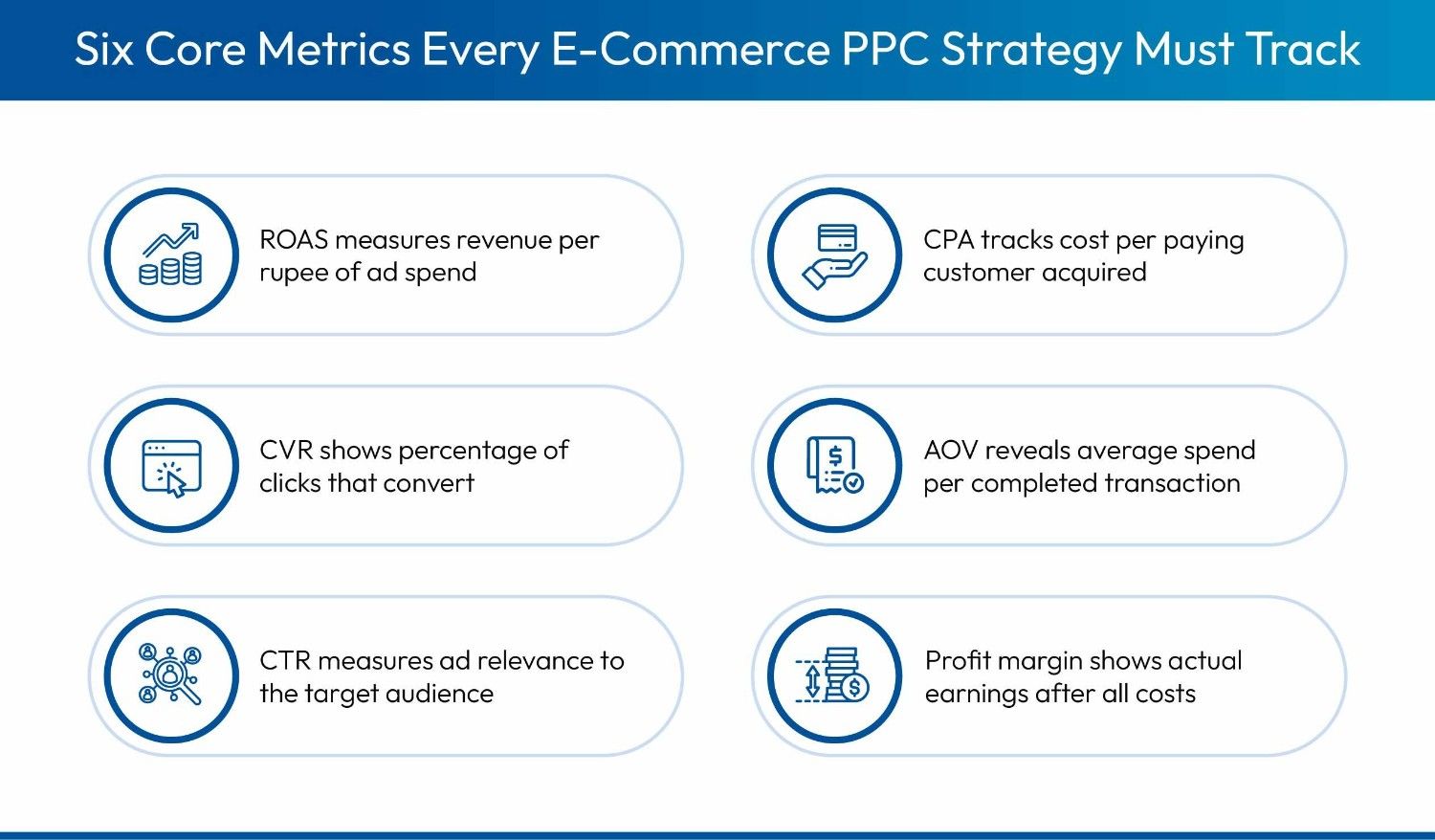
Key Metrics Every E-commerce PPC Strategy Must Track

Strong e-commerce PPC management depends on consistently tracking the right numbers, not just the ones that look good in your Google Analytics dashboard after a strong week.
Key metrics for monitoring e-commerce PPC strategy

  • ROAS (Return on Ad Spend): ROAS measures the revenue generated for every rupee or dollar spent across e-commerce PPC campaigns on various platforms. A ROAS of 3x means 3 rupees earned for every 1 rupee spent, but this figure becomes misleading without comparing it to your actual profit margin and AOV.
  • CPA (Cost Per Acquisition): CPA tracks how much it costs to acquire one paying customer through a specific PPC campaign across PPC platforms like Google Ads or Microsoft Ads. This metric connects ad spend directly to customer acquisition and tells you whether your e-commerce PPC management budget is generating profitable customers or expensive ones.
  • CVR (Conversion Rate): CVR measures the percentage of PPC ad clicks that result in a completed purchase across your e-commerce PPC campaigns. A low CVR signals a disconnect between the ad copy and the landing page or checkout experience, meaning the PPC marketing spend generates intent that the site then fails to convert.
  • AOV (Average Order Value): AOV tracks average spend per completed transaction and determines whether each converted click generates enough revenue to justify the CPA from your e-commerce PPC spend. Improving AOV through upsells and bundles increases ROAS without requiring additional ad budget from your PPC management allocation.
  • CTR (Click-Through Rate): CTR measures the percentage of people who click your PPC ad after seeing it in search engine results or on social media platforms. A strong CTR signals that your ad copy and creative resonate with your target audience at the keyword and audience level across PPC platforms.
  • Profit Margin: Profit margin tracks actual earnings after product cost, logistics and operational overheads are deducted from revenue generated through e-commerce PPC campaigns. Brands with thin margins must watch this closely alongside ROAS, because a campaign can look profitable at the ad level while the underlying business runs at a loss.
Focusing on ROAS alone creates a distorted view of e-commerce PPC performance across any PPC agency or in-house team. A campaign may show strong returns on paper while margins are thin and AOV is low, leaving the business unprofitable. Tracking ROAS alongside CPA, AOV and profit margin gives a complete picture of whether your performance marketing e-commerce investment is working.

How to Build an E-commerce PPC Strategy That Works

Building an effective e-commerce PPC strategy starts with planning each campaign at the structural level before spending a single rupee on PPC advertising across any ad platforms.
  • Use Google Keyword Planner and competitor research to identify specific keywords with the right search volume and purchase intent. They should match your specific products and price points across Google Search and Microsoft Advertising.
  • Segment your audience across new visitors, cart abandonment audiences and past buyers before setting bids and budgets in any PPC campaign. Each group needs a different message and a different bidding strategy to convert profitably.
  • Split your e-commerce PPC budget between different acquisition campaigns targeting cold audiences on social media platforms. Allocate the remaining budget to retargeting campaigns targeting visitors who have already shown intent on your site.
  • Write a persuasive ad copy that clearly highlights detailed information on the product, a specific offer, and a sense of urgency. Test multiple headline variations through A/B testing to identify what resonates with your target audience before scaling spend.
  • Match every landing page directly to the PPC ad that drives traffic to it. This ensures that the shoppers see the same offer and messaging throughout the session for accurate conversion tracking.
 Kwik Engage recovers abandoned e-commerce PPC sessions through automated WhatsApp flows

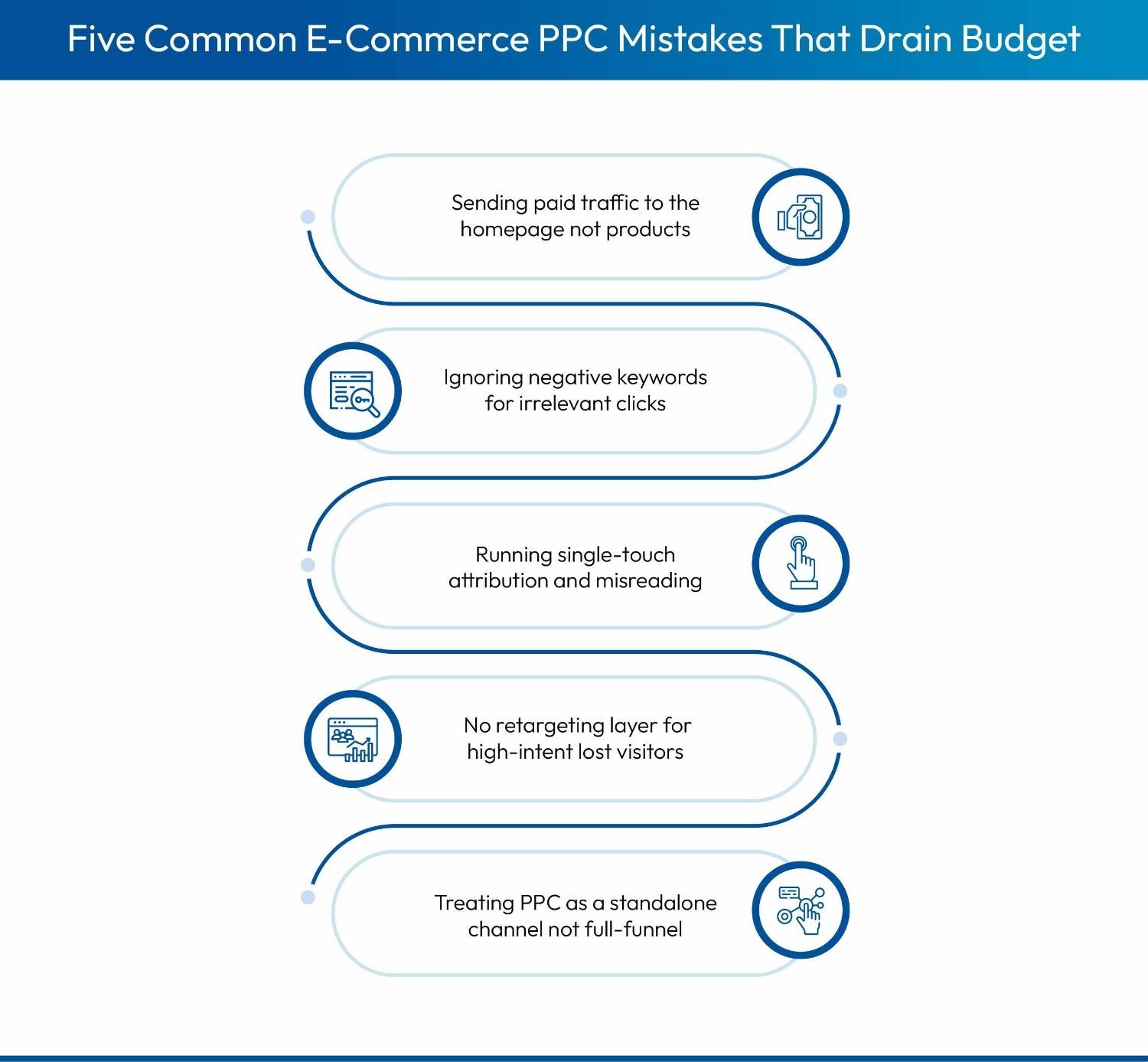
Common E-commerce PPC Mistakes That Drain Budget

Most e-commerce PPC budgets leak through the same avoidable mistakes that compound across PPC campaigns and reduce profitability.
Common e-commerce PPC mistakes to avoid

  • Sending PPC traffic to a homepage instead of product or collection pages wastes intent and lowers conversion rates before meaningful engagement begins.
  • Skipping negative keywords in Google Ads and Microsoft Ads campaigns drives irrelevant traffic and increases costs, distorting performance reporting across campaigns.
  • Using single-touch attribution in Google Analytics miscredits revenue, leading brands to cut channels that influenced earlier purchase decisions in journeys.
  • Without retargeting in PPC for e-commerce strategy, brands lose high-intent visitors who leave initially and fail to return through remarketing campaigns across platforms.
  • Treating PPC as a standalone instead of an integrated performance marketing limits results, since conversions depend on optimized checkout flows and strong post-click recovery systems.

Why Paid Traffic Fails Without a Conversion-Optimized Checkout

PPC for e-commerce generates the click and the intent. The checkout determines whether that intent turns into revenue for your e-commerce business.
  • Paid traffic landing on slow or friction-heavy checkout loses conversions before campaigns receive credit, making performance metrics misleading and scaling profitability difficult.
  • Without pre-filled address data at checkout, longer form completion increases friction, causing higher drop-offs and directly reducing returns on every PPC for e-commerce campaigns.
  • COD-heavy traffic without prepaid incentives increases RTO rates after delivery, weakening profitability from originally successful PPC-driven sessions.
  • Without post-click recovery systems, shoppers abandoning after clicking ads represent permanently lost revenue, as PPC platforms alone cannot recover missed conversions.

How GoKwik Helps D2C Brands Convert Their PPC Traffic

https://panel.gokwik.co/storage/app/public/images/asset12x_1778685625.jpeg

GoKwik acts as the conversion layer that makes e-commerce performance marketing profitable from first click to completed order, addressing every gap left open by standard checkout infrastructure.

Kwik Ads for Better PPC Targeting

Kwik Ads uses smart AI to find people who are actually ready to buy. While standard ads target shoppers with generic demographics, Kwik Ads connects directly with Meta to share better targeting data. It uses shopping habits from 200 million real customer interactions to make sure your ads reach high-intent audiences.
The system can automatically optimize your campaigns and optimize ad spends for maximum ROAS. On average, brands see a 25% jump in ad profit and a 15% drop in the cost of getting new customers. Kwik Ads ensures your budget is spent on real sales rather than just empty clicks.

Kwik Checkout for High Converting Checkout

Kwik Checkout combines pre-filled address data, a smart discounting engine, COD-to-prepaid conversion nudges and RTO intelligence to convert PPC for e-commerce traffic at above-average rates across all campaign types.
Brands using Kwik Checkout can enjoy conversion rates that are significantly above the Indian e-commerce industry average. This directly improves the return on every e-commerce PPC campaign, driving paid sessions to the store.

Kwik Pass for OTP login and Identify Anonymous Visitors from Ads

Kwik Pass gives returning shoppers a one-tap SSO login using mobile number or Truecaller. This eliminates the account-creation step that causes drop-off among returning visitors arriving via retargeting e-commerce PPC campaigns.
Pre-filled payment and address details compress checkout to under 10 seconds for over 85% of returning buyers. It helps with recovering sessions that slow login flows, permanently lost from PPC marketing budgets.
Kwik Pass helps identify anonymous users that visit from your PPC ads by using a network of 200M+ shoppers.

Kwik Engage for Retargeting Campaigns

Kwik Engage recovers shoppers who clicked a PPC ad and reached the checkout but abandoned it before completing payment. It triggers automated WhatsApp flows within minutes of exit, bringing users back while intent remains high.
Brands using Kwik Engage report 134% improvement in cart recovery, directly increasing returns on the original PPC spend that drove those sessions.

GoKwik Cart for Higher AOV Conversions

GoKwik Cart enhances the on-site experience by surfacing prepaid incentives, upsell recommendations, and clear cost breakdowns directly within the cart. By addressing friction before the payment stage, it increases AOV from paid traffic and converts COD-heavy intent into prepaid orders. This helps strengthen the cash flow while reducing RTO risk across PPC for e-commerce campaigns.
Every rupee spent on e-commerce PPC marketing should drive a completed, profitable order rather than a click that disappears at checkout.

Summing it up

PPC is the engine of e-commerce growth, but in 2026, it is no longer as simple as "buying clicks." With rising ad costs and the shift toward AI-driven targeting, your success depends on how well you use first-party data and how smoothly you convert that traffic. If you drive thousands of visitors to your store but lose them to a slow checkout or high RTO (Return to Origin) risk, your ad budget is essentially a donation to the ad platforms. To stay profitable, you need a strategy that doesn't just capture attention but guarantees a frictionless path to the "Thank You" page.
GoKwik is the conversion layer that ensures your PPC efforts actually pay off.
Book a demo today and see how the full product suite converts your PPC for e-commerce traffic into completed orders at scale.

Frequently Asked Questions

Conclusion

Enjoying this article? Share it with the world!
Parousia Khan

AUTHOR

Parousia Khan

Senior Product Marketing Manager @GoKwik

Parousia leads product marketing strategies at GoKwik, and she is an expert in driving e-commerce optimisation, conversion growth, and innovative GTM strategies. She crafts compelling messaging and creates content pertaining to D2C commerce.