How KwikAds helped Shop Unrush boost ROAS by 37% in 3 months
How KwikAds helped Shop Unrush boost ROAS by 37% in 3 months
How KwikAds helped Shop Unrush boost ROAS by 37% in 3 months
How KwikAds helped Shop Unrush boost ROAS by 37% in 3 months
Kwik Engage
WhatsApp Pricing Change Proposed By Meta – Effective June 1, 2023
 28 Nov 2024
 12 Min Read
Suhag spearheads D2C growth strategies at GoKwik, focusing on e-commerce optimisation, conversion funnels, and sales enablement. Based in Bengaluru and an MICA alumnus, he excels in crafting GTM playbooks and marketing campaigns tailored for D2C brands.
Read this blog on your favourite platform
In recent times, the popularity of WhatsApp commerce has suddenly spiked among Indian businesses. So much so that nearly 15 million companies are rigorously using WhatsApp Business to build and enhance customer communication. The WhatsApp Business platform facilitates fast message exchanges over various devices, including smartphones, laptops, desktop computers, tablets, and smartwatches. This enables companies to engage in meaningful one-on-one conversations, leading to successful conversions. While the shift has proved beneficial to the e-retailers, Meta, the parent company of WhatsApp, has increasingly started monitoring the activities and has decided to take some necessary steps. One such step has been to upgrade WhatsApp pricing to align with the diverse use cases and experiences offered by the platform.
The new WhatsApp pricing will be effective from June 1st, 2023.
Let’s dive deep and see what these changes mean for your business.
The Old WhatsApp Pricing Model
Under the old pricing model (until June 2023), businesses were being charged based on conversations rather than individual messages. For instance, delivery notification.
Ideally, a fee was applied per 24-hour conversation window, irrespective of the number of messages exchanged between a business and its customers. The fee depended on who initiated the conversation.

The New WhatsApp Pricing Model
Starting June 2023, the new WhatsApp pricing model will sustain its primary characteristic, i.e. the conversation-based approach. However, it will lay more emphasis on the different types of conversations occurring throughout the customer journey.
WhatsApp Business will now encompass service-related interactions along with marketing messages, notifications, and other exciting features. These will be more aimed at delivering the ultimate customer experience at various touch points rather than just exchanging messages.
Changes in a nutshell:
- WhatsApp will not charge businesses per message but per 24-hour ‘sessions’ or ‘conversation windows’
- Cost per conversation will be charged irrespective of who starts the conversation – business or customer/user
- Within the 24-hour conversation window, WhatsApp will charge for both user-initiated or business-initiated conversations but depending on the country code of the user’s phone number
- A business will incur WhatsApp cost only when it sends a message to the customer either in response to a query or while sending a push message to customer
- The first 1,000 conversations per month will be free for each WhatsApp business API account
- Conversations that start from Ads that Click-to-WhatsApp or Page CTAs on Facebook will be free
- Meta enables businesses to send more types of messages to users who opt-in to receive them. These include, personalised product recommendations, informational alerts, relevant offers, and more.
Let’s now define different types of conversation categories and see what they entail.
Different Types Of Conversation Categories
To reflect its vision via the new WhatsApp pricing model, Meta has introduced four conversation categories. These are as follows.
1. Utility Conversations
These are business-initiated conversations which typically entail transactions, such as,
- Purchase information
- Confirmations
- Post-purchase notifications
- Opted-in recurring billing statements.
As per Meta’s new WhatsApp pricing plan, utility conversations have become cheaper with an aim to enhance customer service and experience.
2. Authentication Conversations
As the name suggests, Authentication conversations are those that prioritise security.
Businesses ideally use authentication templates to verify user identities through one-time passwords during login or verification processes, including account registration and recovery.
While Meta is yet to reveal the final WhatsApp pricing for Authentication conversations, it’s expected to be lower than the existing rates and are aligned with Utility conversation cost.
3. Marketing Conversations
Marketing conversations refer to business-initiated communication for promoting products or services to customers. Businesses can use Marketing templates to send relevant offers, deals, product restocking information, and more such messages to customers. Any business-initiated conversation that does not fit into the Authentication or Utility category falls under Marketing.
The rates for Marketing conversations have been increased. However, this category also offers a higher return on investment compared to other messaging channels.

4. Service Conversations
Service conversations are typically user-initiated conversations and primarily aim to resolve customer inquiries. For instance, a conversation initiated by a customer for tracking their order or to know more about a particular product or service offered by a business.
The fees for Service conversations has been kept similar to the current user-initiated conversations owing to the nature of the category.
Note,
Since business-initiated conversations are more template-driven, Meta will now use these templates to determine the conversation type of the (24 hour) conversation window. Businesses will be able to switch between categories to start a new conversation. However, these will also be charged, but accordingly.
For instance, if you begin a conversation with a Marketing template to promote your newly launched products, it will fall under the Marketing category. And, you will be charged as per the new Marketing conversation fee.
However, if during the conversation, you switch to a Utility template, a new 24-hour window will begin and you’ll be charged as per the Utility conversation fee structure.
All the existing WhatsApp Business templates have been categorised under these four categories starting April 1, 2023.
Kwik Engage: 5 Hacks To Make The Most Of The New WhatsApp Pricing
While the new WhatsApp pricing structure has left many businesses rethinking their WhatsApp strategies, Kwik Engage has come up with 5 major hacks to convert this bane into boon and maximise returns.
Hack No. 1 – Use The Click-to-WhatsApp Ad Strategy
From the new WhatsApp pricing plan, we understand that user-initiated or now termed as Service conversations are free for the first 72 hours. So, let’s leverage that.
When running ads on various platforms like Google, Facebook, Instagram, etc., direct users to your business WhatsApp using a pre-filled text CTA. Avoid taking them to one of your website’s landing pages and then asking them to explore your products or services or fill a contact form.
Once a user clicks on a pre-filled text CTA and lands on your business WhatsApp chat, WhatsApp automatically counts it as a user-initiated conversation and charges less.
Now, there are two use cases to engage landed users and convert them into leads/conversions.
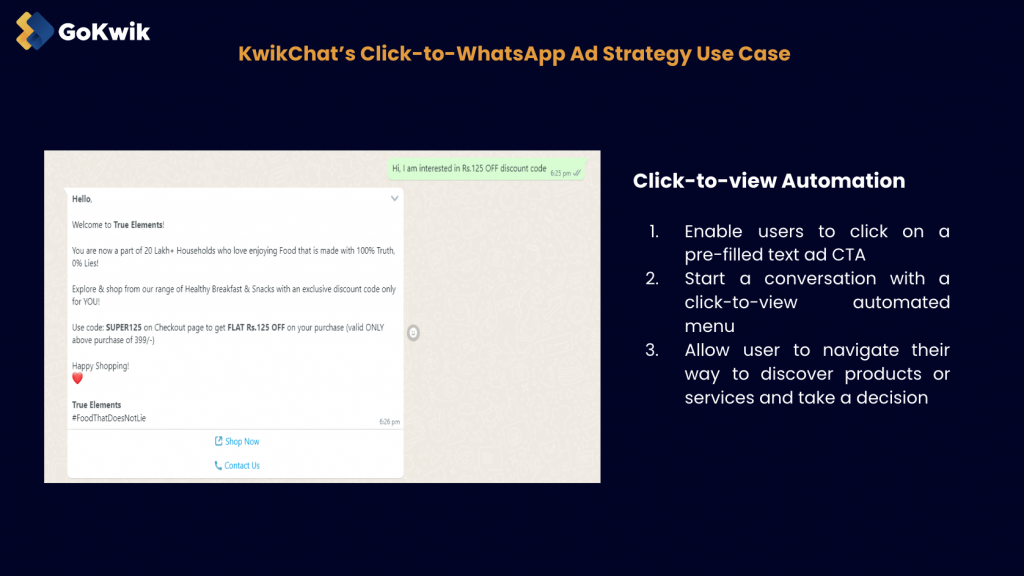
Use Case 1: Build A Click-to-view Automation
- Enable users to click on the pre-filled text ad CTA
- Once a user lands on your WhatsApp chat, start a conversation with a click-to-view automated menu
- The user can then navigate their way to discover your products or services and take a decision
Use Case 2: Talk To An Agent
- Enable users to click on the pre-filled text ad CTA
- Once a user lands on your WhatsApp chat, greet them with a welcome message
- Send a follow-up message and connect the user to an agent for real-time conversation and query resolution
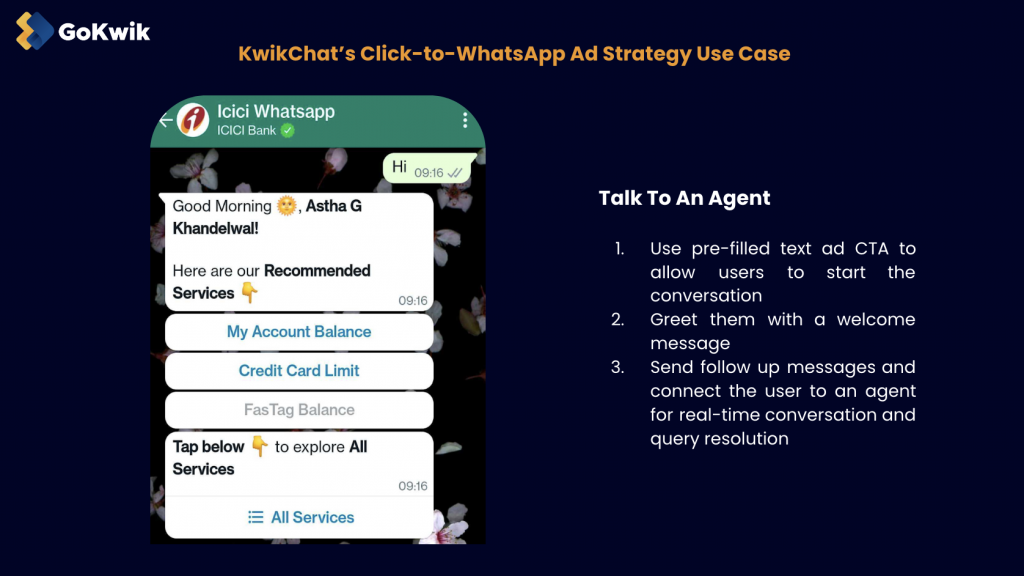
Here, Kwik Engage uses its built-in intelligence to offer maximum automated chat support to users. In cases where involvement of agents becomes necessary, Kwik Engage automatically assigns tickets to executives for smoother operations and least turn-around time.
Hack No. 2 – Use Conversational Messaging
Even though there’s been a rise in the prices of Marketing-led conversations, that’s something which businesses cannot rule out. Precisely because, no matter if you’re informing your customers about an upcoming sale, launch of a new product or about any other promotional activity, it’s something that helps your business spread awareness and widen product discovery across your target segment.
But, there’s a catch.
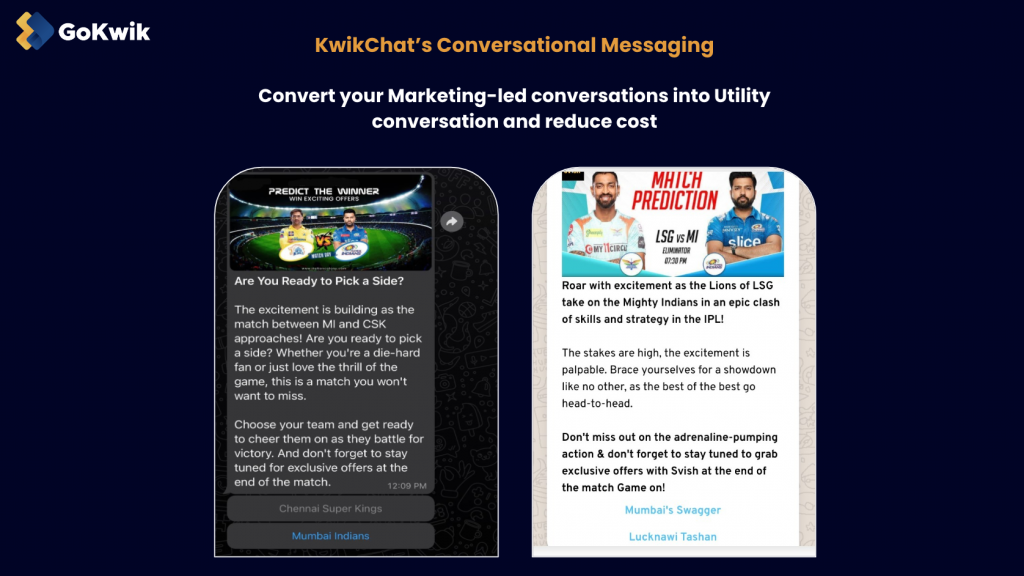
You can now easily convert your Marketing-led conversations into Utility conversation and reduce cost.
To give you an example, Kwik Engage recently enabled many of its merchants to run IPL promotional campaigns via WhatsApp to increase customer engagement and sales.
Let’s take Italian Colony’s example here.
During the match, the men’s wear eCommerce brand,
- Initiated polls among fans, encouraging them to predict the match winner
- Used CTA buttons to make predictions easier
Post match, Italian Colony,
- Offered discounts as rewards to the winners
- Offered exclusive discounts to fans supporting both the team
- Ran additional campaigns to ensure engagement
By doing so, the eCommerce brand saw 10X increase open rate, 3X increase in reply rate and overall higher than usual sales figures.
Hack No. 3 – Abandoned Checkout Strategy
Kwik Engage is the industry’s first WhatsApp solution that offers the best abandoned cart solution to merchants powered by headless checkout experience. But how does that reduce cost?
In an ideal scenario, you’d send abandoned cart recovery messages to customers on WhatsApp and redirect them to your website.
Even if a user clicks on your WhatsApp CTA and lands on the website to complete their purchase, there still remain high chances of drop offs or complete abandonment.
And, WhatsApp counts abandoned cart recovery messages as Marketing conversations. So, each time you send out an abandoned recovery message beyond the 24 hours conversation window set by Meta, your spend increases.
Now the hack?
Offer complete headless checkout, increase abandoned cart recovery, and the resulting conversions.
Kwik Engage has built a smart solution that enables users to complete their entire purchase on WhatsApp itself, including payment. This means, you can easily leverage the 24 hour window to convert a higher number of abandoned carts into confirmed orders.

Hack No. 4 – Smart Segmentation
This is another industry leading feature offered by Kwik Engage to reduce marketing spends. Using Kwik Engage ’s intuitive analytics dashboard, you can easily segment your audience base into different buckets depending on their previous purchase behaviour or buying history.
You can then build different marketing strategies for each of the identified segments and run campaigns accordingly to increase engagement and conversions.
Here are two examples for your understanding.
Use Case 1: Use Segmentation To Run Specific Marketing Promotions
Let’s say you want to run a promotional marketing campaign to announce the launch of a new product – Grooming Beard Oil. You understand that this is a men’s specific product and the messaging should be sent to only men.
You can either send this promotional messaging to your entire men-specific database or use Kwik Engage ’s analytics to go deep and identify the age group of men who show much interest in such types of grooming products. By doing so, you further increase the chances of conversions.
Use Case 2: Use Segmentation To Upsell/Cross-sell
Smart segmentation by Kwik Engage opens the door for upsell and cross-sell opportunities and significantly reduces your marketing spends.
Here’s how.
Let’s consider that you sent the Grooming Beard Oil product launch messaging to 1000 men. Of these, 200 bought the oil. This pool of 200 men becomes your new segment.
You can now leverage this pool to cross sell similar products like beard Beard Wash, Beard Growth Kit and so on. Since these men are interested in beard related products, the probability of them buying similar products increases.
Meanwhile, you can also target this pool (after a certain period) to stock up their inventory – in our case the Grooming Beard Oil. You can also suggest the quantity they can or should buy based on their purchase frequency. This helps upsell products and increase average order value.
And of course, you can do everything using Kwik Engage’s headless checkout on WhatsApp.
From a cost point of view, when you send messages to targeted segments and not to an entire pool of data base, you reduce the number of WhatsApp send and hence, are charged less. Meanwhile, segmentation increases your conversion chances, in turn, increasing your ROI.
Hack No. 5 – Engage Throughout The Customer Life Cycle
Gone are the days when you could expect results via broadcasted messages to your entire customer base to announce the launch of a sale period with attractive, non-personalised offers. It’s important to rejig your marketing strategy on Whatsapp and engage with your customers from the time they discover you, show interest or buy their first product from you.
Let me show you how you can do so:
Use Case: Map the customer journey
Take for instance, a customer buys a product from your website, say, headphones. Start a WhatsApp conversation with them by sending the order confirmation message on WhatsApp. Remember, this is a utility message which costs less.
The following day send them an update on their order’s status. Keep the customer informed by sending delivery notifications at regular intervals: from order purchase to shipment and final delivery. Meanwhile, also share the products warranty card. This way you engage with your customer, keep your cost low and eliminate the chances of customer remorse.
The day after the customer’s headphones are delivered, send them a “how to use” video and continue to engage with them. After 7-15 days, send them a feedback form to collect an honest review of the product. In another few days, suggest another product that may be suitable for them or a product that’s usually bought by people in conjunction with the headphones. Finally, during an upcoming sale period, send them a personalised offer based on their historical buying behaviour.
Don’t forget them just yet, stay in touch just like you would with your long-distance girlfriend to keep the spark alive.
When you are engaged with your customers throughout their journey, helping and supporting them with a two way communication that is not always promotional in nature, you win their trust. And the next time you want to send them a marketing message, they will be more receptive towards your offer leading to higher conversions for your business.
Kwik Engage can help you build such interactive workflows. This, in turn, helps develop an effective communication framework for your D2C business on WhatsApp and increases conversions.
Wish to know more about the new WhatsApp pricing change? Get in touch today!

AUTHOR
Suhag Vamja
Head of Product Marketing @ GoKwik