How KwikAds helped Shop Unrush boost ROAS by 37% in 3 months
How KwikAds helped Shop Unrush boost ROAS by 37% in 3 months
How KwikAds helped Shop Unrush boost ROAS by 37% in 3 months
How KwikAds helped Shop Unrush boost ROAS by 37% in 3 months
Kwik Checkout
Solve Customer Anxiety About Failed Transactions With GoKwik
 09 Feb 2026
 06 Min Read
Atul leads marketing at GoKwik, championing D2C brand building, growth strategies, scalable GTM for e-commerce, and data-driven customer acquisition. A former Amazon leader and IIFT MBA alumnus based in Bengaluru, he brings 15+ years scaling business across e-commerce, and fintech.
Read this blog on your favourite platform
According to media sources, the Indian eCommerce market recorded a whopping 37% increase in order volume in 2022. Isn’t that great? Certainly! But, there’s a gap here. Even though the numbers showcase an upward tick in order volumes, what about the number of failed transactions?
Every failed transaction, especially in a situation like the amount debited, order not confirmed (ADONC) on an eCommerce site means a loss of revenue for the merchant. In many cases, it also means,
- A higher number of cash order attempts can further result in a higher percentage of return-to-origins (RTOs)
- Loss of customers, especially new customers, who may never return to the store due to bad experience
- An increased customer acquisition cost
As per a report published byLexisNexis, businesses across the globe lost USD 11.5 billion in sales due to failed payments in 2021. That’s a huge number!
However, if we think about it, digital transaction failures are hardly something that online brands can control. Most transaction failures happen due to,
- Bank downtime
- Scheduled maintenance
- Interrupting communication between servers
- Network issues at the bank or National Payment Corporation of India’s end
But, what can brands do? For starters, they can put necessary measures in place to,
- Reduce failed transactions by means under their control
- Introduce measures to keep customer anxiety in check
- Optimise to convert failed digital transactions to cash-on-deliveries and reducing the chances of revenue loss
In this blog, we’ll cover different ways in which eCommerce brands can mitigate customer complaints resulting from failed digital transactions, and provide a seamless end-to-end customer experience.

Gokwik’s Communication Suite For ADONC Cases
Be it about the status of their order, the delivery timeline, or as critical as payment status (success or failure information), proper communication is the key to high customer satisfaction. While most eCommerce behemoths have this sorted, most D2C brands are still learning the art.
This is primarily because direct-to-consumer is a fairly newer channel that picked up pace only after the outbreak of the pandemic. D2C brands have some distance to cover when it comes to providing effective communication, especially when it comes to situations like amount debited, orders not confirmed due to failed digital transactions.
This was causing,
- An increase in the number of complaints
- Permanent loss of customers and the resulting revenue
Studying the entire scenario, GoKwik realised that there had to be a better solution for D2C brands to help them solve issues like ADONC. It then developed a robust Communication Suite to address the problem.
Quick Failed Transaction Communication Via SMS
Many new-age banks have the tech and infrastructure that automatically inform the customers when payments fail. However, not all of them do so. And, with customers using a plethora of new payment methods, this communication is not always done.
To solve this problem, GoKwik introduced SMS communication for ADONC and refunds for D2C brands to use.
How does it work?
Every time a transaction fails, GoKwik’s SMS Communication system instantly triggers an SMS to the customer informing them about the status of their payment and refund period.
Here’s an example of failed transaction communication for your reference.
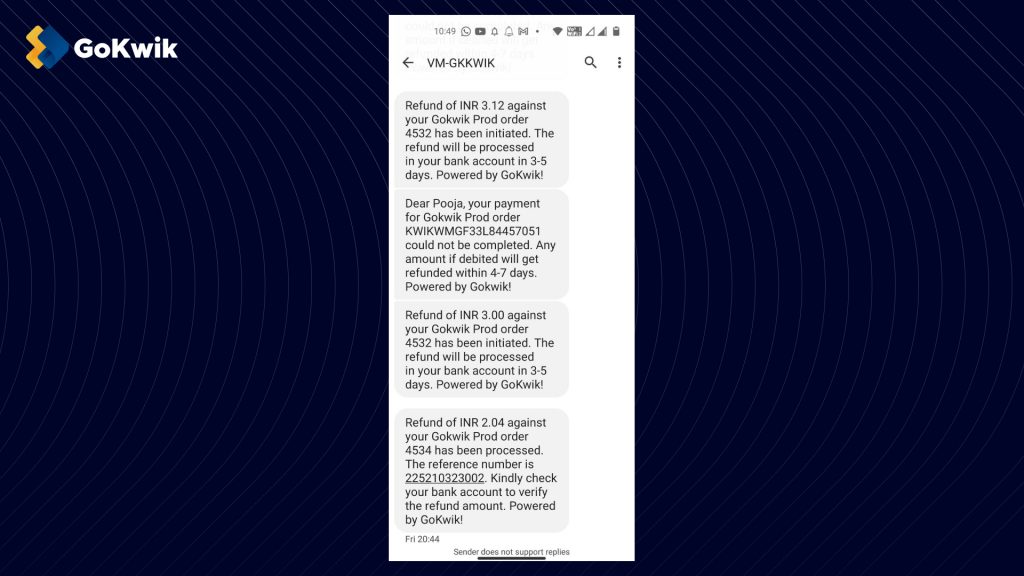
The SMS communication includes all the necessary details needed to reduce a customer’s anxiety and keep them from escalating the matter further or abandoning the brand forever.
The SMS communication includes all the necessary details needed to reduce a customer’s anxiety and keep them from escalating the matter further or abandoning the brand forever.
Front-end Communication With Payment Retry Option
Apart from promptly sending SMS to customers regarding their failed transactions, GoKwik also enables D2C brands to show the same message on the website while customers are still there, shopping. Such kind of front-end communication solves multiple issues in one go. These include,
- Instantly informing the customers about the failed transaction
- Giving them an option to try making the payment again and swiftly place their orders
- Reducing custom anxiousness and maintaining brand trust among shoppers
But why do transactions fail in the first place? Let's take a look at some of the most common reasons.
1. Payment Failure Due To PSP Server Issue
Most D2C brands partner with a payment service provider to process payments on their platforms. Sometimes, during the payment routing, issues can occur causing the transaction to fail.
In such a case, GoKwik captures this information and tries to intercept the reason behind payment failure. If it’s unable to get a terminal status (transaction success or failure message) it sends out a pop-up message, as visible in the image below, on the customer’s screen informing them about the issue.
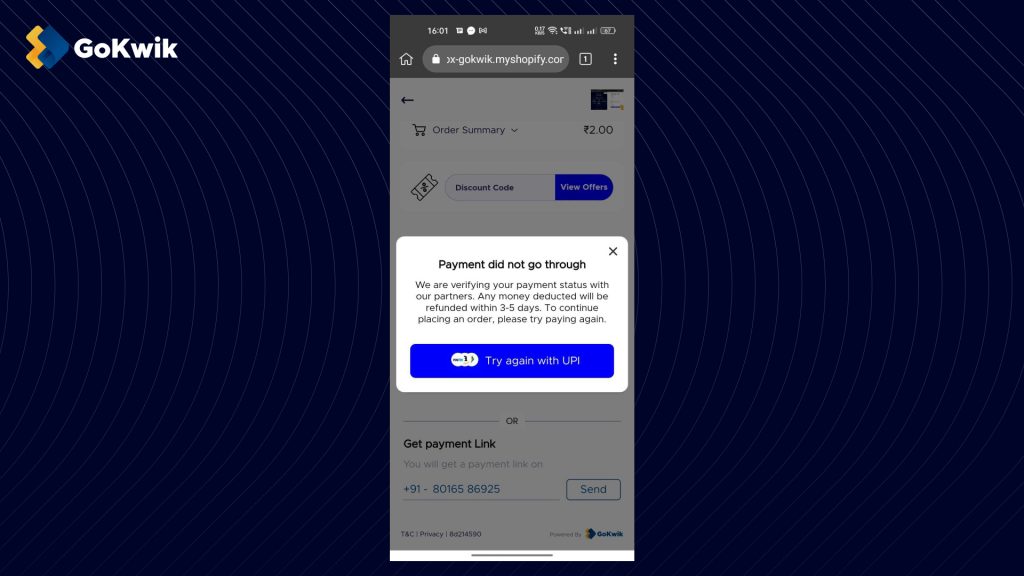
This amount debited, order not confirmed communication,
- Gives customers a sense of satisfaction that the brand and partner PSP along with GoKwik are working at the backend to find the reason behind payment failure
- Informs the customer that their money will be refunded to their account within 3 to 5 working days in the case of payment failure
- Gives customers another opportunity to complete their purchase by using another mode of payment such as UPI in this case (refer to the image above)
2. Payment Failure Due To Cart Verification Issue
In another case, an order is not placed when cart verification fails from the brand’s end. When this happens, GoKwik instantly pops-up a message on the customer’s screen informing them about the issue. Look at the image below for reference.
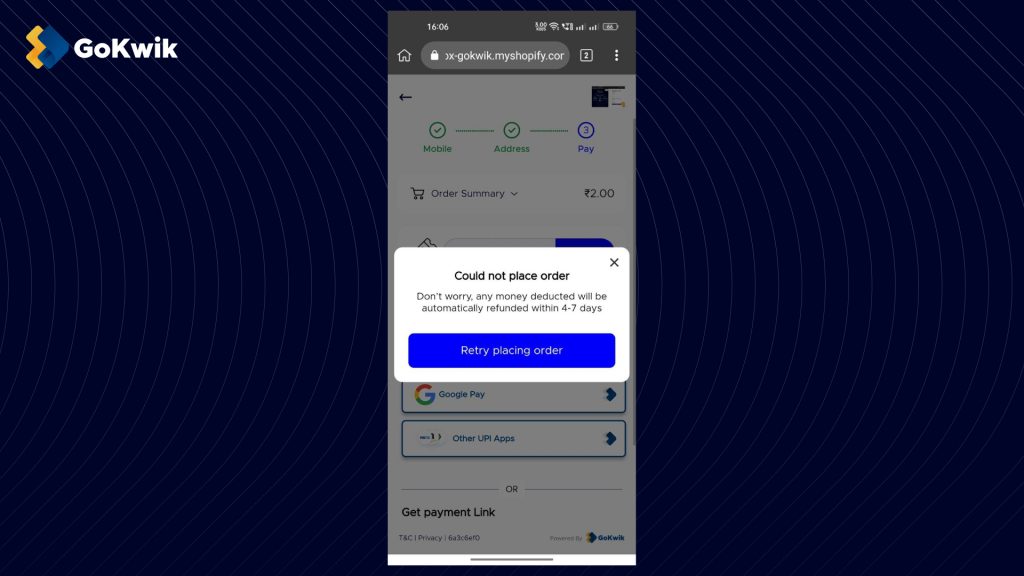
This is another example of how brands can keep customer anxiety in control and even persuade them to retry to place an order. This helps ensure that the customer doesn’t abandon their cart and contributes to conversions.
3. Order Placement Status
Besides the above-mentioned use cases, sometimes when a customer tries to place an order, the backend API of the D2C brand’s platform fails to grab the order details.
In such a case, both customer and the platform remain in a dilemma of whether the order was placed or not.
To ensure that a customer is duly informed about their order status, GoKwik helps the brand send out the respective communication. Take a look at the image below.
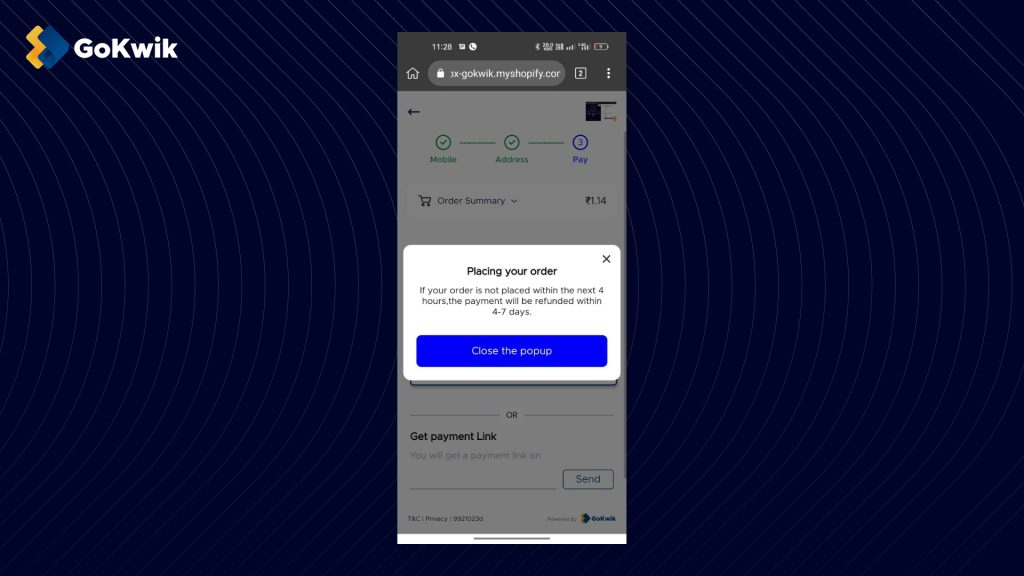
By sending such an important communication, a brand can assure customers that in the case their order is not placed, their money will be refunded to the source within 4 to 7 working days.
Meanwhile, if the brand’s backend API can register the order, then further communication is sent to the customer informing them that their order has been successfully placed and they will receive their order in the aforementioned time.
Go That Extra Mile With GoKwik
Transaction failure is increasingly contributing to the number of dissatisfied customers resulting in loss of revenue, loss of customer, and a higher customer acquisition cost. Solving this problem has become paramount in today’s time, especially when there’s fierce competition out there and the chances of customers moving to a competitor brand are at an all-time high.
GoKwik helps D2C brands fight the problem of amount debited, order not placed and keep those anxious customers from abandoning their carts and the brand in totality.

AUTHOR
Atul Bansal
Head of Marketing
Explore Related Blogs
Kwik Engage
8 Best AI Chatbots for E-Commerce in 2026: Features, Pricing and Best Fits
28-Apr-202614 Min Read
Kwik Engage
24 Types of Emails Every D2C E-Commerce Brand Should Send
14-Apr-202614 Min Read
Kwik Engage
What is Promotion Mix and How E-commerce Brands Can One for Maximum Sales?
13-Apr-202614 Min Read