How KwikAds helped Shop Unrush boost ROAS by 37% in 3 months
How KwikAds helped Shop Unrush boost ROAS by 37% in 3 months
How KwikAds helped Shop Unrush boost ROAS by 37% in 3 months
How KwikAds helped Shop Unrush boost ROAS by 37% in 3 months
eCommerce
10 eCommerce Metrics That Every D2C Brand Must Track Regularly
 20 Mar 2026
 10 Min Read
Suhag spearheads D2C growth strategies at GoKwik, focusing on e-commerce optimisation, conversion funnels, and sales enablement. Based in Bengaluru and an MICA alumnus, he excels in crafting GTM playbooks and marketing campaigns tailored for D2C brands.
Read this blog on your favourite platform
Running an eCommerce business is not just about clocking sales and increasing brand revenue. It’s also about keeping an eye on different eCommerce metrics that help you achieve your key business goals. However, while most of us are aware of some of the basic metrics that we should map, many go unnoticed, which, to your surprise, may be critical for your business.

In this blog, we’ve compiled a list of the top 10 eCommerce metrics and KPIs that help you,
- Measure overall brand performance
- Identify new trends based on customer behaviour
- Optimise marketing efforts
- Improve customer experience, and
- Increase profits
Let’s start by first understanding what exactly is a metric.
What Is A Metric?
In layman’s language, a metric is a quantifiable standard by which business performance can be measured. For instance, conversion rate, average order value, cart abandonment rate, and traffic sources, all of these are eCommerce metrics that help define development.
Meanwhile, metrics can only be measured if there’s enough data to do an analysis and draw conclusions.Google Analytics, social media sites, product pages, checkout and shopping carts, and even homepages are excellent sources of data which help interpret business results and derive trend measurement over time.
10 Important eCommerce Metrics That You Should Definitely Track
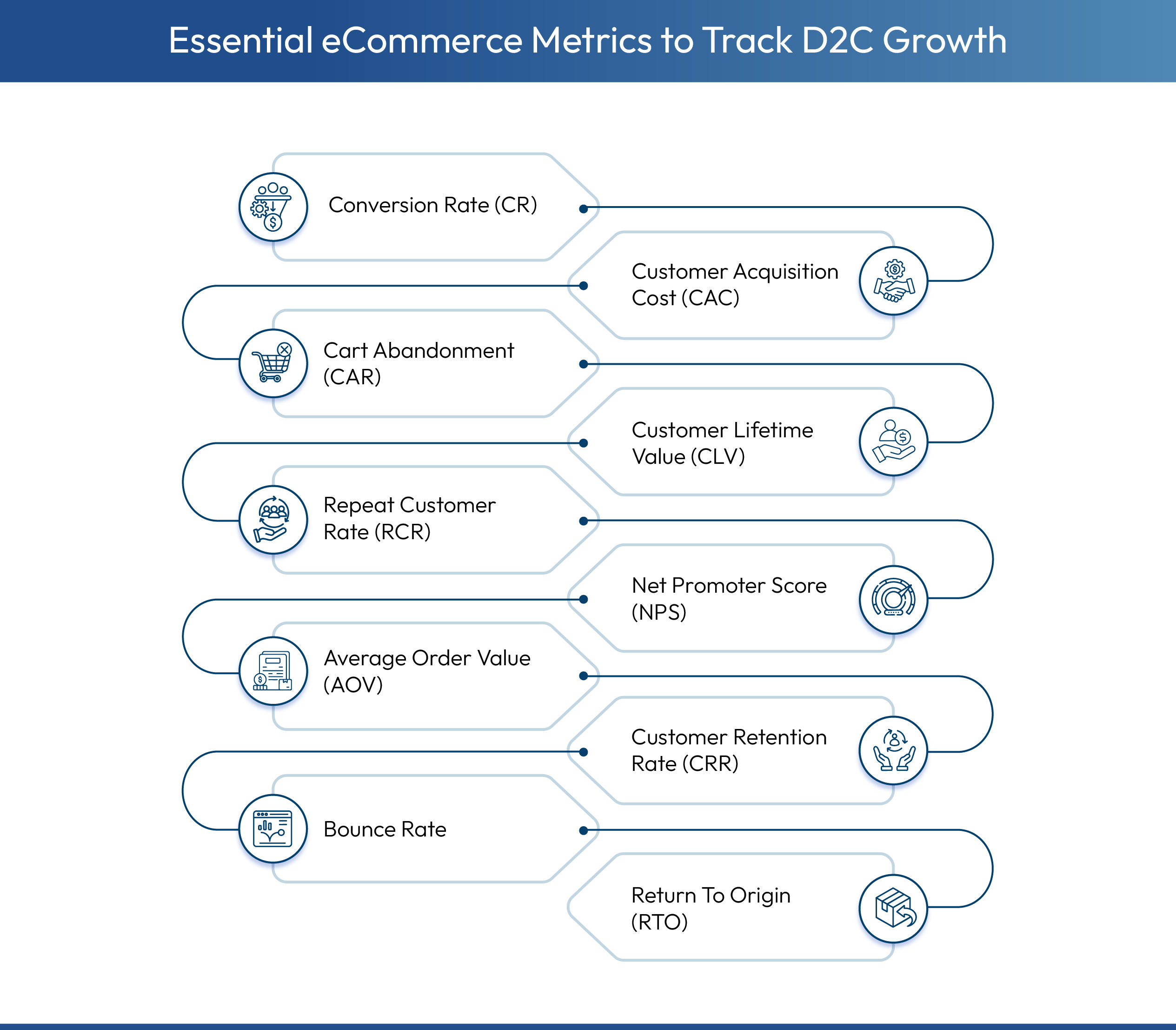
Conversion Rate (CR)
CR = (Total Number of Conversions/Total Number of Visitors on the Website) x 100
Conversion Rate (CR) is one of the most crucial eCommerce KPI metrics to keep track of. It ideally refers to the percentage of shoppers who completed a purchase on your website and converted into paying customers.
The higher the conversion rate, the higher your business revenue and hence, net profits. Meanwhile, a lower conversion rate depicts friction and leakages in your checkout funnel.
Here’s how you can calculate your eCommerce brand’s conversion rate.
If your conversion rate is low, check your site’s speed, pay attention to content, run a/b tests, and optimise your checkout funnel to fix leakages.
Customer Acquisition Cost (CAC)
Customer Acquisition Cost = Cost Spent On Acquiring A Customer/Number of Customers Acquired
Customer acquisition cost or commonly termed CAC is an eCommerce metric that tells you how much it costs you to acquire a new customer.
Regularly tracking CAC helps you analyse areas of improvement as you can’t afford to spend all your money on acquiring new customers.
If your CAC is higher than the cost of sales and marketing, it’s time to reconsider your campaign efforts and bring down the cost. That’s because, if you're not getting enough customers, you’re not clocking enough sales, and this will hurt your profits in the long run.
Cart Abandonment Rate (CAR)
Cart Abandonment Rate = (1 – Number of Completed Transactions / Number of Shopping Carts) x 100
Cart Abandonment Rate or CAR is another key metric that eCommerce brands should keep an eye on. This particular metric ideally informs you about the percentage of customers who added products to their shopping carts but dropped off midway without completing the purchase. There could be many reasons – a complicated checkout process, high delivery charges, lack of desired payment options, and more.
Here’s how you can calculate your eCommerce brand’s cart abandonment rate using this formula.
Customer Lifetime Value (CLV)
CLV = Customer Value x Average Customer Lifespan
or
Customer Value = (Average Purchase Value x Average Number of Purchases)
Customer Lifetime Value is an indicator of how much you’re earning from a single customer throughout its purchase history with your eCommerce brand.
It’s important to measure CLV as it gives you insight into your brand’s price point and popularity in the market. Meanwhile, if your CLV is higher than your Customer Acquisition Cost (CAC), you’re surely in a win-win situation. However, if the numbers are opposite, it’s time to make some amends. If you are not earning enough from a single customer after acquiring them, then your eCommerce brand will soon start clocking losses.
Here’s how you can calculate your CLV using this formula.
Repeat Customer Rate (RCR)
Repeat Customer Rate = (Numbers of Repeating Customers /Total Number of Customers) x 100
This eCommerce metric lets you analyse the percentage of your existing customers who’ve made purchases on your website more than once. If your repeat customer rate is low, it’s a sign that your online site is missing that important factor it takes to bring a customer back to make more purchases. Meanwhile, if the percentage hits the positive side, it’s definitely a win for your eCommerce business.
RCR also helps measure a shopper’s second, third, fourth, and all consecutive purchases over time, offering a snapshot of the customer’s sentiments. The higher the customer retention, the higher the customer satisfaction rate. This also means better product offering and shopping experience.
Net Promoter Score (NPS)
NPS = % of Promoters – % of Detractors
Net Promoter Score is one of the most prominent metrics and not just in the eCommerce industry.
To understand this metric, you need to know who Promoters and Detractors are.
NPS is calculated by sending out a survey with one question – “How likely would you recommend our product to a friend or family member.”
And, the customer responds to this question in the range of 1-10. Those who respond with 9 or 10 are Promoters, while 7 or 8 are considered Neutral, and those with a score less than 7 are Detractors.
Net promoter score allows you,
- See how satisfied your customers are with your offerings
- Determine how many of your customers are loyal to your online brand
- Take the necessary steps to keep this score as high as possible
You can calculate the NPS and check whether it is more than 0 to be on the safe side. But if your score is negative, you must work on your product to make it better.
Average Order Value (AOV)
Average Order Value = Total Revenue / Number of orders
Average Order Value is one eCommerce metric that everyone keeps a track of but it’s critical to highlight its importance. Whenever a customer comes to your online store, you want them to spend more and AOV tells you exactly how much they are spending.
Increasing your average order value can save you delivery costs and is also an indicator of customers’ trust towards your eCommerce brand.
Customer Retention Rate (CRR)
CRR = ((Number of Customers at end of the period – Number of new Customers during that period)/Number of Customers at the start of the period) x 100
Customer Retention Rate gives you a rate at which you are retaining your customers during a period. So, a low CRR means you are failing to impress new customers and are spending more to retain them. However, the opposite means higher profits and low customer acquisition costs.
It’s a great practice to look at your CRR because it will not only lower your CAC but also increase your CLV.
Bounce Rate
Bounce Rate = Total Number of One-page Visits / Total Number of Entries to a Website
The bounce rate tells you how many users are visiting only one page of your website before leaving. A high bounce rate means your customers are failing to find what they need from your website and hence leaving it even before exploring the site in detail.
To decrease your bounce rate,
- Optimise your website for speed
- Make the user interface more intuitive
- Write better copies
- Integrate a better navigation system
Your website must also look trustworthy so that people stay on your website and make purchases. A high bounce rate also means that you’ll end up spending more money to get people on your site which means low profitability.
Return To Origin Rate (RTO Rate)
RTO Rate = (Good Cancelled/Rejected At Doorstep / Number Of Goods Sold) x 100
The return to origin (RTO) rate refers to the rate at which people cancel orders after they’ve left the warehouse or reject them at the time of delivery. This is more prominent when people place cash on delivery orders.
A high RTO rate means,
- Lost profits
- High logistics and reverse logistics cost
- High operational cost
- Inventory stuck issues
- Repeated quality checks
- High product damage propensity
The best way to keep the RTO rate in check is by implementing necessary interventions on your website such as using RTO Protection Suite powered by GoKwik. Such tools help you identify high-risk shoppers with low buying intensity and prevent them from placing COD orders.
Final Thoughts: Mastering Your eCommerce Metrics
Mastering eCommerce metrics is the definitive way to transition from guesswork to data-backed growth. By consistently monitoring your performance indicators and optimizing for customer behavior, you build a resilient D2C brand. Focus on the data points that impact your bottom line to ensure your marketing strategy delivers sustainable results and long-term eCommerce success.
Book a demo with GoKwik today to see how our solutions can help you optimize your checkout and improve your eCommerce metrics.
What are common mistakes to avoid when tracking ecommerce metrics?
Tracking ecommerce metrics requires precision to avoid overlooking critical data points like RTO rates or bounce rates. Many brands fail by focusing solely on vanity metrics rather than analyzing customer behavior or shipping costs. Avoiding these errors allows you to make informed decisions that improve your ecommerce store’s long term profitability and overall ecommerce success.
How can I choose the right ecommerce metrics for my business goals?
Choosing the right ecommerce metrics involves aligning your key performance indicators with specific business objectives, such as increasing brand awareness or driving repeat purchases. Focus on important metrics that reflect your target audience’s journey through the sales funnel. This strategic approach ensures every marketing strategy effectively supports your bottom line and growth.
What are the 7 C's of e-commerce?
The 7 C's of e-commerce are essential ecommerce metrics and frameworks used to evaluate an ecommerce website’s effectiveness. These include context, content, community, customization, communication, connection, and commerce. By optimizing these elements, you enhance the user experience on landing pages, ensuring website visitors take the desired action to boost your online sales.
What are the key metrics in e-commerce?
Key metrics in e-commerce act as vital performance indicators, measuring everything from website traffic to the sales conversion rate. Critical data includes customer acquisition cost, average order value, and customer loyalty levels. Tracking these over a specific period of time helps brands understand the shopping cart abandonment rate and refine their email marketing efforts.
How does GoKwik help Shopify stores improve their eCommerce metrics?
GoKwik helps Shopify stores improve their eCommerce metrics by providing full-stack solutions that reduce shopping cart abandonment and manage RTO risks. By streamlining the checkout process and implementing loyalty programs, GoKwik enhances the customer experience. This intervention helps brands increase their conversion rates and unlock significant growth for their ecommerce store.
What are the 5 ecommerce marketing metrics?
The 5 ecommerce marketing metrics focus on evaluating the success of marketing campaigns and the overall sales funnel. These typically include customer acquisition cost, click-through rates from search results, conversion rates, and the number of times users interact with product descriptions. Monitoring these ensures your marketing efforts effectively drive high-quality traffic and sustainable revenue.

AUTHOR
Suhag Vamja
Head of Product Marketing @ GoKwik
Explore Related Blogs

Kwik Engage
8 Best AI Chatbots for E-Commerce in 2026: Features, Pricing and Best Fits
28-Apr-202614 Min Read
Kwik Engage
24 Types of Emails Every D2C E-Commerce Brand Should Send
14-Apr-202614 Min Read
Kwik Engage
What is Promotion Mix and How E-commerce Brands Can One for Maximum Sales?
13-Apr-202614 Min Read