|
Factor |
Hosted (SaaS) |
Self-Hosted |
|
Setup Time |
Minutes. No technical setup. |
Days/weeks. Requires server configuration. |
|
Maintenance |
Platform handles updates, security automatically. |
Brand manages updates, patches, security. |
|
Cost Structure |
Monthly subscription + transaction fees. |
Hosting costs + development time. |
|
Customization |
Limited to templates and approved plugins. |
Complete control over code and checkout. |
|
Scalability |
Platform handles traffic spikes automatically. |
Requires manual scaling and optimization. |
|
Technical Requirements |
None. Works out of the box. |
Requires developers for setup and maintenance. |
|
Security |
Platform manages SSL, PCI compliance. |
Brand responsible for all security measures. |
|
Examples |
Shopify, BigCommerce, WooCommerce hosted |
GoKwik Cart, Magento Open Source, custom builds |
|
Best For |
Small brands, fast launches, non-technical teams |
Brands with developers, unique requirements, scale needs |
How KwikAds helped Shop Unrush boost ROAS by 37% in 3 months
How KwikAds helped Shop Unrush boost ROAS by 37% in 3 months
How KwikAds helped Shop Unrush boost ROAS by 37% in 3 months
How KwikAds helped Shop Unrush boost ROAS by 37% in 3 months
Kwik Checkout
What is an E-Commerce Shopping Cart ? 2026 Guide for D2C Brands
 28 Apr 2026
 17 Min Read
Parousia leads product marketing strategies at GoKwik, and she is an expert in driving e-commerce optimisation, conversion growth, and innovative GTM strategies. She crafts compelling messaging and creates content pertaining to D2C commerce.
Read this blog on your favourite platform
When you walk into a physical supermarket, you pick up a basket and fill it with items while browsing each aisle. In the digital world, an E-Commerce shopping cart serves the exact same purpose for online shoppers.
It connects product discovery in your store to a secure, completed purchase. For D2C founders building a scalable revenue engine, understanding the E-Commerce shopping cart is critical.
A poorly designed cart sends users away. A well-optimized e-shopping cart retains users. It automatically calculates their order total, applies discount offers, and nudges them toward payment with zero friction.
This guide covers what e-commerce shopping cart mechanics look like in practice. We will also cover which features drive conversions, and how brands recover lost sales on auto-pilot through WhatsApp marketing.
.

What is an E-Commerce Shopping Cart?
An E-Commerce shopping cart is a software that lets customers pick products, review their orders, and proceed to a secure checkout experience without friction.
- Information Storage: The E-Commerce shopping cart remembers every product detail the customer selects during their browsing session. It securely stores each buyer's product size, color, quantity, and selected variant.
- Financial Calculation: The cart computes the order's final cost in real time as items are added. It automatically calculates applicable taxes, shipping fees, promotional discounts, and coupon adjustments to display an accurate total.
- Gateway Connection: The E-Commerce shopping cart acts as a secure bridge between your storefront and the payment gateway. It encrypts the order data and sends it to the payment processor to complete the transaction securely.
- User Experience: The cart offers a clean, intuitive interface for shoppers to review their product selections. Customers can update product quantities, apply discount codes, or remove items before completing the checkout process.
What are the Types of E-Commerce Shopping Carts?
Choosing the right shopping cart for your E-Commerce store depends on your business size, technical resources, and long-term growth plans. Each cart type comes with a distinct set of features and trade-offs.
SaaS (Hosted) Shopping Carts
Platforms like Shopify, BigCommerce, WooCommerce, and Salesforce Commerce Cloud offer ready-to-use E-Commerce shopping cart functionality on a monthly subscription basis. These platforms offer built-in security and fast setup, so brands can launch without building their own backend.
Self-Hosted Shopping Carts
A self-hosted cart gives brands control over installation, design, and server management for total customization. GoKwik Cart is a high-performance example, offering Indian D2C brands a conversion-optimized checkout layer that integrates seamlessly with Shopify, Magento, WooCommerce, and custom-built storefronts.
Open-Source Shopping Carts
Open-source platforms like OpenCart give development teams complete freedom to modify the codebase without licensing fees. These solutions work well for cost-conscious brands with in-house developers who can handle setup, maintenance, and ongoing customizations.
Headless Commerce Carts
This model completely separates the customer-facing store from the backend cart engine. Brands gain the ability to deliver fast, highly customized interfaces across multiple channels while the backend manages inventory, payments, order data, and fulfillment logic.
Difference Between Hosted vs Self-Hosted Shopping Carts
Hosted carts run on provider's servers. Self-hosted carts run on your infrastructure.
Each model serves different business needs. Decision depends on technical resources, customization requirements, growth plans.
- Choose hosted if: No developers, need fast launch, prefer predictable costs.
- Choose self-hosted if: Have technical team, need custom flows, want long-term cost control.
GoKwik Cart combines self-hosted control with SaaS simplicity. Get customization without maintenance burden. We’ll read more about that later, for now let’s understand how e-commerce shopping carts work.
How Does an E-Commerce Shopping Cart Work?
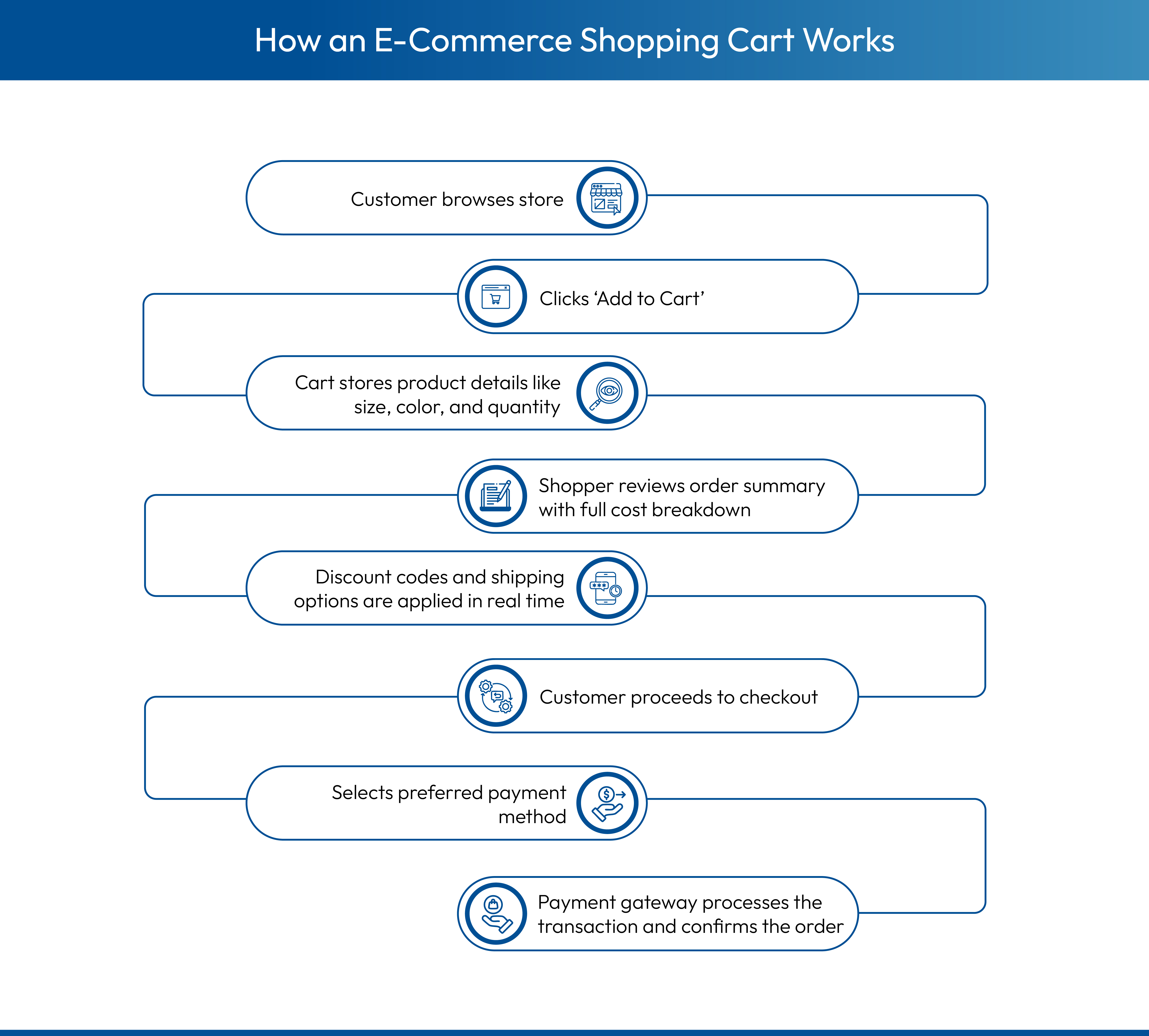
Understanding the shopping cart workflow helps brands identify friction points and optimize each step for higher conversions. Here's the complete journey from product selection to completed purchase.
Step 1: Customer Browses Your Store
The customer lands on your E-Commerce site and explores products across categories, collections, or search results. The shopping cart remains empty but ready to capture selections at any moment.
Step 2: Adding Products to Cart
When the customer clicks "Add to Cart," the shopping cart software captures product details including SKU, variant attributes, quantity, and price. This data is stored temporarily in the session or saved to the customer's account for later retrieval.
Step 3: Cart Review & Modification
The shopper views their cart summary showing all selected items with images, descriptions, quantities, and individual prices. They can update quantities, remove unwanted items, or apply discount codes before proceeding.
Step 4: Real-Time Calculations
The cart automatically calculates subtotals, applies discounts, adds shipping fees based on delivery location, and computes applicable taxes. The customer sees the final order amount with complete transparency before checkout.
Step 5: Checkout Initiation
When the customer clicks "Proceed to Checkout," the cart transfers all order data to the checkout page. Guest checkout or account login options appear, allowing the shopper to choose their preferred path forward.
Step 6: Payment Gateway Integration
The shopping cart securely transmits encrypted order details to the payment processor. The customer selects their payment method (UPI, cards, wallets, COD) and completes authentication through the gateway's secure interface.
Step 7: Order Confirmation
Once payment is verified, the cart receives confirmation from the gateway and updates order status from "pending" to "confirmed." The customer receives an order confirmation email while the merchant gets notified to begin fulfillment.
This seven-step workflow happens in seconds for optimized carts, but each stage presents opportunities for abandonment if not properly designed and tested.
What are Some Examples of E-Commerce Shopping Carts?
Here's how top brands design their carts to convert browsers into buyers.
boAt Lifestyle
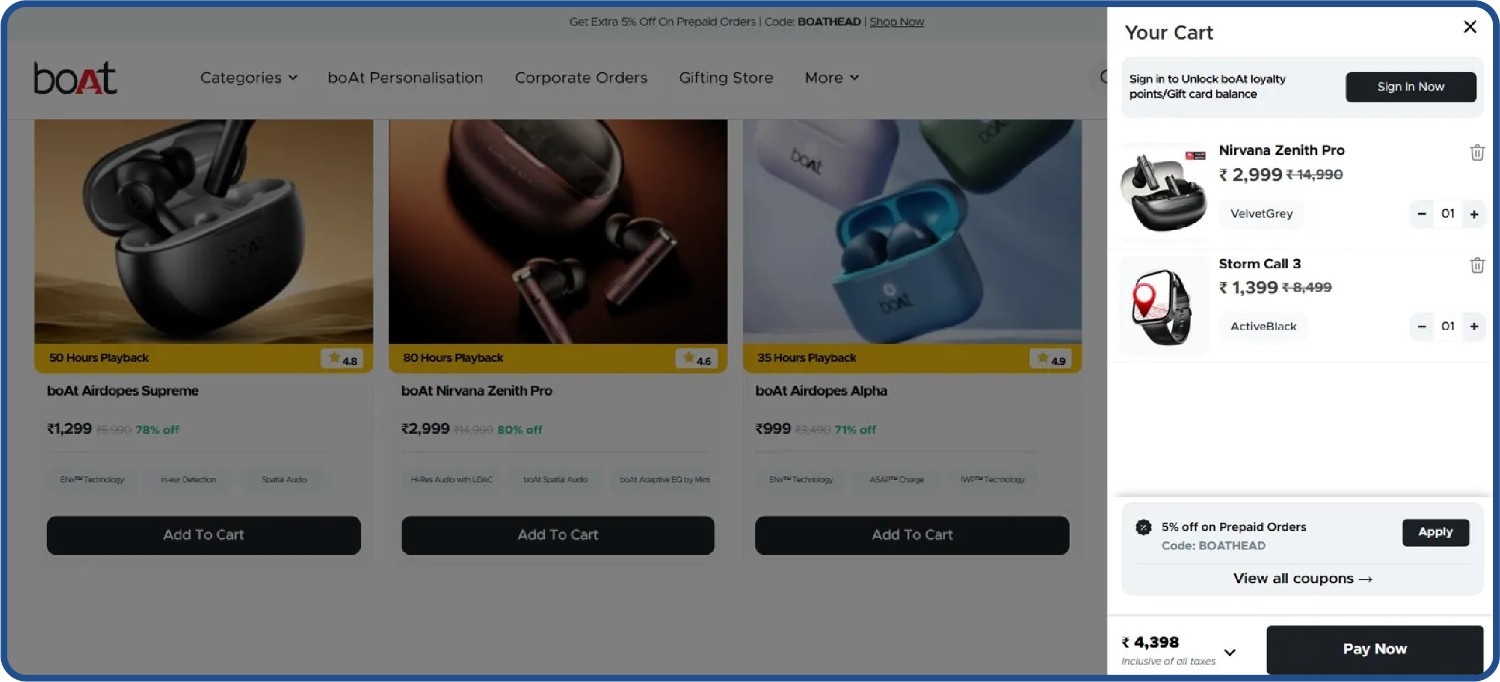
boAt's side drawer cart focuses on loyalty and discounts to drive checkout momentum.
- Loyalty prompt at top: Creates FOMO. "I'm losing rewards if I don't sign in" drives account creation.
- Strikethrough pricing: Anchors value. ₹14,990 → ₹2,999 registers as massive win, not expense.
- Coupon with "Apply" button: Removes code-hunting friction. Shows best deal instantly.
- Clean quantity controls: Keeps momentum. Shoppers modify without leaving cart.
- Total always visible: Eliminates surprise fees that trigger abandonment.
Amazon
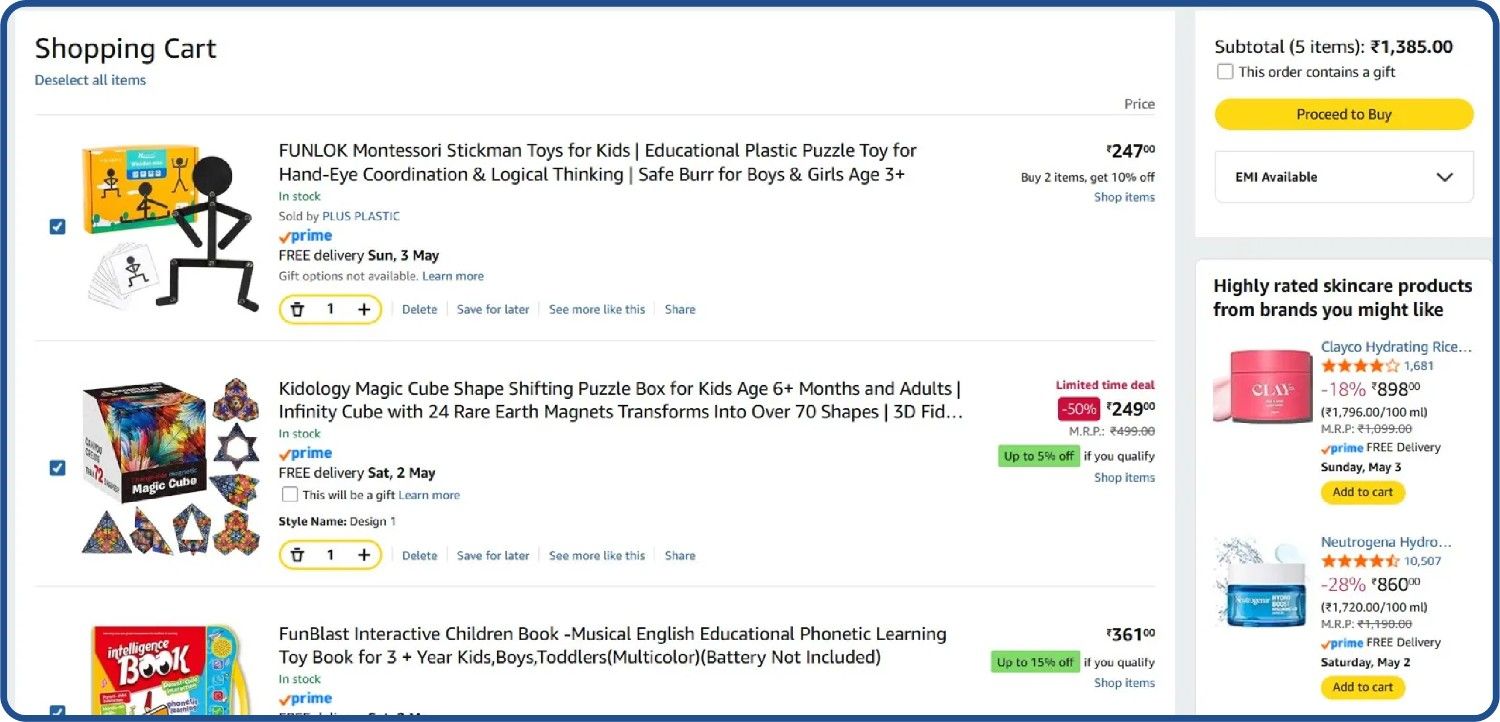
Amazon's full-page cart removes friction with detailed product information and delivery transparency.
- Prime badge + delivery dates: Reduces delivery anxiety. "When will it arrive?" answered immediately.
- Bulk discount alerts: Triggers opportunistic buying. "Add one more, save 10%" increases AOV.
- "Save for later": Softens abandonment. "Not now" feels less final than deleting items.
- Gift checkbox visible: No hunting for gift options. Friction removed.
- Cross-sell recommendations — Social proof + personalization. "People like you bought this."
- EMI options displayed: Reframes affordability. ₹1,385 → ₹346/month removes price barrier.
Gymshark
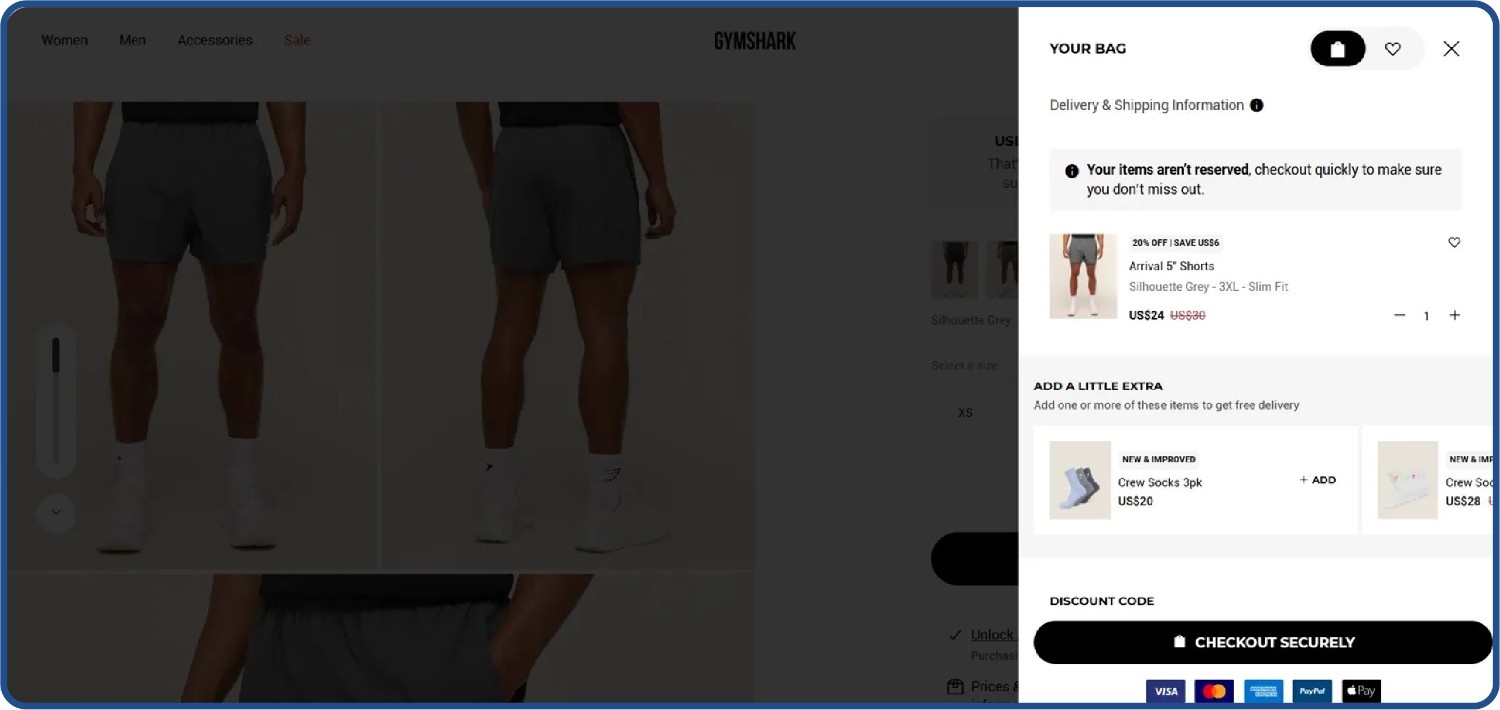
Gymshark's side cart uses urgency and upsells to increase conversion and AOV.
- "Items aren't reserved" warning: Creates scarcity pressure. Fear of losing items overrides hesitation.
- "20% OFF | SAVE US$6": Frames savings two ways. Percentage + dollars both register.
- "Add a little extra" upsells: Leverages sunk cost. Already spending $24; adding $20 for free shipping feels smart.
- Payment icons at bottom: Shows preferred method available. Removes "can I pay?" friction.
- "Checkout Securely" in black: Premium urgency + trust signals combined.
Lenskart
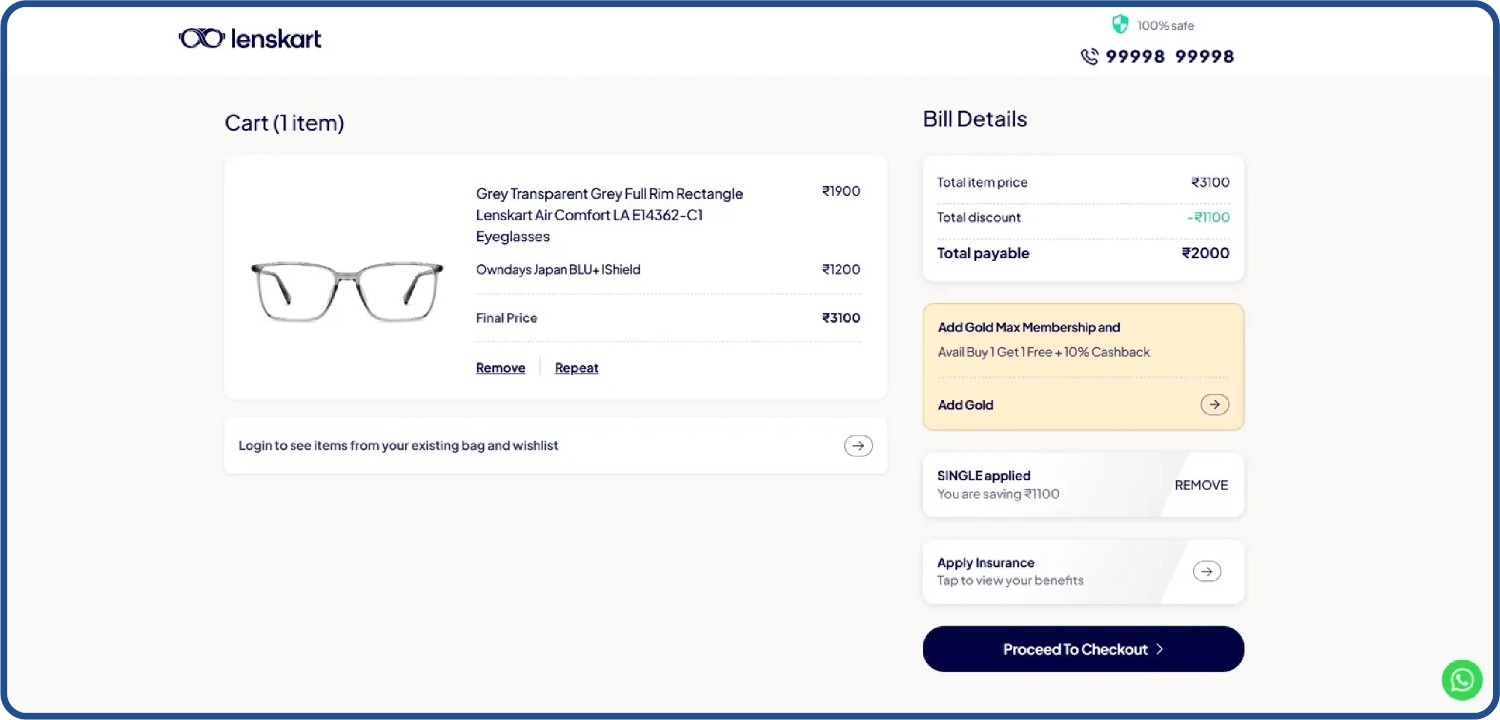
Lenskart's split-screen cart balances product details with real-time pricing transparency.
- Split screen: cart left, bill right: Real-time price breakdown. No surprise fees at checkout.
- Product image + specs: Visual confirmation. "Yes, this is what I want" before paying.
- Membership upsell: Positioned as benefit. "Pays for itself immediately" = smart financial decision.
- Coupon in green: "Saving ₹1100" triggers reward response. Green = winning.
- Insurance add-on: Addresses "what if they break?" when question naturally occurs.
- Login prompt: Loss aversion. "You might have other items you forgot."
Bonker’s Corner (Powered by GoKwik)
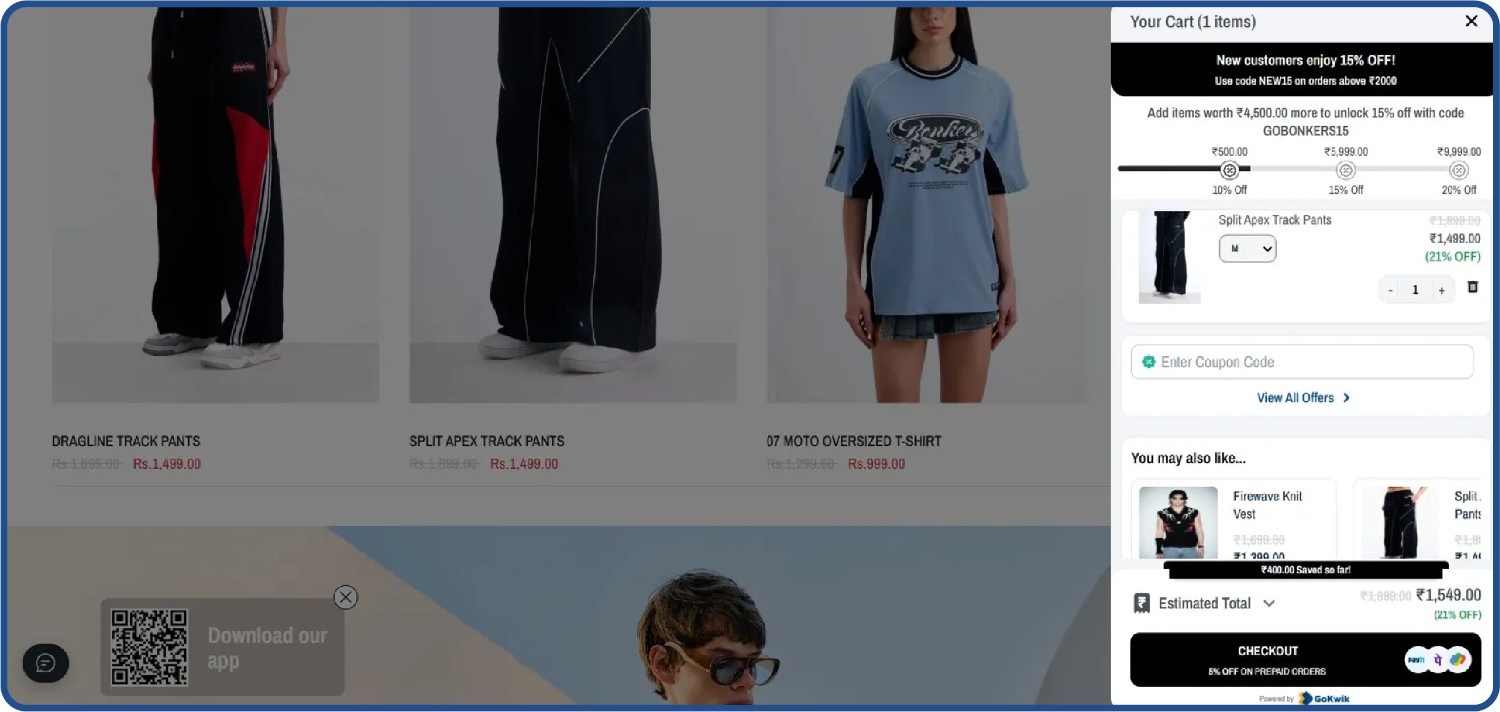
Bonker Conner's gamified cart encourages larger orders through visual reward tiers.
- Progress bar with tiers: Completion compulsion. "₹4,500 away from 15% off" feels like video game achievement.
- "₹400 Saved so far!": Positive reinforcement. Every tier = dopamine hit. Adding items = winning.
- "You may also like": Positioned after gamification primes shoppers to add more.
- "5% OFF ON PREPAID": Reframes prepaid as smart deal, not giving up COD.
- "View All Offers": Prevents "let me Google codes" abandonment.
- GoKwik branding: Signals fast checkout to returning shoppers.
- "(21% OFF)" in green: Absolute + relative savings both visible.
What are the Benefits of an E-Commerce Shopping Cart?
There are many benefits of an e-commerce shopping cart for customers and for D2C brands.
For customers an e-commerce shopping cart offers:
- Flexible Shopping: Customers add items across sessions. Cart remembers selections.
- Transparent Pricing: All costs shown before payment. No surprise fees.
- Quick Modifications: Change quantity, remove items, apply discounts instantly.
- Multiple Payment Options: Choose UPI, cards, wallets, or COD based on preference.
- Secure Transactions: Encrypted data protects payment information throughout checkout.
For D2C brands an e-commerce shopping cart offers:
- Higher AOV: Upsells and recommendations in cart increase order values.
- Reduced Abandonment: Optimized carts recover lost revenue through WhatsApp and email.
- Better Analytics: Track abandonment patterns, identify friction points, optimize flows.
- Inventory Control: Real-time stock updates prevent overselling and customer frustration.
- Automated Marketing: Cart data powers personalized recovery campaigns without manual work.
What are Important E-Commerce Shopping Cart Features?
Every E-Commerce shopping cart needs specific features to consistently convert browsers into paying customers. Missing even one of these elements can cause drop-offs and silently drain revenue at the final purchase step.
- Mobile Responsiveness: Most consumers in India shop from their smartphones, making mobile optimization a non-negotiable requirement for any store. Your E-Commerce shopping cart must perfectly adapt to smaller screens and deliver a frictionless experience.
- Guest Checkout Options: Forcing users to create an account to buy products is considered an unnecessary friction in the checkout flow and drives first-time buyers away. Allowing guest checkout accelerates the buying process and directly increases conversion rates without sacrificing order data collection.
- Clear Cost Breakdowns: Showing all charges upfront, including shipping fees and applicable taxes, builds trust with the customer at the earliest stage of checkout. Transparent pricing eliminates the last-step surprises that drive a large share of cart abandonment globally every year.
- Security Badges: Customers need visible reassurance that their financial information stays protected throughout the payment process. Displaying SSL certificates, recognized payment icons, and PCI compliance badges gives hesitant buyers the confidence to complete their E-Commerce shopping cart purchase.
How to Choose the Right E-Commerce Shopping Cart?
Selecting the wrong shopping cart platform can limit your store's growth potential and create expensive migration headaches later. Evaluate these critical factors before committing to any solution.
Payment Integration Capabilities
Your cart must support every payment method your Indian customers prefer. Look for platforms offering native UPI integration, digital wallets (PhonePe, Paytm, Google Pay), credit/debit cards, and Cash on Delivery. GoKwik Cart provides all these options in a single unified interface optimized for Indian checkout behavior.
Scalability & Performance
Can the cart handle traffic spikes during flash sales or festive season rushes? Test load times, concurrent user capacity, and server response rates. A cart that crashes during peak demand directly translates to lost revenue.
Customization Flexibility
Your shopping cart should match your brand identity without requiring extensive developer resources. Look for drag-and-drop customization, CSS/HTML access, and the ability to modify checkout flows without breaking core functionality.
Abandoned Cart Recovery Features
Does the platform provide built-in tools for cart recovery? Native email reminders, WhatsApp automation, exit-intent popups, and discount trigger capabilities can recover 15-30% of abandoned sessions without manual intervention.
Analytics & Reporting
Data-driven optimization requires granular insights. Your cart should track abandonment rates by device, drop-off points in the checkout flow, average order values, and conversion rates by traffic source.
Integration Ecosystem
Check compatibility with your existing tech stack: inventory management systems, CRM platforms, email marketing tools, analytics software, and shipping providers. Seamless integrations eliminate manual data entry and reduce operational friction.
Pricing Structure
Compare monthly subscription costs, transaction fees, payment gateway charges, and hidden costs for premium features. Calculate total cost of ownership across 12-24 months rather than focusing solely on the advertised base price.
Customer Support Quality
When checkout breaks, every minute of downtime costs revenue. Evaluate support response times, availability (24/7 vs business hours), and technical expertise. Look for platforms offering dedicated account managers for enterprise clients.
What is E-Commerce Shopping Cart Abandonment?
Cart abandonment is one of the most costly and underestimated revenue leaks in E-Commerce today. Customers add items to their E-Commerce shopping cart and exit without completing the purchase for these specific, preventable reasons.
- Unexpected Costs: High shipping fees and last-step taxes send buyers away before they complete the transaction. Hidden charges at the final step make customers feel misled, causing them to leave instantly.
- Complicated Navigation: A confusing layout and excessive form fields frustrate shoppers who arrive at checkout ready to pay. Long, multi-step checkout flows destroy purchase momentum and push customers to abandon the order permanently.
- Lack of Payment Options: Buyers have strong preferences about how they pay, especially across India's diverse digital payment ecosystem. If your store lacks UPI, digital wallets, Pay Later options, and COD availability, shoppers leave rather than adapt to your limitations.
- Trust Issues: A slow-loading checkout page or an inconsistent interface creates immediate security concerns in the customer's mind. If the checkout page appears unfamiliar or insecure, customers protect their financial data by abandoning the purchase before entering any details.
How does GoKwik help Optimize E-Commerce Shopping Cart?
Most shopping carts are passive, but GoKwik Cart is a high-performance slide cart designed to guide high-intent shoppers toward bigger baskets and faster purchases. It transforms your checkout from a basic utility into a conversion engine with a sub 100ms load time.
- Maximize AOV with AI Upsells: Use AI-powered product recommendations and one-tick add-ons to capture instant upsell wins directly in the cart.
- Gamified Rewards & Motivation: Motivate larger orders using gamified progress bars and tiered rewards that encourage shoppers to hit specific discount thresholds.
- Auto Offer Visibility: Populate all Shopify and GoKwik discounts automatically inside the cart. This eliminates the need for manual code entry and accelerates purchase decisions.
- Urgency & Engagement: Drive impulse purchases with time-sensitive flash deals and timer banners that create immediate peak intent.
- Perfect Brand Match: Fully customize the interface to match your brand identity. You can adjust colors, fonts, and banners, or insert custom code for a seamless customer experience.
- Intelligent Inventory Handling: Sync your product inventory in real time to display only available stock. This ensures shoppers never face the frustration of out-of-stock items at the final payment step.
How does Kwik Engage help Recover E-Commerce Shopping Carts?
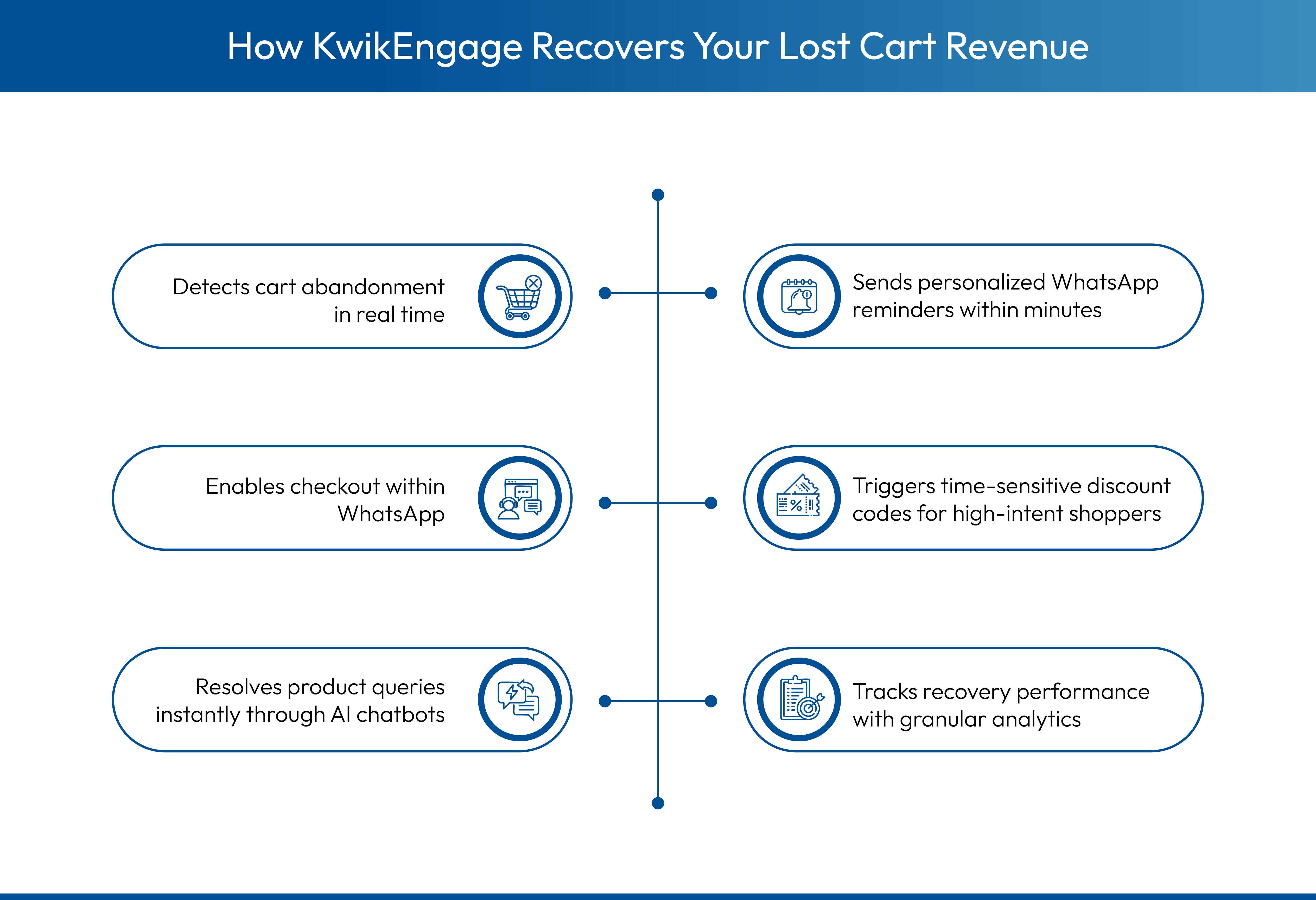
- Brands cannot manually prevent all cart abandonment, and chasing every lost session through email is no longer effective. Smart D2C brands rely on automated WhatsApp marketing to re-engage shoppers who exit before purchasing. Kwik Engage automatically recovers lost revenue from abandoned carts without extra work from your team. Automated Recovery Alerts: Kwik Engage detects the exact moment a shopper exits your website with items remaining in their E-Commerce shopping cart. It sends a personalized WhatsApp message within minutes, reminding the customer about their pending items and inviting them to return immediately.
- Seamless In-Chat Checkout: Customers do not need to navigate back to your website to complete a pending purchase. Kwik Engage allows shoppers to review their cart and confirm the order directly inside the WhatsApp conversation without switching apps or re-entering details.
- Exclusive Discount Triggers: The platform automatically sends time-sensitive discount codes to high-intent customers who abandoned their cart without completing the purchase. These automated discounts convert hesitant shoppers into buyers without any manual setup.
- Real-Time Query Resolution: Shoppers frequently exit because product questions remain unanswered at the moment of peak purchase intent. Kwik Engage deploys AI-powered chatbots to resolve product queries in real time, removing the uncertainty that leads to late-stage abandonment in high-consideration categories.
- Advanced Analytics Dashboard: The platform provides granular performance metrics covering delivery rates, open rates, click-through rates, and recovered revenue per campaign. Brands use these insights to continuously refine their WhatsApp recovery strategy and improve overall E-Commerce shopping cart performance.

How does Kwik Checkout help Reduce E-Commerce Shopping Cart Abandonment?
Prevention outperforms recovery in every revenue calculation. The most successful D2C brands eliminate checkout friction before abandonment occurs. Kwik Checkout fixes the root causes of abandonment by removing every hurdle between the cart and payment.
- India's Fastest Checkout: Kwik Checkout leverages GoKwik's vast network of pre-filled customer addresses to complete a full transaction in under 10 seconds. Returning shoppers across the GoKwik merchant network skip form-filling entirely and confirm their order with a single tap.
- Trust-Building UI: Kwik Checkout integrates familiar security badges, a clean professional layout, and recognized payment icons at every stage of the checkout flow. This visual reassurance addresses customer hesitation at the exact moment they consider abandoning their E-Commerce shopping cart.
- Complete Payment Suite: The platform supports UPI, credit cards, Pay Later options, and COD within a single unified checkout interface. Every Indian shopper finds their preferred payment method available, eliminating one of the most common triggers of digital shopping cart abandonment.
- RTO Protection: GoKwik's machine learning backend scores each incoming order for RTO risk in real time during the checkout process. High-risk COD orders receive intelligent nudges toward prepaid alternatives, protecting brand revenue without blocking genuine buyers from completing their purchase.
Final Takeaway: Optimize Your Cart for Growth
E-Commerce shopping cart captures purchase intent at highest point. Intent without conversion = lost revenue in analytics. Brands that grow invest in prevention and recovery together.
- Prevention: GoKwik Cart eliminates friction before abandonment happens. Sub-100ms load time, AI upsells, gamified rewards, auto-applied discounts guide shoppers to payment instantly.
- Recovery: Kwik Engage automates WhatsApp recovery for visitors who leave. Personalized messages, seamless in-chat checkout, time-sensitive discounts bring shoppers back where email cannot reach.
Optimize cart experience first. Recover lost sessions second. Both tools working together turn abandonment into conversion opportunity. Book a demo with GoKwiktoday and turn your shopping cart into a revenue engine.
What is a shopping cart in E-Commerce?
A shopping cart in E-Commerce is the shopping cart software layer that allows customers to select physical products or digital products, store them temporarily, and review their full order before proceeding to payment. This shopping cart experience bridges the gap between product pages and a completed purchase, forming the commercial core of every E-Commerce website.
What is an E-Commerce shopping cart?
An E-Commerce shopping cart is a digital tool embedded in an online store that holds customer-selected items, calculates shipping costs and shipping rates, and connects securely to payment processing. By mastering best practices, brands can use this functionality to protect payment information and design a checkout that increases customer satisfaction and conversion rates.
What are the two types of shopping carts?
The two primary types are hosted (SaaS) shopping carts and self-hosted shopping cart solutions. Hosted carts on an E-Commerce platform like Shopify offer simplicity for a small business with a fixed monthly fee, while self-hosted options like GoKwik Cart give brands customization options and total control over the customer experience for Indian D2C markets.
What is the shopping cart model in online business?
The shopping cart model in e-business refers to a system where potential customers add multiple items to a virtual cart, review an order summary, and complete a single transaction. It mirrors the physical shopping cart used in a retail store, focusing on ease of use and inventory management to form the foundation of modern online business operations.
Which is the best online shopping cart software?
The best shopping cart depends on your technical setup and transaction fees. For Indian D2C brands, GoKwik Cart is the best shopping cart software because it offers a seamless shopping experience with one-click checkout, RTO protection, and support for a credit card, Google Pay, or Apple Pay across major platforms.

AUTHOR
Parousia Khan
Senior Product Marketing Manager @GoKwik