How KwikAds helped Shop Unrush boost ROAS by 37% in 3 months
Kwik Engage

What is a Payment Gateway? A Complete Guide for E-Commerce Businesses

05 May 2026
10 Min Read
What is a Payment Gateway? A Complete Guide for E-Commerce Businesses

Parousia Khan

Senior Product Marketing Manager @GoKwik

Parousia leads product marketing strategies at GoKwik, and she is an expert in driving e-commerce optimisation, conversion growth, and innovative GTM strategies. She crafts compelling messaging and creates content pertaining to D2C commerce.
Share it on


The moment a customer clicks "Pay Now," a chain of encrypted payment information transfers, fraud checks and bank authorizations runs silently in the background. A payment gateway powers it all.
For ecommerce businesses, choosing the right payment gateway is not a technical detail. It determines whether a customer completes the purchase or abandons the cart. India processed over 21 billion UPI transactions in January 2026 alone, and that volume demands high-functioning gateways built for speed, security and conversion. The growth of electronic payments and digital transactions across the country has made this decision more consequential than ever for D2C brands.
This guide covers what a payment gateway is, how it works, the types of payment gateways available, the payment gateway benefits for your business, and how GoKwik's checkout solution takes the standard gateway model further for D2C brands.
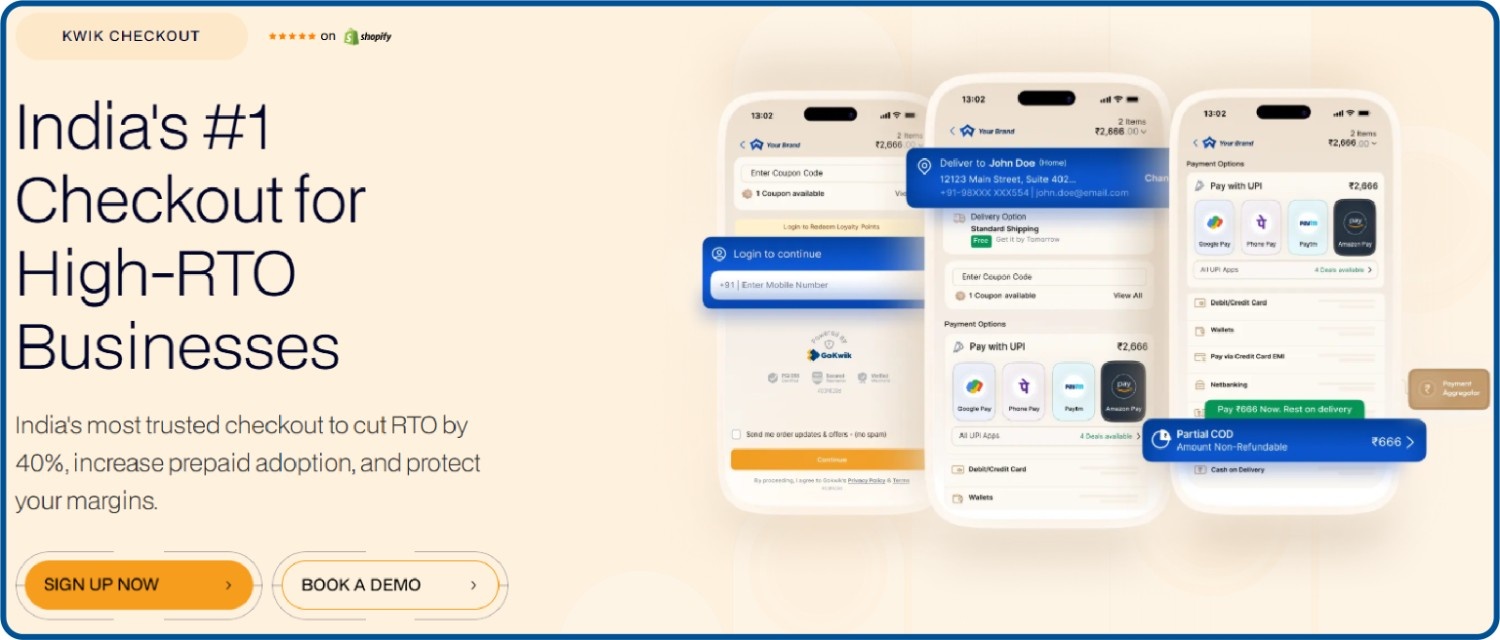
Kwik Checkout optimizes payment gateway performance for D2C ecommerce brands

What is a Payment Gateway?

By now, you might be thinking, ‘What is meant by payment gateway’ in practical terms? It is the technology platform that sits between your customer's checkout process and the financial institutions processing the transactions. It collects, encrypts and securely transmits payment data so funds move from the customer's bank to yours.
When a shopper enters card details on the merchant's website, the gateway immediately captures that data and prepares it for transmission. Unlike a card reader used at a physical retail counter, an online payment gateway handles card-not-present transactions without any physical device at the point of sale.
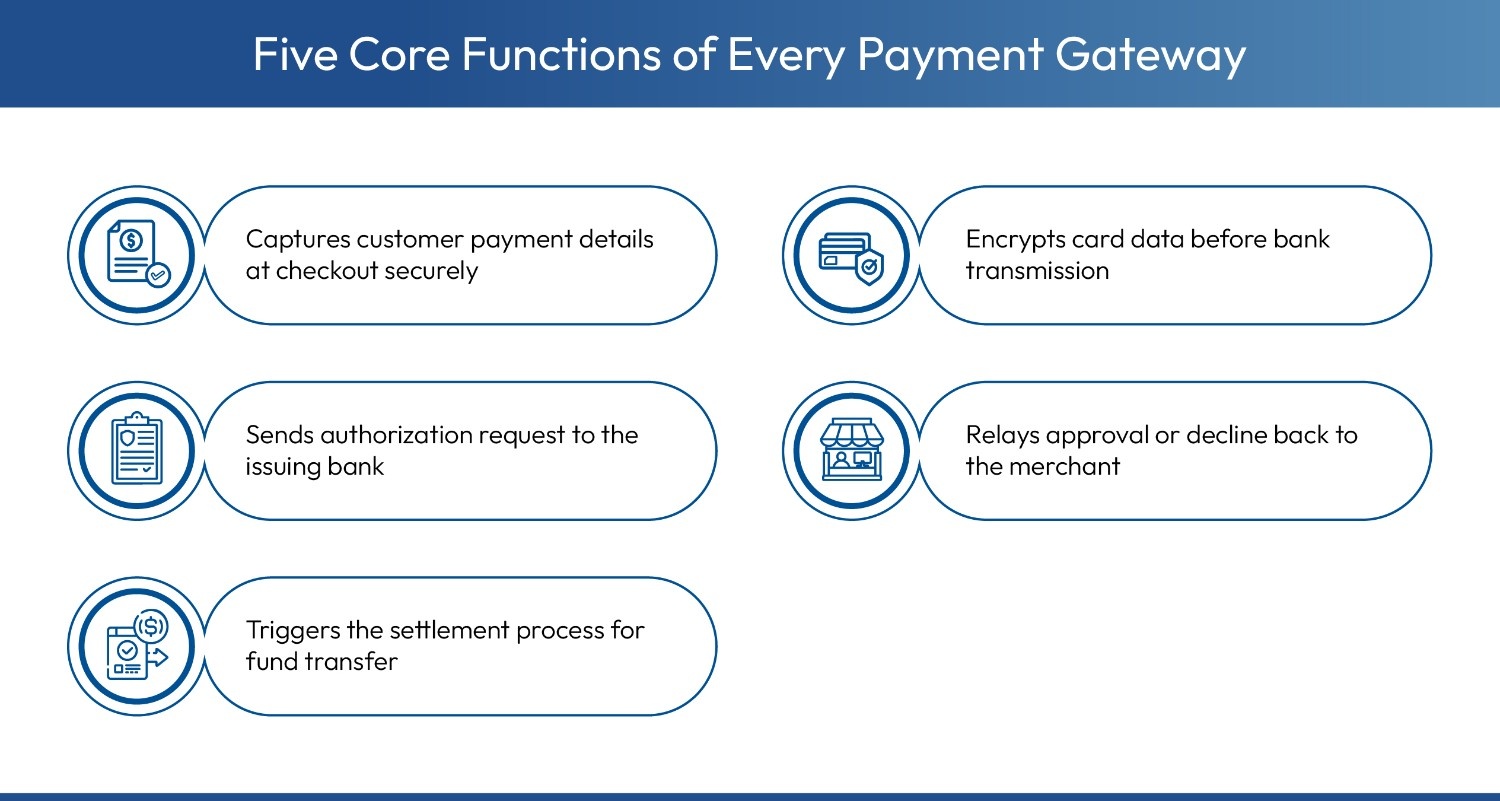
Here is what a payment gateway does in every transaction.
  • Captures the customer's payment details and card information securely at checkout without storing raw data.
  • Encrypts sensitive data, including credit card information and UPI credentials, before transmission to the acquiring bank.
  • Sends the transaction data to the acquiring bank and card network for authorization and approval.
  • Receives the approval or decline response and relays it to the merchant and customer immediately.
  • Triggers the settlement process so funds reach the merchant's account within the agreed payout timeline.
 Key functions of a payment gateway

Payment Gateway in the Ecommerce Context

For an ecommerce store, the gateway is the invisible infrastructure that determines whether a shopper's purchase intent becomes confirmed revenue.

Payment Gateway vs. Payment Processor

A payment gateway handles the front-end capture and encryption of payment information at the checkout page. A payment processor takes that encrypted data and moves funds between the customer's bank and the merchant's bank for final settlement.
Most modern ecommerce platforms bundle both into one service. Understanding the distinction helps when evaluating vendors and diagnosing failed online transactions.

Payment Gateway vs. Payment Aggregator

A payment processing system called a payment aggregator pools multiple merchants under one shared merchant account and handles setup on their behalf. A payment gateway requires each merchant to maintain their own merchant account directly with a bank.
Aggregators lower the barrier for new sellers. Dedicated gateways offer more control over transaction fees and settlement timelines at higher volumes.

Payment Gateway vs. Merchant Account

A merchant account is a dedicated bank account that holds funds after a transaction clears, before they reach your regular operating account. The merchant payment gateway routes the payment data to make that transfer of funds happen correctly.
You need both for a complete payment processing setup. Many modern payment solutions combine them under one contract to simplify onboarding for businesses of all sizes.

Single Gateway vs. Multi-Gateway Architecture

A single payment gateway processes all online payments through a single provider, simplifying reconciliation and reducing setup time. A multi-gateway architecture routes transactions across two or more providers based on success rates, geography or payment methods in use.
D2C brands with high order volumes benefit from multi-gateway setups, which protect against downtime and route each transaction to the provider most likely to approve it.

Standard Payment Gateway vs. Integrated Checkout Solution

A standard payment gateway processes credit card payments and settles funds, serving businesses of all sizes across markets. An integrated checkout solution like Kwik Checkout layers RTO intelligence, COD-to-prepaid conversion and post-payment recovery on top of the payment processing core. For Indian D2C brands, this difference determines whether the order delivers profitably and whether the customer returns.
Kwik Checkout helps D2C brands use multiple payment gateways as backups

What is a Payment Gateway and How It Works? A Step-by-Step Breakdown

Understanding what is a payment gateway and how it works requires following the full transaction path from checkout initiation to final fund settlement.
  • Step 1: The customer enters payment details on a secure checkout form, which the payment gateway captures and prepares for encrypted payment information transmission.
  • Step 2: The gateway applies SSL encryption and runs automated fraud detection on each transaction detail before passing sensitive data to the processor.
  • Step 3: The payment processor sends an authorization request through the payment card network, and the issuing bank checks the account balance and fraud signals before responding.
  • Step 4: The issuing bank sends an approval or decline, which the gateway relays to the merchant and customer in real time.
  • Step 5: The acquiring bank initiates the settlement process and transfers approved funds into the merchant's account on an agreed payout schedule.

Types of Payment Gateways for Ecommerce

Understanding the different types of payment gateways helps you match your store's technical resources, compliance requirements and customer experience goals.
  • Hosted Gateway: The shopper completes online payments on the gateway provider's page, outside your online store. Setup is fast and PCI compliance sits with the provider, though your brand loses control over the checkout experience and design.
  • Self-Hosted Gateway: The payment process runs on your own site and gives you full control over the checkout experience and payment data flow. You need developer resources to maintain the integration and meet PCI DSS compliance independently.
  • API-Based Gateway: An API-based gateway lets developers build a custom checkout experience with complete brand control over the payment experience. This option requires technical expertise and suits brands scaling across multiple payment methods and markets.
  • D2C Conversion Gateway: A D2C conversion gateway combines checkout optimization, fraud detection and post-purchase recovery on top of standard transaction processing. Kwik Checkout is a strong example, addressing RTO risk and COD-to-prepaid conversion alongside core seamless transactions at scale.

Key Security Features to Look for in Payment Gateways

What is an online payment gateway without robust security? Every trustworthy gateway must implement the following security measures across every transaction it handles to protect customer trust and meet industry standards.
  • SSL encryption secures all payment data transmitted between the shopper's browser and the server during every checkout transaction.
  • PCI DSS compliance ensures every merchant handling card details meets the global security standards set by payment card networks.
  • Tokenization replaces raw card information with encrypted tokens so sensitive data never travels through the merchant's systems.
  • 3D Secure authentication adds a second identity verification step for high-risk transactions before the issuing bank confirms authorization.
  • Fraud detection tools screen every order using behavioral signals and velocity pattern analysis to block suspicious transactions before approval.

Payment Gateway Benefits for Ecommerce Businesses

The payment gateway's benefits extend beyond accepting card payments. A well-chosen gateway directly affects conversion rates, customer trust and profitability across every order.
Let’s take a closer look at the core advantages:
  • Wider Payment Method Coverage: Supporting UPI, digital wallets, Apple Pay and debit card payments alongside credit card processing captures more buyers at checkout. Limiting various payment methods to one or two options reliably loses revenue at the final purchase step.
  • Faster Settlement Cycles: Gateways that offer T+1 or same-day settlement improve cash flow for brands processing high order volumes. Faster access to funds reduces dependence on credit lines and supports better inventory planning across mobile app and desktop sales channels.
  • Fraud Protection at Scale: Built-in fraud detection tools screen every transaction using velocity checks and behavioral analysis before authorization. This protects brand revenue and the shopper's customer's credit card information from fraudulent activity at volume.
  • Higher Checkout Conversion: A fast checkout process that loads without redirects on mobile converts more ready-to-buy shoppers. Each second of friction or a missing payment method measurably reduces the number of sessions that complete payment and damages the payment experience at the most critical step.
  • Scalable Infrastructure: A well-built payment gateway handles traffic spikes from sale events without failed digital transactions that damage the customer experience. Growing brands need infrastructure that scales without requiring a gateway migration at higher order volumes, giving them competitive pricing leverage with providers over time.
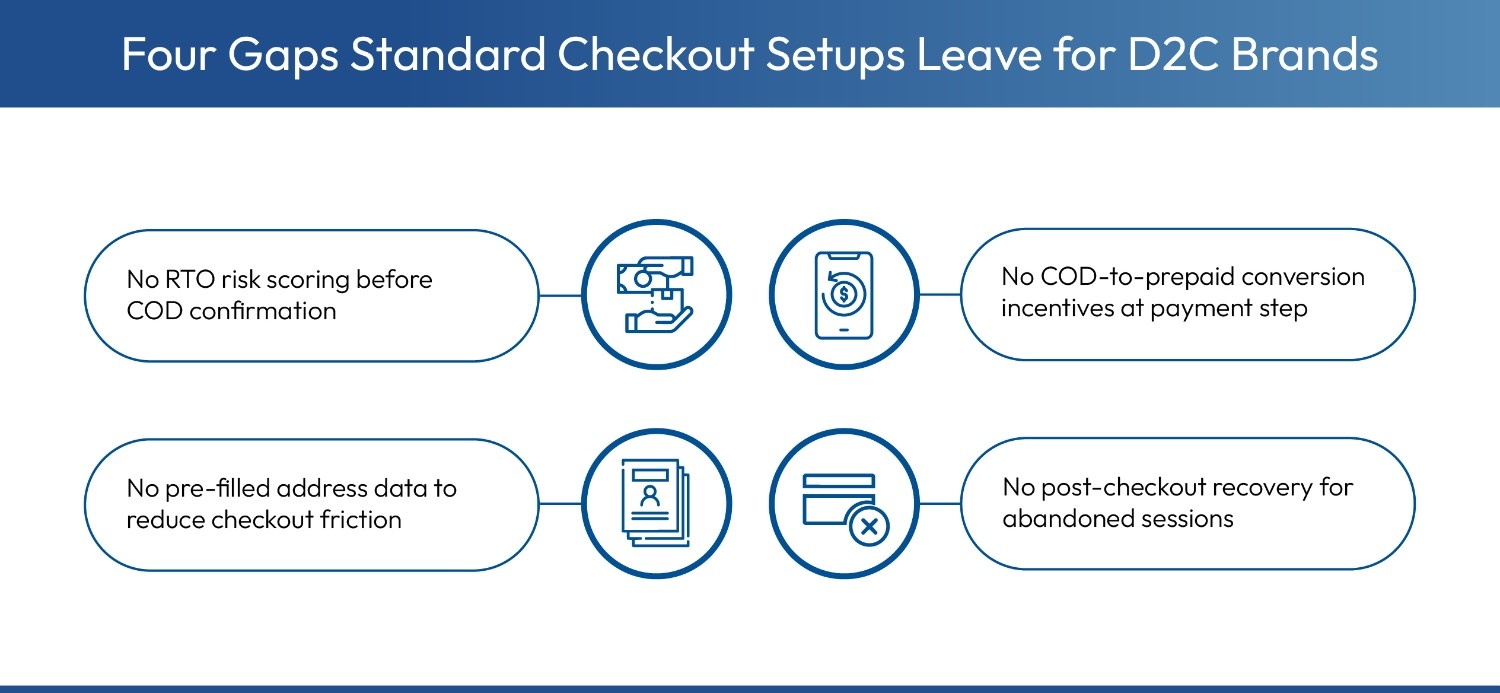
Gaps in standard checkout experience for D2C

What D2C Brands Need to Move Beyond a Standard Payment Gateway?

A standard payment gateway processes the transaction. It does not reduce RTO risk, convert COD buyers to prepaid or recover shoppers who abandoned the checkout process before paying.
Here is what most gateways leave unresolved for D2C brands:
  • Standard payment gateways offer no RTO intelligence to flag and manage high-risk COD orders before the brand confirms dispatch.
  • No pre-filled address data means longer checkout forms, higher drop-off rates and more failed deliveries from input errors.
  • Standard gateways include no COD-to-prepaid conversion incentives at the payment step to shift buyer intent toward prepaid orders.
  • No post-checkout recovery infrastructure exists for shoppers who exit the checkout page before completing payment and leave permanently.
 Kwik Engage recovers abandoned carts via WhatsApp for D2C ecommerce payment gateway optimization

How Kwik Checkout Empowers D2C E-Commerce Stores

Kwik Checkout offers ecommerce specific features for best payment experiences and higher conversions

GoKwik solves all four gaps in a single connected product suite. Kwik Checkout handles conversion, RTO scoring and COD-to-prepaid conversion at the payment step. Kwik Engage automatically recovers abandoned checkout sessions through WhatsApp without any manual effort from the brand team.
  • One-Tap SSO Login and Pre-Filled Checkout: Kwik Checkout gives every returning shopper a one-tap SSO login using mobile number or Truecaller, removing the account creation step entirely. It pre-fills verified address data for over 85% of GoKwik network shoppers, cutting form time and checkout drop-off.
  • RTO Intelligence with 70+ Interventions: Kwik Checkout scores every COD order for return-to-origin risk before confirmation using a machine learning model across 70+ interventions. The platform flags high-risk orders and nudges buyers toward prepaid to protect margins from undeliverable orders.
  • COD-to-Prepaid Conversion and Smart Discounting: Kwik Checkout displays instant discount offers on the payment screen for COD-intent buyers, converting them to prepaid at the payment step. This improves cash flow and reduces reverse logistics costs across every order processed.
  • WhatsApp Cart Recovery via Kwik Engage: Kwik Engage detects checkout abandonment in real time and sends personalized WhatsApp recovery messages within minutes of the shopper exiting. Multi-step flows with optional discount triggers run without manual effort and convert abandoned sessions into recovered revenue.

Conclusion

A single payment gateway is essential infrastructure for any ecommerce brand starting out. Multi-payment gateway architecture routes transactions based on real-time success data and consistently delivers higher conversion rates across markets.
D2C brands that grow beyond a single gateway gain more control over success rates and settlement timing. Kwik Checkout delivers all of that in one system alongside RTO management and cart recovery.
Book a demowith GoKwik today and see how Kwik Checkout outperforms a standard payment gateway for Indian D2C ecommerce brands.
Enjoying this article? Share it with the world!

Frequently Asked Questions

Parousia Khan

AUTHOR

Parousia Khan

Senior Product Marketing Manager @GoKwik

Parousia leads product marketing strategies at GoKwik, and she is an expert in driving e-commerce optimisation, conversion growth, and innovative GTM strategies. She crafts compelling messaging and creates content pertaining to D2C commerce.