How KwikAds helped Shop Unrush boost ROAS by 37% in 3 months
How KwikAds helped Shop Unrush boost ROAS by 37% in 3 months
How KwikAds helped Shop Unrush boost ROAS by 37% in 3 months
How KwikAds helped Shop Unrush boost ROAS by 37% in 3 months
Smart COD Suite
What Is Return To Origin (RTO) In eCommerce? All You Need To Know
 12 Mar 2026
 14 Min Read
Vardhan leads product and growth initiatives at GoKwik, driving D2C e-commerce innovations, conversion optimization, and scalable growth programs for products. An ISB alumnus based in Bengaluru, he brings expertise from Unacademy, Ola, and Mahindra in building high-impact product strategies.
Read this blog on your favourite platform
Return to Origin (RTO) has become one of the most critical challenges facing online retailers today. When a customer places a cash-on-delivery order but cancels it in transit or rejects it at delivery, that product must travel back to your warehouse at your expense, creating a complete revenue loss for that transaction.
Every RTO creates a cascade of costs: double shipping fees, blocked inventory, wasted packaging, quality check labor, and damaged goods risk. For a typical ₹1,000 COD order that becomes an RTO, brands lose ₹200-250 while earning zero revenue. Scale that across hundreds or thousands of orders monthly, and RTO becomes one of your largest profit drains. But here's the important part: RTO is manageable. By understanding why returns happen, calculating your true RTO costs, and implementing smart prevention strategies, you can reduce RTO rates by 40% and significantly improve your bottom line.
While the most obvious step to eliminate RTO would be to stop offering COD altogether, this isn't a viable strategy in India. COD remains a preferred payment method for many customers, making it essential for eCommerce D2C Shopify stores to offer it to build trust and drive growth, particularly in Tier 2 and 3 cities.
This guide breaks down everything you need to know: what causes RTOs, how to calculate their real cost to your business, and proven strategies to reduce them without eliminating cash-on-delivery as a payment option.
What is Return-to-origin (RTO)?
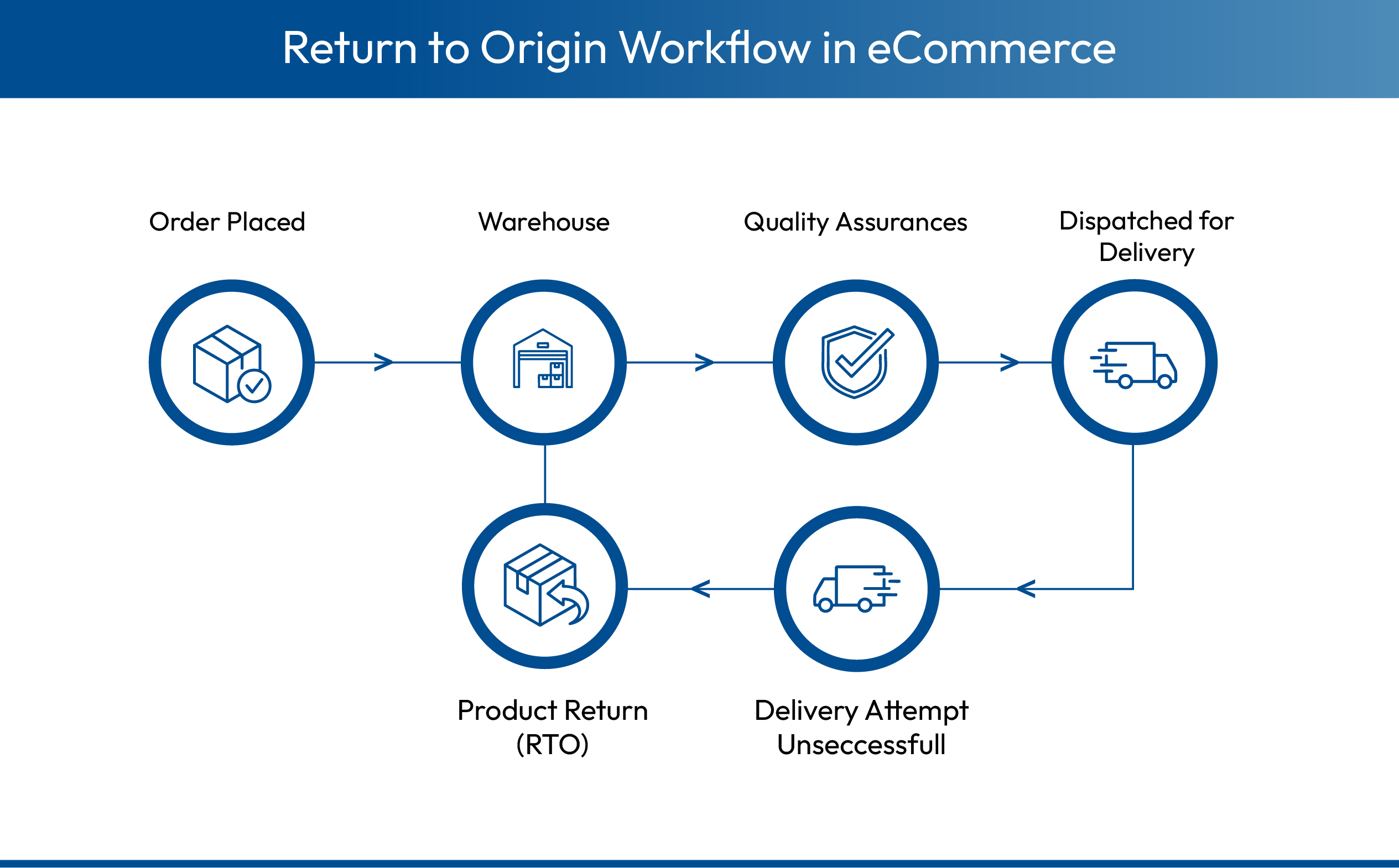
Return to origin means a phenomenon wherein a shopper places a cash-on-delivery-led order but cancels the order while it’s in transit or rejects it at the time of delivery due to unforeseen circumstances or unknown reasons.
In other words, RTO essentially quantifies the portion of cash-on-delivery orders that could not be successfully delivered to the customer and had to be sent back to the seller's warehouse.
According to GoKwik’s internal data, the Indian eCommerce industry witnesses an average RTO rate of about 20-25% and goes up to nearly 40% depending upon a brand’s industry, the states, cities, and pin codes that they’re servicing, the kind of products they’re selling, and more.
While digging deeper to understand how the problem of RTO originated, we realised that it’s a consequent effect of customer satisfaction. The way eCommerce brands handle returns and returns to origins serves as a make-or-break moment for customer loyalty. With the rise of free shipping, no-questions-asked returns, easy anytime cancellations, and hassle-free returns, online brands are equipping shoppers with more power and paying a price in the form of RTOs.

How does RTO impact an eCommerce brand?
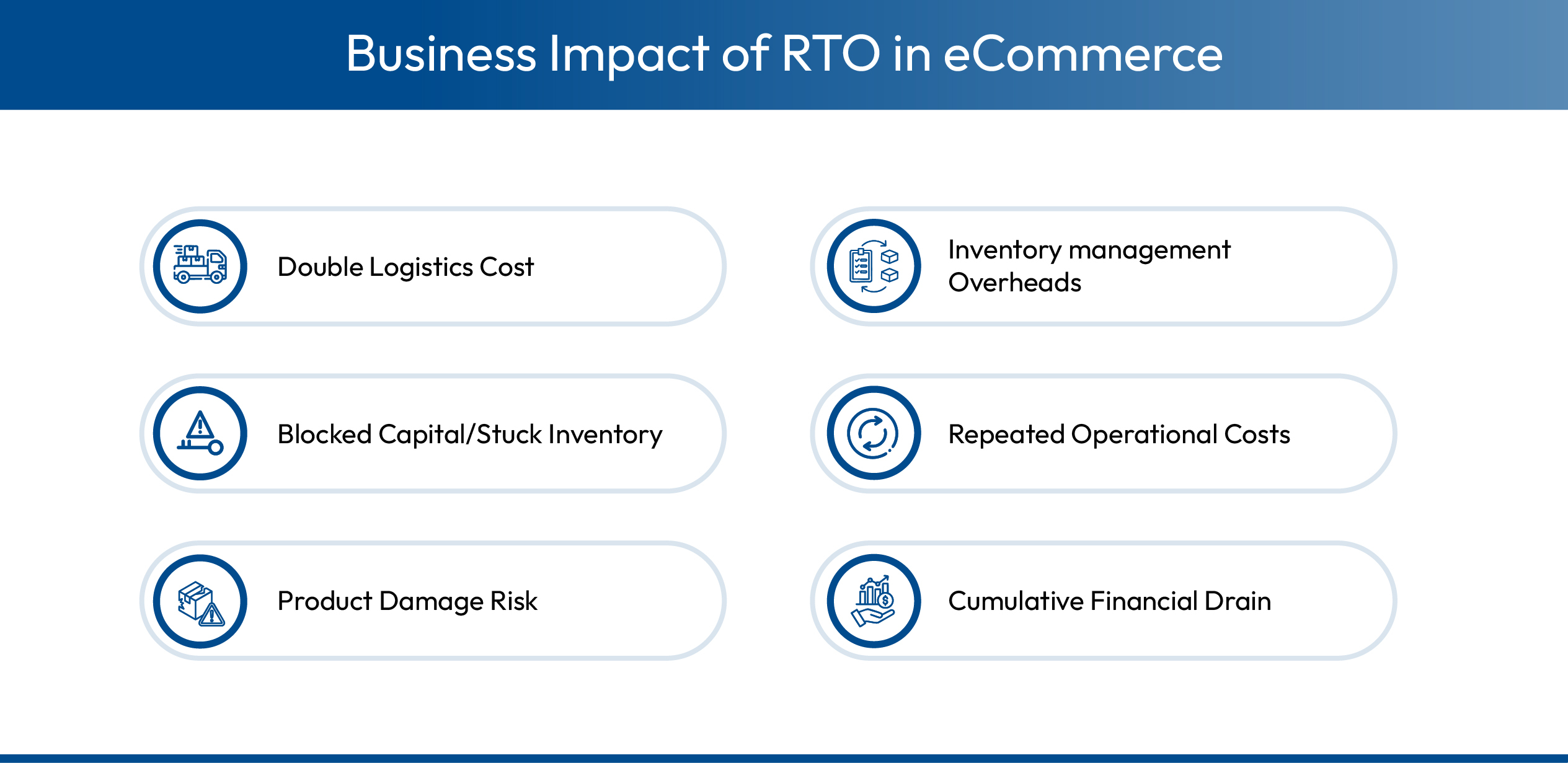
Return to origin in eCommerce is a pressing concern. It bleeds an online business dry in many ways. Some of the top ways RTO impacts an eCommerce business are as follows.
- Double Logistics Fees: Every RTO triggers two logistics charges: forward shipping to the customer and reverse shipping to the warehouse. Unlike successful deliveries, RTOs force you to absorb both costs with zero offsetting revenue
- Inventory Management Overhead: Returns demand time-consuming manual work, including physical inspection, system updates, and record reconciliation. Without proper oversight, this leads to inventory discrepancies and misplaced stock
- Blocked Capital & Stuck Inventory: Inventory remains blocked and unsellable throughout the entire shipping and return journey, often spanning weeks. This is critical for seasonal items, which may lose their value or trend appeal before they can be restocked
- Repeated Operational Costs: You incur operational expenses twice for the same product. RTOs require fresh packaging, re-inspection, and additional labor, effectively doubling your processing costs for a single potential sale
- Product Damage Risk: Double handling and extended transit increase the risk of damage from heat, moisture, or rough logistics. A damaged return represents a total loss of the product value on top of the RTO costs already incurred.
- Cumulative Financial Drain: Hidden costs such as locked working capital, storage fees, and administrative time, collectively eat into margins. High RTO rates can quickly turn seemingly profitable product lines into money-losing operations.
RTO transforms what looks like a healthy order volume into a much less profitable reality. Brands often celebrate high order counts without realizing that a significant portion will return as RTOs, each one draining resources and capital. The key insight is simple: even modest improvements in RTO rate directly translate to better profit margins. This is why understanding and reducing RTO should be a top priority for any eCommerce brand offering cash-on-delivery.

Understanding the mechanics of RTO
While we’ve touched on how RTO impacts an eCommerce brand and its profitability, here’s an example from the brand’s lens for better understanding.
A successful COD order of about INR 1000/- typically costs an online brand about 13-20% of its original value.
Let’s assume that,
- RTO on every COD order - 40%
- Average one-way delivery cost - INR 85/-
- Packaging cost - INR 15/-
- Working capital cost - 1.5% per month
- Cash collection cost - INR 30/-
- Cash collection from shipper (time lapse) - 15 days
Adding all these costs, on an order of about INR 1000/-, an online brand spends nearly INR 200/- to ensure a safe and successful delivery. This means the brand only earns INR 800/- per cash-on-delivery order, and receives this payment every 15 days in a cumulative form.
Meanwhile, if this order turns into RTO, then the brand loses 40% on the selling price and has to pay an additional INR 85/- as reverse logistics to get the product back to the warehouse.
Had this been a prepaid order, factors like RTO%, cash collection cost and time lapse would not be a part of this equation, bringing the brand cost to only about INR 100/-.
How to calculate return-to-origin rate?
The formula to calculate RTO is relatively simple to understand.
RTO Rate = Number of RTO Orders/Total Number of COD Orders Dispatched x 100
To give you an example, let’s consider that an eCommerce brand dispatched 1000 cash-led orders. Of these, it received 200 orders back to the warehouse as RTOs due to the above-mentioned RTO-related reason.
To give you an example, let’s consider that an eCommerce brand dispatched 1000 cash-led orders. Of these, it received 200 orders back to the warehouse as RTOs due to the above-mentioned RTO-related reason.
Then, RTO Rate would be: RTO Rate = (200 / 1000) x 100 = 20%
What are the top reasons RTO happens?
Return to Origin has become an inevitable reality of offering cash-on-delivery in eCommerce. While customer-friendly policies like easy cancellations, hassle-free returns, and open-box deliveries help increase conversions, they also create opportunities for RTOs. But these aren't the only culprits.
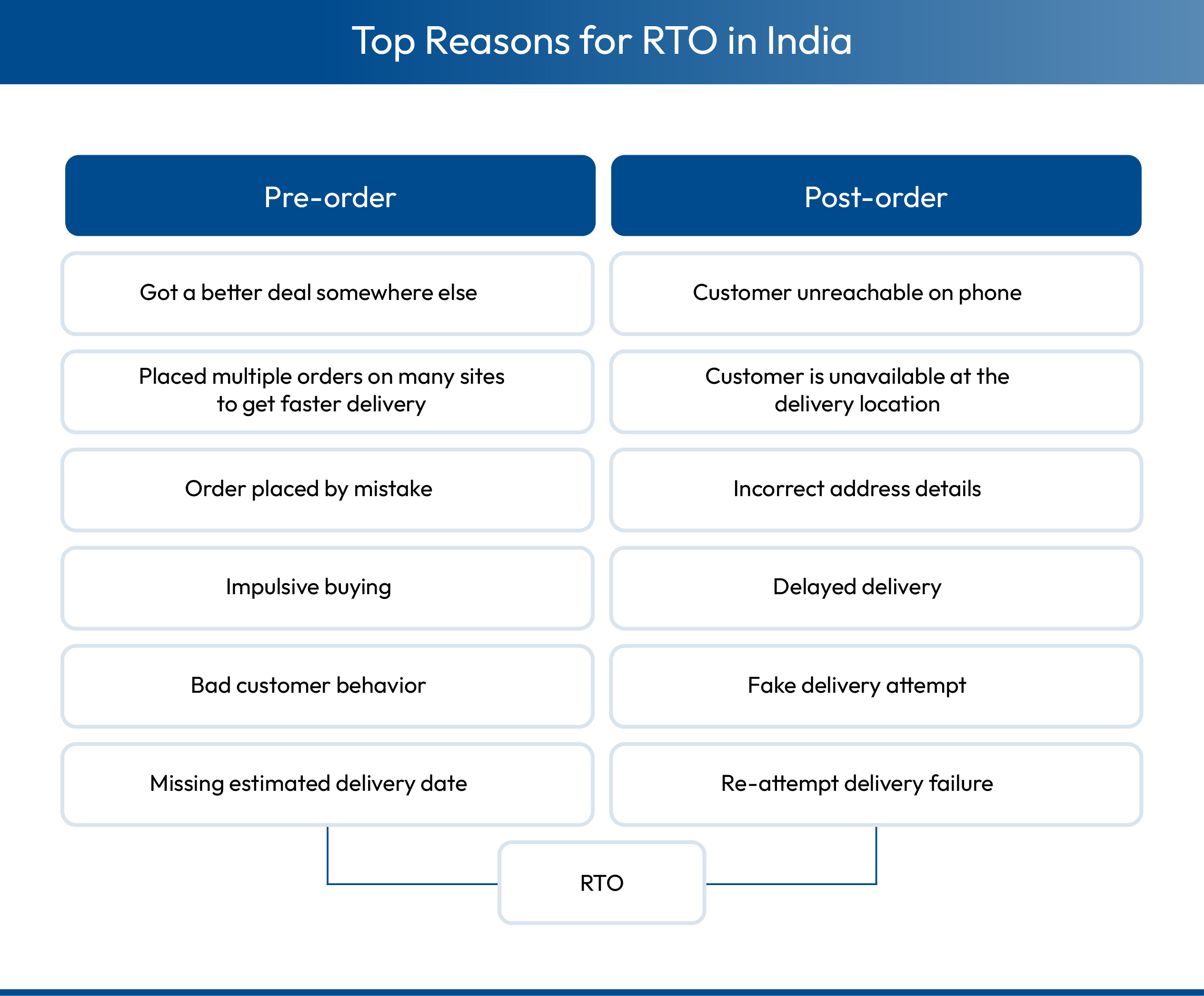
RTO causes fall into two distinct categories based on timing: issues that arise before the delivery is attempted, and problems that occur during or after the delivery attempt. Understanding which type of RTO you're facing is the first step toward reducing it.
- Pre-order RTO reasons happen before the delivery agent even reaches the customer's address. These are typically driven by customer behavior, changing circumstances, or order-related issues.
- Post-order RTO reasons occur at the point of delivery or during the delivery attempt itself. These usually stem from logistics challenges, communication gaps, or unavailability.
Let's examine both categories in detail.
Pre-delivery RTO reasons
These are issues that emerge after the customer places an order but before the delivery agent attempts delivery. Understanding these patterns helps you implement preventive measures at the right stage.
- Got a better deal somewhere else: Customers often find lower prices on competitor sites after ordering. Since COD requires no upfront payment, they cancel or reject the original order without consequence.
- Placed multiple orders on various sites: Prioritizing speed, shoppers may place identical orders on multiple sites. They accept the first arrival and reject the rest, leaving brands to absorb the RTO cost.
- Order placed by mistake: Mistakes during browsing or by family members often go unnoticed until delivery. With no financial commitment, rejecting these COD orders is easy and consequence-free.
- Impulse buying: Urgency-driven purchases (e.g., flash sales) often lead to buyer's remorse. By the time the product arrives, the excitement fades, and the Cash-on-delivery order is rejected.
- Missing estimated delivery date: Lack of clear delivery timelines breeds anxiety. Customers lose confidence and may proactively cancel or buy elsewhere to ensure timely receipt.
- Lack of purchase intent: Some customers place COD orders merely to test delivery reach or for physical comparison shopping, with no genuine intention to purchase
Post-order delivery RTO reasons
These issues occur during the actual delivery attempt or at the customer's doorstep. Unlike pre-order reasons driven by customer behavior, post-order RTOs often stem from logistics challenges, communication gaps, and operational issues that brands have more direct control over.
- Customer is unreachable or unavailable at the delivery location: Delivery fails when customers miss calls or aren't present at the address. Without real-time coordination, agents mark orders as undeliverable.
- Incorrect address details mentioned: Typos, wrong pin codes, or incomplete landmarks prevent location verification. Delivery agents unable to find the address are forced to mark the order as RTO.
- Delayed delivery: Time-sensitive orders (gifts, events) become useless if they arrive late. Extended delays also erode trust, causing customers to buy elsewhere before the package arrives.
- Fake delivery attempt: Agents running behind schedule may mark orders as "attempted" without visiting. Frustrated customers often reject the actual delivery when it finally happens days later.
- Re-attempt delivery failure: If original issues (wrong address, unavailability) aren't fixed, subsequent attempts fail. Once retry limits are exhausted, the order becomes an RTO.
Understanding these root causes is the first step toward mitigation, but to truly grasp the gravity of the situation, it is essential to understand why RTO is a non-negotiable metric for your business's health.
Why is Return-to-origin a crucial metric for eCommerce businesses?
RTO isn't just about failed deliveries. It's a critical business health indicator that affects multiple aspects of your operations, from immediate cash flow to long-term sustainability. Here's why every eCommerce brand needs to track and manage its RTO rate carefully.
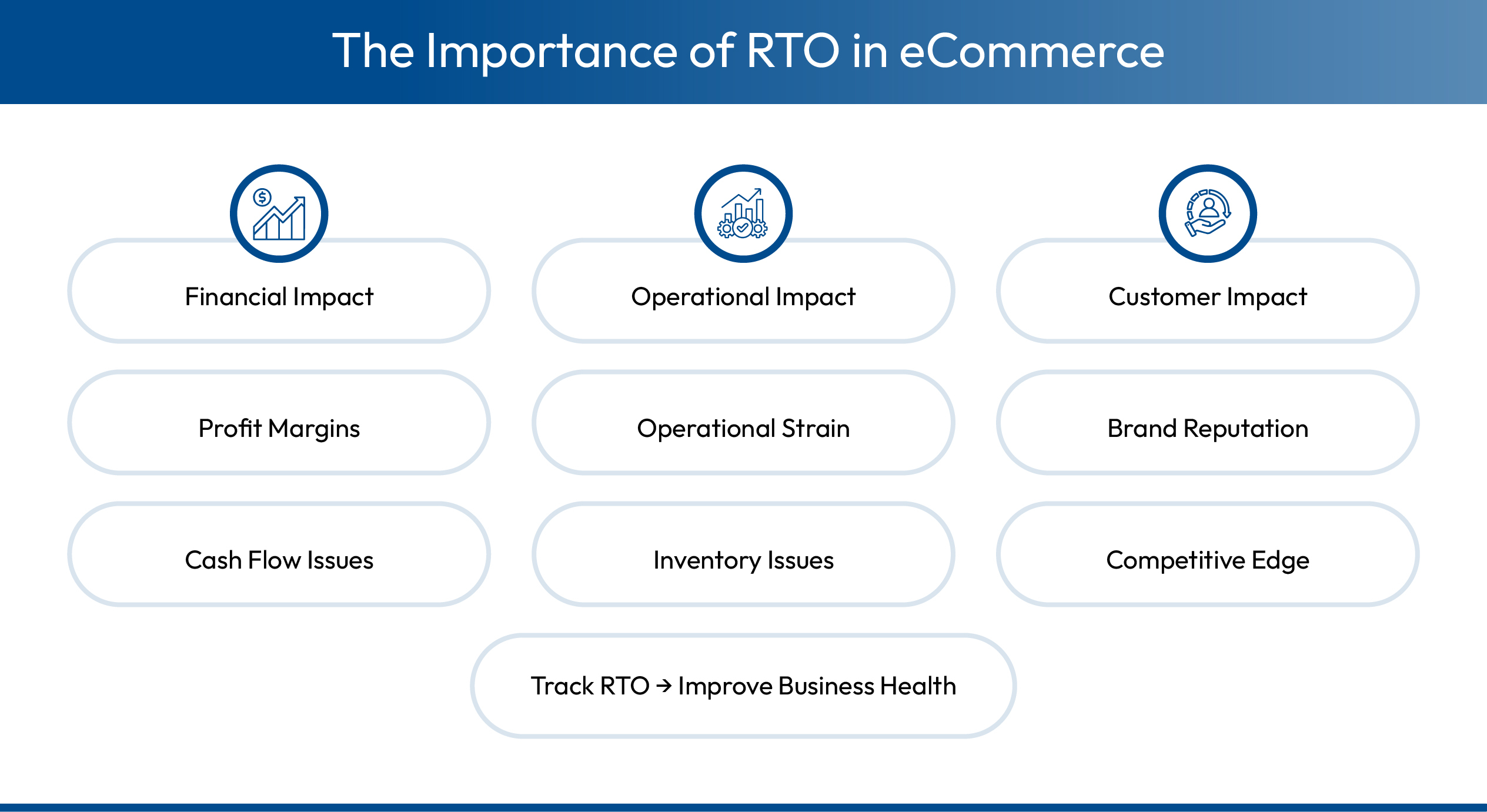
- Direct impact on profit margins: Every RTO triggers immediate financial loss via double shipping, packaging, and operational expenses without generating revenue. For brands with thin margins, this often determines the difference between profitability and loss.
- Cash flow and working capital problems: Upfront investments in packaging and logistics get locked for weeks during the RTO cycle. High RTO rates keep working capital stuck in failed transactions, creating cash crunches that limit growth and restocking.
- Customer experience and brand reputation: Failed deliveries and fake attempts damage brand reliability. This leads to negative reviews and churn; essentially, every RTO represents a lost customer, not just a lost sale.
- Operational efficiency and resource strain: Processing returns consumes significant bandwidth across quality checks and support for zero revenue. This creates bottlenecks and fills warehouse space with non-performing inventory.
- Inventory management challenges: Products in the RTO cycle create artificial scarcity for best-sellers. By the time they return, seasonal demand may have passed, or the product may be damaged, resulting in dead stock.
- Competitive disadvantage: Brands with lower RTOs can reinvest savings into growth and better pricing. Conversely, high RTO rates force you to spend revenue on covering losses, eroding your competitive edge.
RTO rate is a comprehensive health indicator for your eCommerce business. It reveals how well you understand your customers, how efficient your operations are, and how sustainable your business model is. Every percentage point reduction in RTO directly translates to better margins, healthier cash flow, happier customers, and more resources available for growth.
How does GoKwik help reduce RTO?
GoKwik’s internal analysis of its shopper network reveals a crucial insight: 60-70% of RTOs stem from low buying intent (customer psychology), while only 20-25% result from logistics issues.
To address this behavioral problem, GoKwik’s Smart COD Suite uses AI/ML models trained on 180 Mn+ shoppers to identify high-risk users and manage return to origin by deploying targeted interventions based on over 200 parameters.
The 4 modules of GoKwik’s Smart COD Suite
GoKwik offers tailored modules based on a brand's specific growth stage:
- Reduce RTO Module: Uses high-degree interventions to lower high RTO rates. See how Boult achieved a 40.21% decrease in COD-led RTO, significantly improving revenue and capital flow.
- Start COD Module: Enables brands to open PAN-India COD serviceability while filtering out risky pin codes. Learn how Snitch increased COD serviceability by 66% and saw a 182% increase in GMV.
- Grow COD Module: Helps brands expand into previously "no-go" high-risk zones safely. Read how Lenskart expanded from 5,000 to 26,000 pin codes, increasing COD orders by 195% while keeping RTO between 15-19%.
- Limit RTO Module: Designed for brands that have stabilized their returns and want to maintain RTO within defined limits using a mix of interventions.
Proactive high & low degree RTO interventions by GoKwik
Though India’s average RTO rate is about 23.18%, according to GoKwik’s analysis and internal data (based on 180 Mn+ shoppers), tier III cities contribute to the maximum number of returns to origins. On a state level, shoppers from Bihar cause the highest number of RTOs, at about 34.06% annually.
GoKwik categorizes interventions into two stages to catch RTOs before they happen and save orders after they are placed.
A. Pre-order interventions (during checkout)
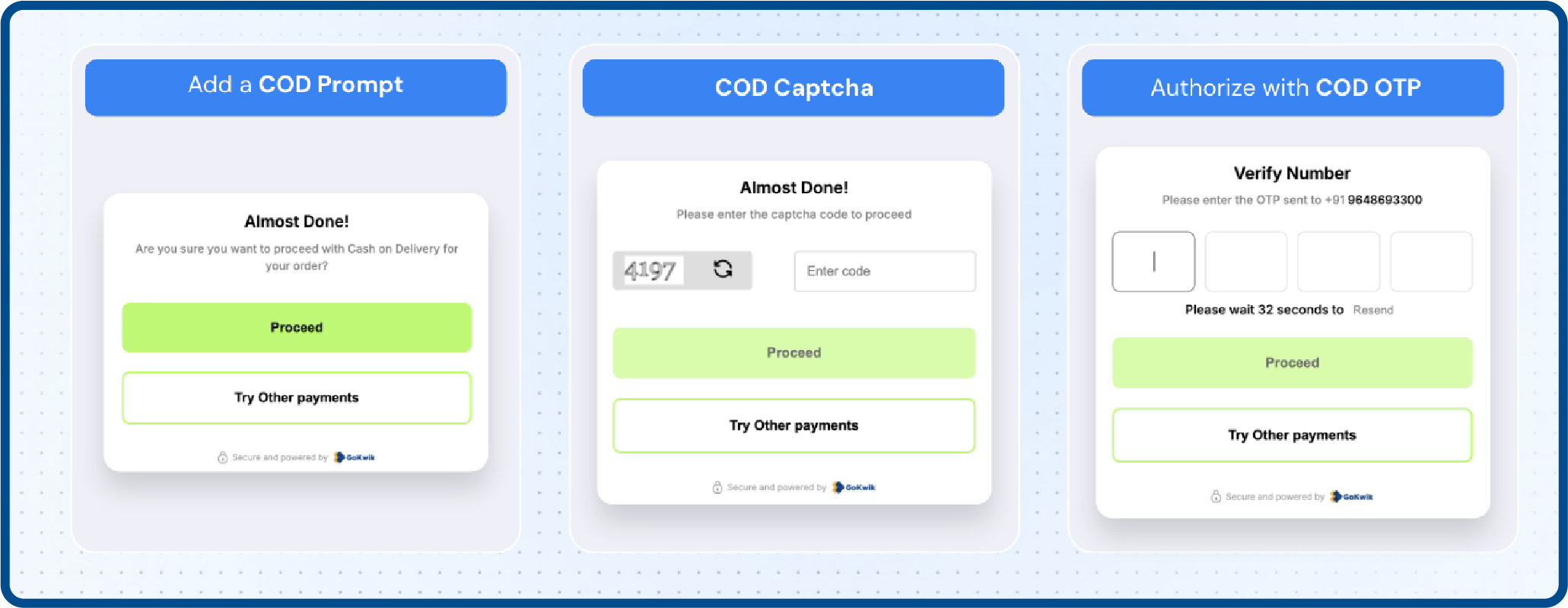
These features filter out low-intent users before the order is finalized.
- COD confirmation prompt: Nudges users to confirm their interest, reducing impulse buying.
- COD captcha: Adds a verification step to stop automated scripts and bots from placing fake orders.
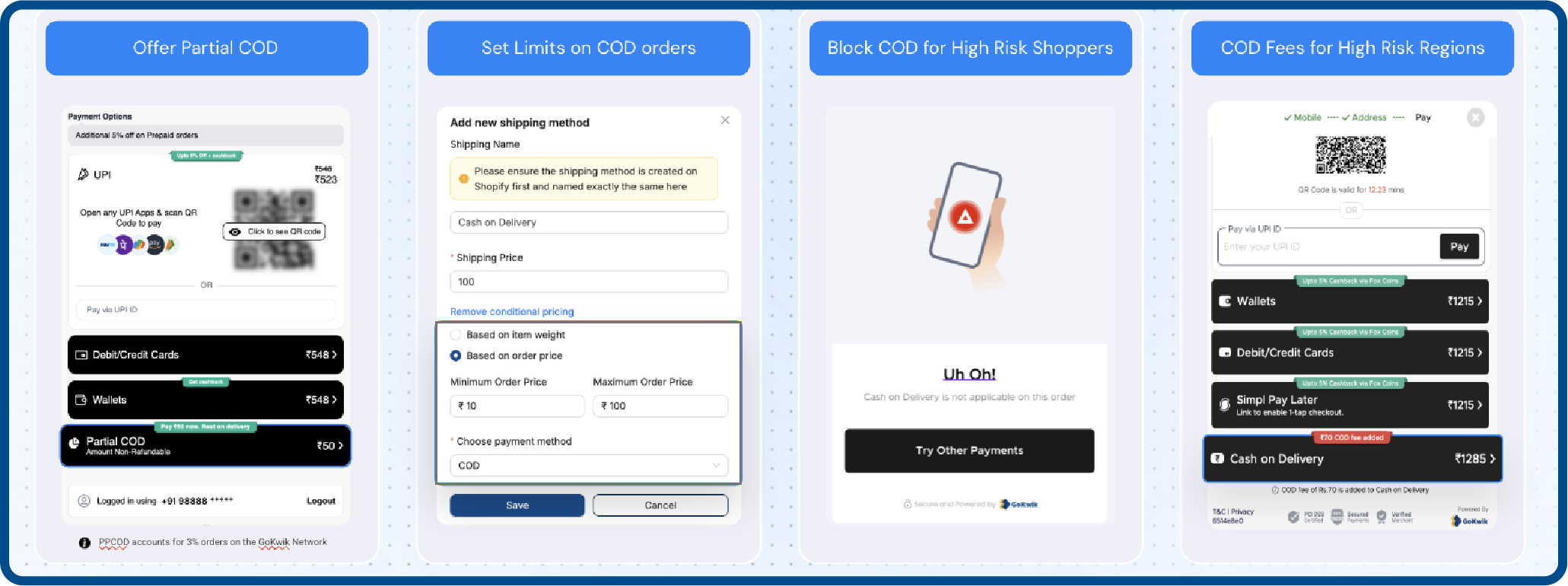
- COD blocking: Blocks COD availability at micro-levels, such as for specific high-return products or high-risk pin codes.
- Shopper blacklisting: Automatically restricts habitual RTO offenders based on their history across the network.
- Partial COD: Partial cash-on-delivery allows shoppers to pay a small amount upfront and the rest on delivery in cash. This creates a financial commitment, reducing RTOs by up to 55%.
- COD timer: Offers a discount on the "Thank You" page if the customer converts their COD order to prepaid within a limited window, leveraging urgency.
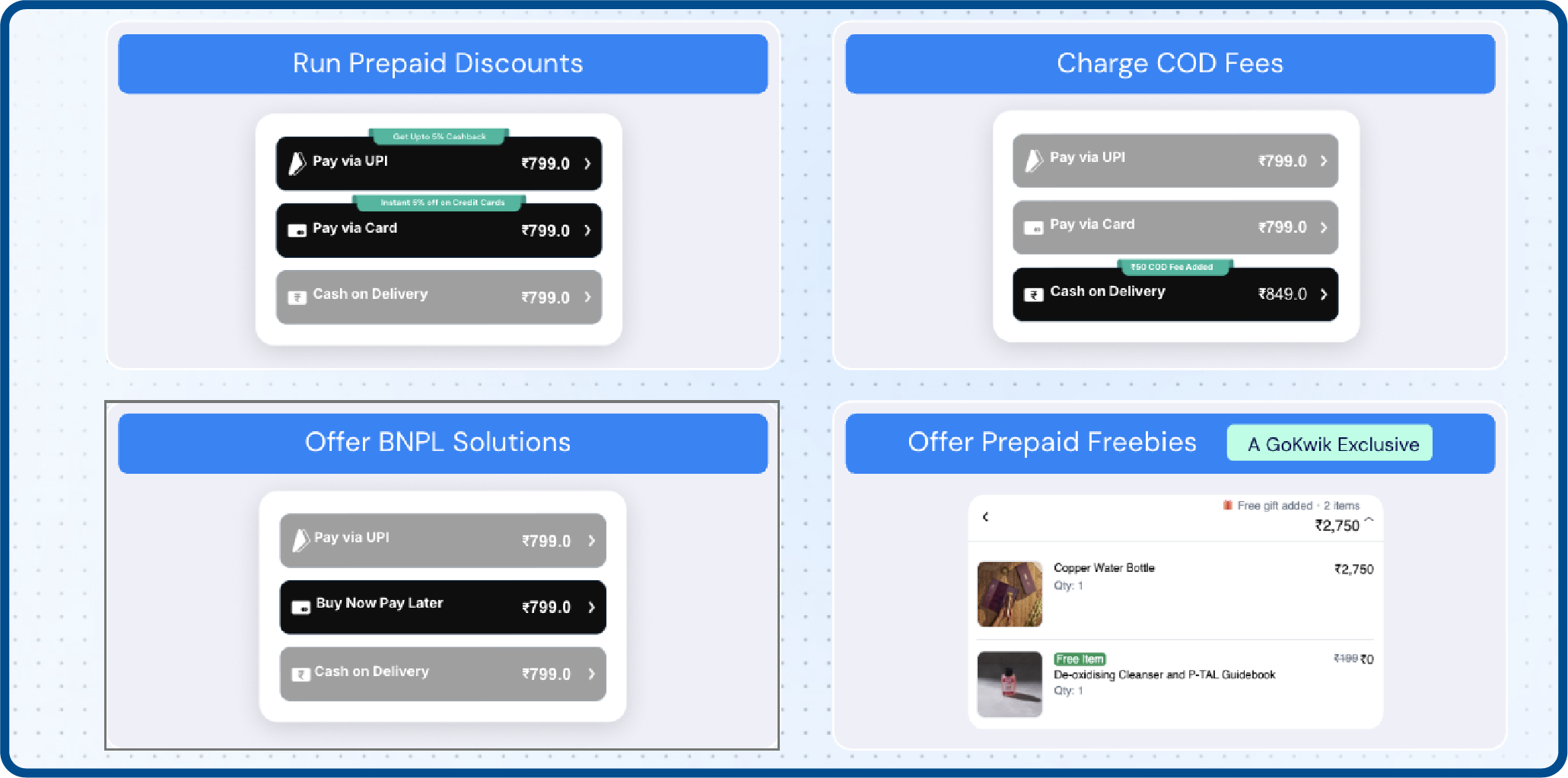
- COD fees & dynamic discounts: Automatically charges a fee for COD while rewarding prepaid methods (e.g., Plum Goodness charges ₹75 for COD to steer users toward digital payments).
B. Post-order interventions (communication suite)
These tools address logistics gaps and eCommerce customer anxiety after the order is placed.
- Real-time WhatsApp updates: Keeps customers informed to build trust and reduce cancellations.
- COD to prepaid conversion: Nudges users via WhatsApp to pay online before delivery.
- Address & phone correction: Prompts users to fix incomplete addresses or add alternate phone numbers, solving the leading causes of delivery failure.
- Reschedule delivery: Allows customers to select a delivery slot when they are actually available, preventing failed attempts.
Summing it up
Return to Origin is a pivotal metric that defines the health of an eCommerce business. It is not just a logistical hurdle but a factor that directly impacts cost efficiency, customer experience, and long-term sustainability.
By actively monitoring and reducing RTO, brands can protect their margins, ensure smoother operations, and gain a competitive edge. Whether through better customer communication or advanced risk intelligence, the goal is to ensure that high order volumes translate into actual profit rather than operational losses.
GoKwik provides the necessary infrastructure to combat RTO effectively. With its Smart COD Suite, brands can minimize returns, expand their cash-on-delivery reach safely, and secure higher profitability.
Ready to reduce your RTO and expand your business? [Book a Demo with GoKwik]
How to reduce RTO in eCommerce?
You can reduce RTO by incentivizing prepaid payments, providing real-time order tracking to reduce anxiety, and using AI-driven tools to identify and filter out high-risk cash-on-delivery orders before they are dispatched.
What is the average RTO in eCommerce?
According to industry data, Indian eCommerce brands typically witness an average RTO rate of 20-25%. However, this can spike up to 40% depending on the specific industry, location, and products involved.
What is the 80/20 rule in eCommerce?
The 80/20 rule often suggests that 80% of your revenue comes from 20% of your customers. In the context of RTO, it implies that a majority of returns usually stem from a small percentage of high-risk pin codes or habitual offenders.
What are the main causes of RTO?
RTO is primarily driven by customer behavior, such as impulse buying and low purchase intent. Operational issues like incorrect addresses, customer unavailability, and delayed deliveries also significantly contribute to failed orders.
How does RTO impact business profits?
RTO drains profits by triggering double logistics fees for forward and reverse shipping while generating zero revenue. It also blocks inventory for weeks, preventing sales to genuine customers and increasing operational overheads.

AUTHOR
Vardhan Jain
Director of Product Program @ GoKwik