

Your 2026 D2C Calendar mapped day by day - Powered by real data from India’s biggest D2C shopping network
Smart COD Suite

What is Cash on Delivery (COD)? Complete Guide for 2026

12 Mar 2026
17 Min Read
What is Cash on Delivery (COD)? Complete Guide for 2026

Suhag Vamja

Head of Product Marketing @ GoKwik

Suhag spearheads D2C growth strategies at GoKwik, focusing on e-commerce optimisation, conversion funnels, and sales enablement. Based in Bengaluru and an MICA alumnus, he excels in crafting GTM playbooks and marketing campaigns tailored for D2C brands.
Share it on
Despite India's rapid digital payment revolution, cash on delivery (COD) remains the preferred payment option for 60% of online purchases.
For eCommerce brands, COD is both an opportunity and a challenge. On one hand, it unlocks access to millions of customers across tier 2, 3, and 4 cities where COD preference can reach up to 90%. On the other hand, it comes with operational complexities, cash flow delays, and the persistent challenge of Return to Origin (RTO), which can reach as high as 50% for some merchants.
This complete guide covers everything you need to know about cash on delivery: what is COD, how it works, its advantages and disadvantages, payment collection methods, and proven strategies to manage COD successfully while minimizing RTO losses.

TL;DR: The 30-Second Guide to Cash on Delivery

What is it? Cash on Delivery (COD) is a payment mode where customers pay for goods at the time of delivery rather than during checkout.
The Strategic Reality:
  • It’s unavoidable: 60% of Indian eCommerce orders are COD, reaching 90% in Tier 3/4 cities.
  • It’s risky: Without controls, Return to Origin (RTO) rates can hit 30–50%, doubling your shipping costs with zero revenue.
The "Smart COD" Playbook: Don't choose between "Growth" (offering COD) and "Profitability" (blocking COD). Use these strategies to balance both:
  • Verify Intent: Confirm orders via WhatsApp/SMS to validate addresses before shipping.
  • Use Tech: Implement AI risk scoring to automatically block high-risk users while letting good customers through.
  • Go Hybrid: Offer "Partial COD" where customers pay a small booking amount upfront to secure the order.
  • Incentivize: Nudge users to prepaid methods with small discounts or faster delivery promises.
Bottom Line: COD isn't going away. The winning strategy is not to eliminate it, but to manage it intelligently to maximize conversions while minimizing RTO losses.

Try Smart COD and scale eCommerce profitably

What is COD or Cash on Delivery?

Cash on Delivery, popularly called “cash on demand,” is a common mode of payment wherein a shopper gets the advantage of paying for their online purchase at the time of delivery.
Unlike digital or prepaid payment methods, where payment is made in advance, cash on delivery allows shoppers to pay only upon receiving the product. With COD, customers also have the leverage to reject the order and return it. back to the seller at the doorstep without having made any upfront payment.

Why Do Indian Consumers Prefer COD?

In India, cash on delivery has been the most common and preferred mode of payment until quite recently, before the coming of digital and online payments and the COVID-19 pandemic. Indian consumers prefer COD for many reasons. Here are some of the reasons:
  • Customers who are wary of sharing their card or bank details online prefer COD as it’s a more secure method.
  • Many Indian consumers still live in isolated locations with limited internet access. For these customers, COD is the best alternative payment method.
  • Many Indian consumers, especially those belonging to older generations, find digital and online payment methods hard to handle. That’s why they prefer COD.
  • With COD, customers can deny delivery at the doorstep if they are not satisfied or change their mind, without having made any upfront payment.
  • Many Indian regions still do not have proper banking infrastructure and facilities. COD is a more accessible payment method in these locations.
  • COD appeals to impulsive shoppers who place orders without firm purchase intent, using the delivery window to decide whether they actually want the product or not.
Success requires understanding not just what COD is, but how it works operationally, which we'll break down next.

How Does Cash on Delivery Work? (Step-by-Step Process)

Cash on delivery involves a coordinated series of steps between the customer, merchant, delivery partner, and payment systems. Understanding this process from all angles helps brands optimize their COD operations and identify potential friction points.
The COD Order Journey from a Customer's Perspective

Here is the complete journey of a COD order:
  1. Browse and Add to Cart: The customer shops on the website or app and selects products just as they would for any other transaction.
  2. Select COD at Checkout: At the payment stage, the customer selects "Cash on Delivery." Unlike prepaid orders, no payment is processed here. Pro-tip: Smart brands often trigger an OTP verification or risk check at this stage to validate the user's intent.
  3. Order Confirmation: The customer receives an email or SMS confirming the order and expected delivery date. On the backend, the merchant validates the details and prepares the shipment with a specific COD label indicating the amount to be collected.
  4. Shipment & Tracking: The package is handed to the logistics partner. The customer tracks the shipment via a link, while the merchant monitors for delivery exceptions or failed attempts.
  5. Delivery & Inspection: Upon arrival, the delivery agent hands over the package to the customer. Depending on the merchant's policy, they may inspect the package condition before accepting it.
  6. Payment Collection: The customer pays the exact order amount at the doorstep. This doesn't have to be physical cash—modern COD often allows payment via QR codes, UPI, or payment links at the door.
  7. Reconciliation: The logistics partner collects the funds and eventually settles the amount with the merchant (typically within 7–15 days), completing the cycle.
Not every COD order ends in a successful transaction. When a customer rejects an order at the doorstep or is simply unavailable, it triggers Return to Origin (RTO), the single biggest challenge in COD management.
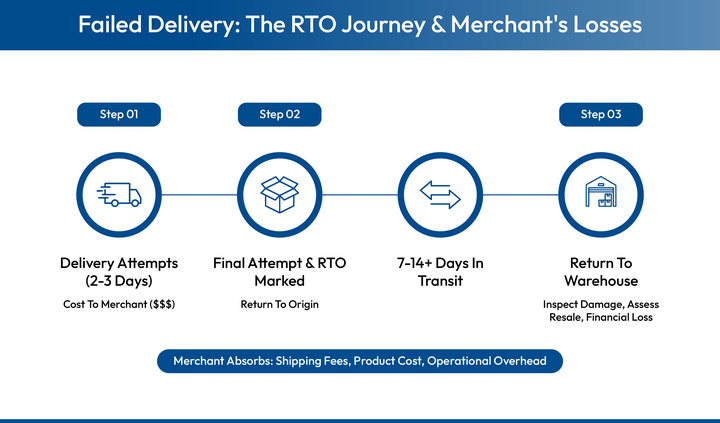
Failed Delivery: The RTO Journey & Merchant's Losses

While a successful delivery ends at Step 6, a failed delivery initiates a costly reverse journey:
  • Multiple Delivery Attempts: If the customer is unavailable, the logistics partner typically attempts delivery 2–3 times over several days, with each attempt costing the merchant time and money.
  • Marked as RTO: After the final failed attempt, the package is officially marked as "RTO" and begins its journey back to the seller.
  • Reverse Transit: The product travels back through the network to your warehouse, a process that can take 7–14 days or longer.
  • Loss Assessment: Upon return, the merchant must inspect the item for damage to determine if it can be resold.
Unlike prepaid orders, a rejected COD order results in a "double loss": you absorb the forward shipping fees, the return shipping fees, and the operational overhead, all without generating any revenue.

Also Read: Navigating the COD Challenges: How eCommerce Brands Can Thrive
Try Kwik COD for better RTO management

What is The Difference Between Cash-on-Delivery vs Prepaid Orders?

Understanding how COD compares to other payment methods helps you make strategic decisions about which options to offer and when.
Prepaid orders encompass all digital payment methods processed during checkout: UPI, credit/debit cards, digital wallets, net banking, and buy now pay later options. While Cash in Advance refers specifically to advance payment, prepaid is the broader term used in Indian eCommerce to describe any non-COD payment method.
Here's how COD and prepaid orders compare across key business metrics:

Most successful Indian eCommerce brands don't choose between COD and prepaid. They offer both but use smart strategies to nudge customers toward prepaid while keeping COD available for those who need it.
Now let's explore the various ways you can actually collect payment for COD orders, including modern alternatives to traditional payment methods that can improve your collection rates and customer experience.

Factor

Cash on Delivery (COD)

Prepaid Orders

Payment Timing

At delivery

During checkout

Customer Risk

Low (inspect before paying)

Higher (pay before seeing product)

Merchant Risk

High (RTO up to 50%)

Low (payment confirmed upfront)

Cash Flow

Delayed (7-15+ days)

Immediate

Transaction Costs

COD fees + higher logistics costs

Payment gateway fees (1.5-3%)

RTO Rate

30-50%

5-15%

Customer Reach

60% of Indian shoppers (90% in tier 3/4)

40% of Indian shoppers (higher in metros)

Working Capital Needed

High

Low

Operational Complexity

High (cash handling, reconciliation)

Low (automated processing)

Best For

New customers, tier 2/3/4 markets, trust-building

Repeat customers, metro markets, faster fulfillment

How Can eCommerce Brands Accept Payment in COD Orders?

The term "Cash on Delivery" is slightly misleading in the modern context. It has evolved beyond just physical currency to include multiple digital payment methods at the doorstep. Offering these alternatives improves collection rates and reduces the operational risks associated with handling cash.
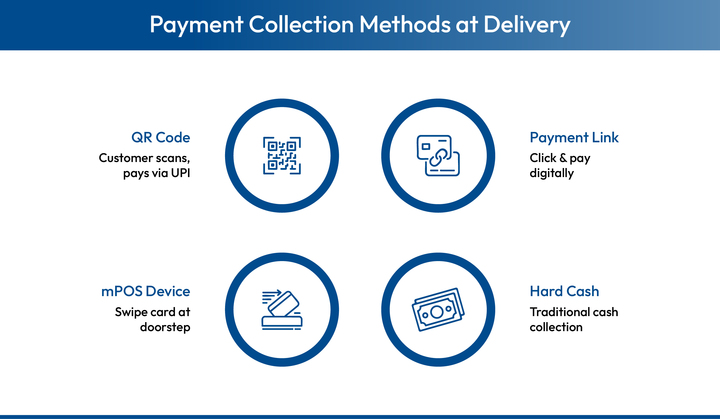
Payment Collection Methods at Delivery

Here are the primary ways brands collect payment for COD orders:
  • QR Code Payments: Delivery agents generate a unique QR code embedded with the specific order details. Customers simply scan this code to pay instantly via UPI apps, ensuring an accurate digital record for the merchant.
  • Payment Links: Merchants or delivery partners send a clickable link to the customer's registered mobile number via SMS or WhatsApp. This allows shoppers to pay using their preferred digital mode (Wallets, Net Banking, UPI) without needing a physical terminal.
  • Mobile Point of Sale (mPOS) Devices: Many logistics partners equip their fleets with handheld mPOS devices. This gives customers the option to swipe credit or debit cards at the doorstep if they are short on cash.
  • Traditional Hard Cash: The classic method where customers pay with physical currency. While still popular, it requires trained personnel to handle cash securely and manage challenges like carrying exact change.
Understanding payment collection methods is just one piece of the COD puzzle. To truly succeed with COD, you need to understand both its advantages and its challenges, which we'll explore in the following sections.

What Are the Advantages of Cash on Delivery for eCommerce Brands?

Cash on delivery offers significant strategic advantages for Indian eCommerce brands. These benefits explain why COD continues to dominate despite the explosive growth of digital payments.

Advantages of Cash on Delivery (COD)
  • Increased Customer Base: COD appeals to a broader audience, including those who may not have access to credit/debit cards or are hesitant to make online payments. This payment option widens the potential customer base significantly.
  • Market Penetration in Tier 2/3/4 Cities: In Tier 3, 4, and rural areas, COD preference reaches 90%. Due to limited banking infrastructure and lower digital payment comfort in these regions, COD is often mandatory for market access.
  • Building Trust: COD allows customers to inspect products before paying, which eliminates perceived risk. For first-time buyers or unfamiliar brands, this opportunity often determines whether they complete the purchase or abandon the cart.
  • Lower Entry Barriers: It lowers the entry barrier for customers who are wary of sharing card or bank details online due to security concerns. This contributes to a more inclusive shopping environment.
  • Competitive Advantage: In markets where most brands offer COD, not having it puts you at a disadvantage. If competitors offer COD and you don't, customers may switch brands purely for the payment preference.
  • Payment Flexibility at Delivery: COD provides flexibility, allowing customers to pay via cash, card, or UPI at the time of delivery. This convenience can improve customer loyalty.
  • Improved Cash Flow: The convenience of paying later often encourages customers to make more impulse purchases.
These advantages make COD indispensable for Indian eCommerce growth. However, every benefit comes with corresponding challenges that require careful management.

What Are the Disadvantages and Challenges of Cash on Delivery?

While COD unlocks massive market potential, it introduces operational complexities and financial risks that can severely impact profitability if not managed properly.
  • Return to Origin (RTO): This is the single biggest challenge in COD management. When customers reject orders or are unavailable, packages return without generating revenue while incurring double shipping costs (forward + reverse). With RTO rates reaching up to 50%, this issue alone can make or break profitability.
  • Delayed Cash Flow: COD settlements typically take 7–15 days after delivery, creating working capital constraints. Brands must finance inventory and shipping upfront while waiting weeks for the cash to hit their bank accounts.
  • Operational Costs & Cash Handling Risks: Handling physical cash incurs additional costs for logistics and security. It also introduces risks such as theft, mishandling during collection, and counting errors.
  • Fraud & Delivery Refusals: The COD model attracts fraudulent orders where customers provide incorrect information or simply refuse delivery at the doorstep. Non-payment due to intentional rejection leads to significant inventory and logistics losses.
  • Complex Refund Management: Unlike digital payments, where refunds are automated, COD refunds are manual and complex. Since there is no source account to credit, merchants must obtain bank details from the customer to process the return, adding operational overhead.
  • Limited Geographic Reach: Not all logistics partners offer COD services to all locations. Remote areas or specific pin codes often face restrictions or premium fees, limiting your ability to serve every customer.
These challenges require strategic COD management. The next section covers proven best practices to maximize benefits while minimizing risks.
Try Smart COD used by 10,000 brands

How to Manage Cash on Delivery Successfully? (Best Practices)

Offering COD without proper management often leads to losses. Smart brands must use strategic interventions and operational best practices to capture COD's benefits while minimizing the risks.
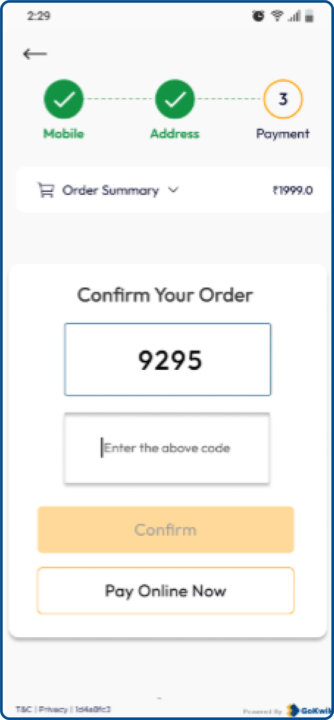
  • Implement Risk-Based Interventions: Use AI-powered risk scoring to analyze customer history, location, and order patterns. You can then apply specific rules: allow low-risk orders to flow normally, require OTP verification for medium-risk ones, and block COD entirely for high-risk users.
Verification enabled by GoKwik’s Smart COD


  • Mandate Customer Verification: Before dispatching, verify order details especially the address via WhatsApp or SMS. Incorrect addresses are a leading cause of returns, so confirming intent before shipping is crucial.
  • Incentivize Prepaid Conversion: Nudge customers to switch by offering 5–10% discounts, faster delivery, or exclusive deals if they pay online. Displaying these offers at checkout can break the "habit" of choosing COD.
    We cover more of this in our exclusive blog post on solutions to combat RTO. Check it out!
  • Adopt Partial Prepaid COD (Hybrid Model): Secure customer commitment by collecting a small percentage of the order value upfront and the rest at delivery. A customer who has paid something is far less likely to reject the delivery than someone with zero financial investment.
  • Set Order Value Limits: Protect against high-value losses by restricting COD availability to orders below a certain threshold (e.g., ₹5,000).
  • Send Post-Order Payment Nudges: Send payment links via SMS or WhatsApp while the package is in transit. Positioning this as "Pay now to skip the delivery hassle" can convert COD orders to prepaid before the courier arrives.
  • Disable COD for High-Risk Profiles: Automatically block COD for serial RTO offenders or addresses with a history of consistent rejection.
  • Partner with Reliable Logistics: Work with delivery partners who have robust cash handling processes and timely settlement cycles. Ensure their personnel are trained to use digital collection tools like QR codes and mPOS devices to minimize payment failures.
Try Kwik COD suite for your eCommerce brand

How to Start Cash on Delivery for Your eCommerce Brand?

Starting COD requires more than just adding it as a checkout option. Strategic implementation with proper risk controls determines whether COD becomes a growth driver or a profit drain.
Before launching COD, evaluate whether your business can handle the operational and financial demands. Use this checklist:

Launch COD with controls built in from day one through a phased approach that minimizes risk.
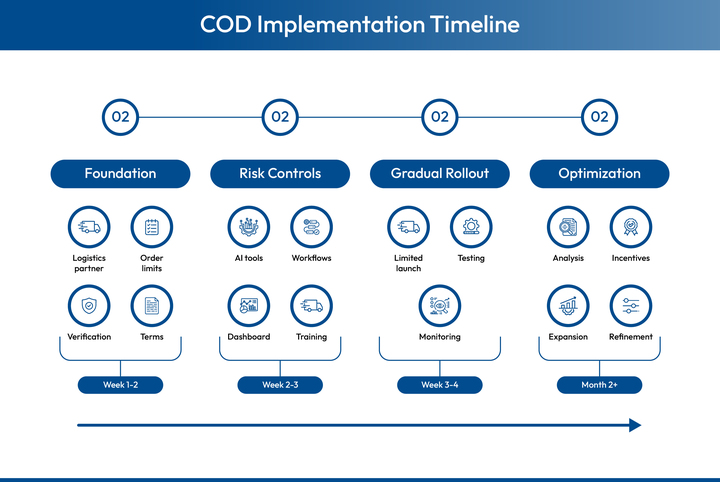
COD Implementation Timeline

Phase 1: Foundation (Week 1-2)
Select a logistics partner with COD capabilities, set conservative order value limits (e.g., ₹3,000 max), configure SMS confirmation and address validation, and establish clear COD terms.
Phase 2: Risk Controls (Week 2-3)
Integrate risk assessment tools, enable customer verification workflows, set up your tracking dashboard, and train your customer service team on COD policies.
Phase 3: Gradual Rollout (Week 3-4)
Start with limited availability in specific categories or regions. Test with low-risk customer segments first. Monitor RTO rates daily and adjust interventions based on early data.
Phase 4: Optimization (Month 2+)
Analyze RTO patterns by location, category, and customer type. Implement prepaid incentives for high-risk segments. Gradually expand COD availability and refine risk scoring based on actual performance.
While manual implementation works for getting started, scaling COD profitably requires technology that can assess risk, trigger interventions, and optimize performance automatically. That's where specialized platforms like GoKwik's Smart COD Suite transform COD from a manual burden into an automated growth engine.
Try Kwik COD for automed COD workflows

Assessment Area

Key Questions

Ready When...

Working Capital

Can you handle 7-15 day payment delays?

You have sufficient cash reserves to finance inventory and operations during settlement periods

Margins

Can your margins absorb COD fees (2-3%) + potential 30-50% RTO?

Product margins are 40%+ or you have volume to offset losses

Target Market

What % of your customers are in tier 2/3/4 cities?

50%+ of target audience is in markets with high COD preference

Order Value

What's your average order value?

AOV is high enough to absorb COD costs (typically ₹500+)

RTO Tolerance

What RTO rate can you sustain profitably?

You've calculated break-even RTO and have mitigation strategies

Logistics

Do your logistics partners support COD?

Partners have COD infrastructure and reasonable settlement terms

Transform Your COD Performance with GoKwik's Smart COD Suite

Managing COD manually doesn't scale beyond a certain point. GoKwik's Smart COD Suite combines AI-powered risk assessment, network intelligence from 180 Mn+ shoppers, and automated interventions to reduce RTO by up to 40% while maximizing conversions. The platform integrates seamlessly with your existing checkout and starts delivering results within days of implementation.
Key Features:
  • AI-Powered Risk Scoring: Analyzes 200+ buyer intent signals (RTO history, pincode, phone number aging, category-specific risk) to assign real-time risk scores to every COD order
  • 70+ Personalized Interventions: Automatically triggers appropriate actions based on risk level, from gentle confirmation prompts to OTP verification, CAPTCHA, partial COD, or complete COD blocking
  • Network Intelligence: Access to 180M+ verified shopper profiles across 10,000+ brands, instantly flagging serial RTO offenders and fraud patterns
  • Proven Results: Brands typically achieve 40% RTO reduction within 30 days of implementation
  • Real-Time Analytics: Track RTO rates by location, category, customer segment, and intervention type with comprehensive performance dashboards
  • Quick Integration: Seamless setup with Shopify, WooCommerce, Magento, and custom platforms in days, not months
Ready to transform COD from a profit drain into a growth driver? Get in touch with us today!

Frequently Asked Questions on Cash on Delivery

Conclusion

Enjoying this article? Share it with the world!
Suhag Vamja

AUTHOR

Suhag Vamja

Head of Product Marketing @ GoKwik

Suhag spearheads D2C growth strategies at GoKwik, focusing on e-commerce optimisation, conversion funnels, and sales enablement. Based in Bengaluru and an MICA alumnus, he excels in crafting GTM playbooks and marketing campaigns tailored for D2C brands.