How KwikAds helped Shop Unrush boost ROAS by 37% in 3 months
How KwikAds helped Shop Unrush boost ROAS by 37% in 3 months
How KwikAds helped Shop Unrush boost ROAS by 37% in 3 months
How KwikAds helped Shop Unrush boost ROAS by 37% in 3 months
eCommerce
7 Effective Tricks To Optimise Your eCommerce Conversions
 09 Mar 2026
 14 Min Read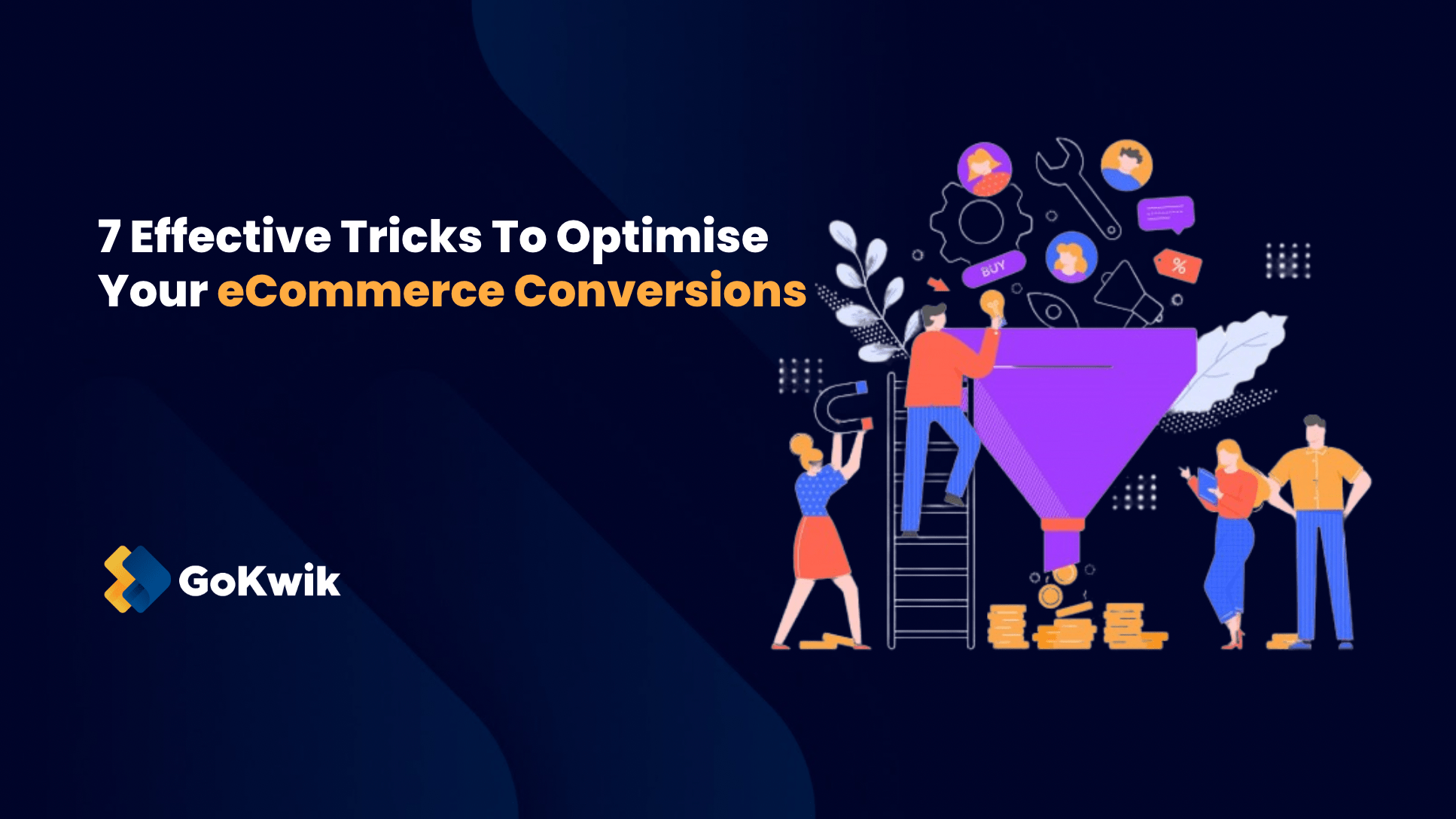
Vardhan leads product and growth initiatives at GoKwik, driving D2C e-commerce innovations, conversion optimization, and scalable growth programs for products. An ISB alumnus based in Bengaluru, he brings expertise from Unacademy, Ola, and Mahindra in building high-impact product strategies.
Read this blog on your favourite platform
Digital storefronts are abound in India. So much so that eCommerce businesses are facing a massive challenge in converting website visitors and potential shoppers into paying and satisfied customers. As eCommerce businesses are striving to maximize their online presence and capitalise on the vast potential of the digital eCommerce landscape, understanding the intricacies of optimising eCommerce conversions becomes paramount.
In this blog, we aim to unveil 7 effective tricks that promise to elevate your eCommerce brand's game, and provide actionable insights and strategies to enhance your website's conversion rates. From user experience enhancements to data-driven decision-making, each trick will prove as a valuable tool in a online brand's arsenal seeking to not only attract but also convert visitors into loyal patrons.
Let's delve into these proven techniques and unlock the key to unleashing the full potential of your eCommerce platform.
In this blog, we aim to unveil 7 effective tricks that promise to elevate your eCommerce brand's game, and provide actionable insights and strategies to enhance your website's conversion rates. From user experience enhancements to data-driven decision-making, each trick will prove as a valuable tool in a online brand's arsenal seeking to not only attract but also convert visitors into loyal patrons.
Let's delve into these proven techniques and unlock the key to unleashing the full potential of your eCommerce platform.
"eCommerce Conversion Rate = Number of Conversions X 100 Number of Visitors"
How To Turn Website Traffic Into Business Conversions?
A very technical and an important question many eCommerce entrepreneurs are constantly finding answers to is, "how to turn website traffic into conversions?"
In an ideal setting, the process of generating business from new and existing customers would run in a clockwise manner.
In an ideal setting, the process of generating business from new and existing customers would run in a clockwise manner.
- A shopper visits the website
- They navigate through the products available across various categories or according to their likes, and add select items to the cart (visit the website with the intent of taking action.)
- They then move down into the checkout funnel, fill in the necessary details, and complete the purchase, aka, result in a website conversion.
However, the notion of an idealistic world is a little different from the actual world. In reality, there are many drop-offs throughout the checkout funnel. This results in low conversions and hence, lower profitability.
At present, cart abandonment rate in India sits as high as 70% and average eCommerce conversion rate is only about 2.5-3%. This means that 7 out of every 10 people who visit an eCommerce store, abandon their cart due to any XYZee reason and only a 2 to 3.5% of the remaining traffic converts into paying customers.
But, the major questions here are,
But, the major questions here are,
- Why are shoppers leaving the website and abanonding their carts more often than ever?
- Why even after a significant amount of traffic, the conversion rate still manages to be significantly low?
- What are the effective ways that brands can utilise or leverage to increase conversions?
The section below sheds light on these questions.
Reasons Behind High Cart Abandonment Rate & Dipping Conversion Rate?
To answer the first question of why shoppers are abandoning their carts and leaving website more frequently now than ever is because of a myriad variety of reasons.
One significant factor is the rise in mobile browsing, as shoppers often switch between devices. This has lead to a disjointed shopping experience. Additionally, the complexity of the checkout process, unexpected shipping costs, and a lack of trust in the security of online transactions contribute to cart abandonment. Moreover, distractions, such as notifications or pop-ups, can divert users' attention, prompting them to exit the site before completing a purchase. To address this issue, businesses must focus on optimising user experience, simplifying the checkout process, and providing transparent information to build trust and encourage conversion.
Meanwhile, despite a substantial influx of traffic, a persistently low conversion rate usually attributes due to many interesting factors. One key element is the misalignment between website content and visitor expectations. If the website fails to deliver on what users anticipate or if the messaging is unclear, visitors may not find what they're looking for, resulting in low conversion rates.
Additionally, issues related to website performance, such as slow loading times or technical glitches, can keep shoppers from completing the desired actions. Furthermore, a lack of personalization and failure to address specific pain points such as a simple and fast one-click checkout process can contribute to low conversion rate.
Let's now dig into some effective tips and tricks to increase eCommerce website conversions and clock in high gross merchandise value (GMV).

One significant factor is the rise in mobile browsing, as shoppers often switch between devices. This has lead to a disjointed shopping experience. Additionally, the complexity of the checkout process, unexpected shipping costs, and a lack of trust in the security of online transactions contribute to cart abandonment. Moreover, distractions, such as notifications or pop-ups, can divert users' attention, prompting them to exit the site before completing a purchase. To address this issue, businesses must focus on optimising user experience, simplifying the checkout process, and providing transparent information to build trust and encourage conversion.
Meanwhile, despite a substantial influx of traffic, a persistently low conversion rate usually attributes due to many interesting factors. One key element is the misalignment between website content and visitor expectations. If the website fails to deliver on what users anticipate or if the messaging is unclear, visitors may not find what they're looking for, resulting in low conversion rates.
Additionally, issues related to website performance, such as slow loading times or technical glitches, can keep shoppers from completing the desired actions. Furthermore, a lack of personalization and failure to address specific pain points such as a simple and fast one-click checkout process can contribute to low conversion rate.
Let's now dig into some effective tips and tricks to increase eCommerce website conversions and clock in high gross merchandise value (GMV).
7 Effective Tips To Increase eCommerce Conversions?
While market behemoths like Amazon boast a 13% conversion rate, the picture for D2C players is not so pritty. According to areport, the average conversion rate of a direct-to-consumer eCommerce brand in India can be as low as 2.42%. But, this doesn't mean that one can not aim higher. This section details on how you, as an eCommerce brand, can leverage these 7 effective tips and tricks to increase your conversion rate and continue to grow business revenue at a steady pace.
#1 Create A Pervasive Interface
As per areport, the first 5 seconds of your website’s load time will have the highest impact on your conversion rate. Everyone who is visiting your website will probably end up buying your product or service if your website provides them with a good user experience.
However, a lot of eCommerce websites are failing to do just that. We understand that brands want to display their products and drive sales. However, if they do that too much, or if they don’t have a proper navigation interface in place, their conversion rate will surely be hampered.
An eCommerce website can be very appealing. However, if it is too congested and making it difficult for the audience to navigate through, they'll leave. As simple as that. End result? Dropping conversion rates even if you receive high traffc.ic.ic
To begin with, the focal aim is to pull the site visitor's eyes to a certain aspect of your website. These aspects will typically be the parts that allow them to browse through the website with the intent of engaging with the brand commercially. Needless to say, the modern consumer is more likely to connect further with an eCommerce site if they feel,
- That a brand's website is informative with organised inlaid text
- The website is easy to navigate
- the website has an alluring product catalogue that is adaptive and invites the user to take action
Make sure you have a team in place who can take care of making the overall user experience better with a pervasive interface. This will definitely help in optimizing your eCommerce website’s conversion.
#2 Ensure an Easy Navigation
Even if a brand have all the interfaces in place, if its visitors are not able to navigate through the website easily, the brand will experience drop-offs. Therefore, ensure that the brand is able to provide shoppers with an easy and seamless navigation throughout the website.
Unlike traditional brick-and-mortar stores, avoid swamping the product over the website haphazardly. To explain this further, let's take the help of an example here.
Suppose people are visiting a brand's website. However, they are not able to browse and discover what they're looking for. What will happen then? The visitors will most likely leave the website. They will then go to a competitor’s website which offers them the navigation experience they are looking for and will purchase the product(s) from there within minutes. This is not something a brand wants right? So, it's essential to improve this process.
A simple strategy could be to integrate a navigation bar that allows users to easily access the venture to the next category in the hierarchy of products. With strategic division, a brand's visitors can easily dig deeper into specific products offered within various categories.
Furthermore, an online must also ensure that the visitors are offered the most relevant product(s) relating to what they are searching for. The products or services should sustain complete information framed to sync with the customer's search queries.
#4 Offer a Seamless Checkout Experience
More than 40% of the buyers drop off while shopping because they complain of a bad checkout experience.
There are chances that an online brand experiences a high influx of shoppers on its website who're ready to make a purchase. However, they get put off by the long and time-consuming checkout process. For instance, when a shopper goes to any website to shop, they're asked to register themselves, add billing information, mobile number, email ID and other personal details.
That itself tires shoppers out the first time. Now imagine they having to do that all over again the next time as well when visiting the same online brand. Shoppers will get turned off and move to a brand that elminates the need to constantly prove the same information everything a shopper wants to place an order.
So, it's critially important for an eCommerce brand to offer a seamless checkoute experience to its shoppers to not only bag those conversions but also convert them into repeat purchasers. A fast one-click checkout has proved to be highly beneficial in also enhancing customer lifetime value and building brand advocacy in the market.
To give you an example, GoKwik via its Kwik Checkout solution, today, empowers 1200+ eCommerce brands across various categories to offer a fast one-click checkout solution to their consumers and convert them into paying, repeat customers.
The solution, backed by RTO-intelligence also allows these eCommerce brands to identify which shoppers are likely to place cash-on-delivery orders and reject them at a later stage (convert into RTOs) and put necessary inverventions to reduce bottom line losses.
So, it's critially important for an eCommerce brand to offer a seamless checkoute experience to its shoppers to not only bag those conversions but also convert them into repeat purchasers. A fast one-click checkout has proved to be highly beneficial in also enhancing customer lifetime value and building brand advocacy in the market.
To give you an example, GoKwik via its Kwik Checkout solution, today, empowers 1200+ eCommerce brands across various categories to offer a fast one-click checkout solution to their consumers and convert them into paying, repeat customers.
The solution, backed by RTO-intelligence also allows these eCommerce brands to identify which shoppers are likely to place cash-on-delivery orders and reject them at a later stage (convert into RTOs) and put necessary inverventions to reduce bottom line losses.
A potential customer is only lost if a brand lets them. With correct strategies, online brands can reduce teh risk of cart abandonments and turn these opportunities into business revenue.
#5 Make Online Payment Easy
Besides offering a seamless checkout experience, payments is another arena where brands need to pay much attention. As India has moved towards digitisation and the options to pay digitally have significantly increased, offering the right and most preferred online payment options has become necessary. UPI, net banking, debit/credit card payments, digital wallets, and PayLater are some common modes of payment that an eCommerce brand must provide to their shoppers.
However, beyond giving a plethora of options, online brands must also minimalise this step as well. Meaning, if a shopper plans to pay via UPI, don't make them juggle between apps. Rather, reduce the number of steps and ensure the process completes in a matter of seconds.
Keeping the online payment process to minimal steps helps increase conversion rate significantly. Create a user interface that facilitates easy payments for shoppers. GoKwik’s Kwik Pay enables eCommerce brands to offer a seamless payment experience for shoppers and increase conversions.
#6 Try To Reduce RTO
A lot of times it's seen that while brands witness a high conversion rate, they also see an increase in RTOs or return to origins.
RTO refers to a situation wherein a shopper places a cash on delivery (COD) order and cancels it or rejects the same at the time of delivery. In such a case, a brand not only loses on that conversion bagged, but has to incur additional cost in getting the order back to the warehouse with an anticipation of least damange to the product and good condition. In India alone, the rate of RTO is as high as 30%
RTO refers to a situation wherein a shopper places a cash on delivery (COD) order and cancels it or rejects the same at the time of delivery. In such a case, a brand not only loses on that conversion bagged, but has to incur additional cost in getting the order back to the warehouse with an anticipation of least damange to the product and good condition. In India alone, the rate of RTO is as high as 30%
But, the major question is, "how to reduce RTO owing to COD orders?"
Considering that cash dominates the eCommerce market with 60% continution coming from cash, it's impossible to remove cash as a payment option altogether. However, brands can integrate a system in place that analyses consumer behavioural patterns and flags high-risk orders. After that, they can decide whether or not to process the COD-led order or charge consumers an extra amount to build a wall of security for the business.
Considering that cash dominates the eCommerce market with 60% continution coming from cash, it's impossible to remove cash as a payment option altogether. However, brands can integrate a system in place that analyses consumer behavioural patterns and flags high-risk orders. After that, they can decide whether or not to process the COD-led order or charge consumers an extra amount to build a wall of security for the business.
Another way is to offer discounts and other incentives on online payments. This way, brands can motivate shoppers to pay through an online payment mode. End result? Reduced RTO and increased prepaid conversions.
GoKwik's Smart COD Suite enables eCommerce brands to embed many such interesting interventions pre- and post-order to reduce the risk of RTOs and enjoy the profit margins.
GoKwik's Smart COD Suite enables eCommerce brands to embed many such interesting interventions pre- and post-order to reduce the risk of RTOs and enjoy the profit margins.
#7 Offer A Strong Support Team
A brand's work doesn’t end after they've successfully managed to optimise their conversion funnel and increased conversion rate. They must also retain and grow that conversion number. In order to do that, eCommerce brands must put a strong support team in place. A customer who is offered continuous support will be the one who will help increase your conversion rates. So, ensure to keep customers happy throughout their shopping experience and beyond that too.
How The Man Company Increased Its Conversion By 25%?
The Man Company is one of the leading pioneers in the men’s grooming industry. Having over 30% share in the beard grooming market, they have a wide range of quality products including beard, body and face care along with fragrance and other products.
Every D2C brand strives to optimize its eCommerce conversions. That’s what The Man Company strived to do as well. Facing the issue of multiple dropoffs throughout the shopping funnel and preference of customers inclining towards cash on delivery, they wanted to set up a system in place that decreased drop-offs, facilitated online payments and boosted conversion with RTO protection. That’s when they decided to collaborate with GoKwik.
Gokwik offered an overall suite of seamless checkout, one step UPI payment and RTO protection using a smart and smooth user interface along with an AI/ML-enabled algorithm tailor-made just for The Man Company.
End result? Their conversion rate soared by 25% and continues to see an upside graph. Moreover, the prepaid orders also increased by a whopping 40%. The Man Company is experiencing success like never before with GoKwik.
Wrapping It Up
eCommerce conversion can be tricky. However, with the right tools, infrastructure, direction and partners in place, online brands can easily move this business metric in a positive direction and reap benefits.
Start with creating a blueprint of what is the current status of one's conversions, map out the reasons behind low conversion rate, and follow the right steps to fix the issues. Collaborate with a partner like GoKwik that can help solve these problems and also unlock 10 business GMV.

AUTHOR
Vardhan Jain
Director of Product Program @ GoKwik
Explore Related Blogs
Kwik Engage
8 Best AI Chatbots for E-Commerce in 2026: Features, Pricing and Best Fits
28-Apr-202614 Min Read
Kwik Engage
24 Types of Emails Every D2C E-Commerce Brand Should Send
14-Apr-202614 Min Read
Kwik Engage
What is Promotion Mix and How E-commerce Brands Can One for Maximum Sales?
13-Apr-202614 Min Read