How KwikAds helped Shop Unrush boost ROAS by 37% in 3 months
How KwikAds helped Shop Unrush boost ROAS by 37% in 3 months
How KwikAds helped Shop Unrush boost ROAS by 37% in 3 months
How KwikAds helped Shop Unrush boost ROAS by 37% in 3 months
eCommerce
The Role Of Technology In Enabling D2C eCommerce Growth
 25 Mar 2026
 09 Min Read
Atul leads marketing at GoKwik, championing D2C brand building, growth strategies, scalable GTM for e-commerce, and data-driven customer acquisition. A former Amazon leader and IIFT MBA alumnus based in Bengaluru, he brings 15+ years scaling business across e-commerce, and fintech.
Read this blog on your favourite platform
Globally, the surge in D2C eCommerce is evidence from the fact that brands are now increasingly understanding the value of selling to customers, directly. According to a report published by KPMC, the Indian D2C eCommerce market is predicted to reach USD 60 billionby the end of FY 2027 by growing at a CACG of about 40%. This means no more resellers; companies are now working towards establishing a bond with the customers directly. And, technology has made of this possible. D2C technology has and is still empowering eCommerce businesses to set up and manage their online stores independently with ease and scale at an exponential rate.
In this blog, we aim to dive deep into how technology is aiding in the growth of D2C eCommerce along with many interesting examples.
Let's get started!
Let's get started!
How Is Technology Empowering The D2C eCommerce Growth
With scalability, personalisation, and freedom to market how they want, D2C eCommerce is an empowered way to do business. With digital transformation and a multitude of capabilities, here are the different ways technology is helping build the direct-to-customer eCommerce business landscape.
1. Selling Online Across Markets
Today, D2C businesses can easily leverage various types of technologies to scale their operations. For instance, budding brands can quickly set up their online stores on Shopify, WooCommerce, Magento, or any other platform by simply leveraging ready-to-use templates. They can have their stores up and running within a matter of days, depending on the complexity of the website.
Having such technology by their side helps D2C brands expand their market horizons exponentially and even unlock global avenues while sitting in any part of the world. Furthermore, technologies like WhatsApp Commerce equips brands to grow their customer reach to even the remotest of areas of the country and cater to their needs effectively and efficiently. Brands can set up corresponding payment gateways to handle the international market and even manage inventory on the go alongside offering quick support assistance to consumers.

2. Market Their Brand Better
Reaching to the right target audience to market better is essential for D2C brands and it's easier with today’s myriad variety of technology-led tools. D2C eCommerce businesses can build an online presence through different social media platforms like Instagram, Twitter, Facebook, and TikTok.
They can create content that resonates with the user such as crafting compelling images, videos, and posts that help the users understand the brand USP, and convert into a paying customer. Brands can also utilise the power of influencer partnerships and connect with influencers in their niche that align with their values. This provides more reach and helps drive sales.
Here is a look at BlissClub’s Instagram account. They started in 2020, but have grown in sales by 25X in 2021 alone by approaching marketing the right way. Their Instagram account, which has over 200k followers, is filled with helpful guides, product videos, customer testimonials, and influencer-collaborative content.

Another media platform that D2C brands can utilize is the good old CTV (Connected TV) ads. Xavier Meirer, Director of Brand Management at Nice Brands, said, “Traditional media forms have rotated back into the fold of needle-turning best practices. Direct mailer campaigns and TV spots are currently trending in the D2C landscape.” It allows D2C brands to find a targeted audience through wide media attention.
But it’s the technology that is helping these brands consistently create and maintain their presence on so many digital platforms – think about content creators, automation tools, schedulers and similar technology.
3. Take Orders Easily
17% of shoppers have abandoned orders because of complicated or long-drawn checkout processes. Direct-to-consumer eCommerce businesses can make this process easy by reducing the steps required to make a purchase using technology.
To do this well, they can:
- Allow customers to checkout as guests instead of signing up and complicating the process
- Reduce friction by reducing the number of forms filled and only asking relevant data
- Offer a range of payment options such as credit cards, debit cards, digital wallets (e.g., PayPal, Apple Pay, Google Pay), and bank transfers
- Provide clear and concise product information, final pricing, shipping, and return policies
[youtube id="u6e7rz2AHmE"]
4. Streamline Internal Operations
Managing inventory and maintaining the right delivery schedule manually is a tedious and error-prone process. This can lead to delivery delays and unhappy customers. A study found that if customers do not receive their order within two days of the delivery date, 69% of the customers will not purchase from the brand again.
To avoid such situations, D2C eCommerce brands can use an Order Management System (OMS) to help track all the products and manage inventory. This prevents businesses from overselling a product and then canceling the order – instead, they can know when a product is running low on stock and update the inventory. It also helps them trigger replenishment for the products that are out of stock.
Technologies in eCommerce such as an OMS also helps D2C businesses to route orders to warehouses, automate the shipping process, and provide real-time shipping information to customers. It also helps customers make easy return or exchange requests, and brands can fulfill them without hassle.
5. Helps Keep Return To Origin (RTO) Problems At Bay
Many businesses suffer from the problem of returning to origin (RTO), which can result in significant losses due to the need for repackaging, product damages, and added delivery costs. It’s a frustrating issue that affects the bottom line of many companies, and finding a solution is crucial for continued success. While providing the option to return products is essential for businesses to satisfy customers, in several instances, such situations can be avoided, and eCommerce technologies can help in the process.
- Authenticate the user’s address by email and message before delivering; products like Gokwikcan help and also auto-correct address mistakes.
- Automatically notify customers when their delivery is on the way so that the products reach when the customers are available, avoiding returns
- Use data analytics to understand why products are returned. This helps brands identify patterns that help them make corrections for product quality, internal mistakes such as the delivery of wrong orders, and delivery promptness.
- Empower customers by self-service capabilities with auto updates of the order at every stage, such as when it is shipped and out for delivery – improving customer experience.
- Use technology to gather customer feedback through WhatsApp messages, emails, or in-app prompts. This will help brands understand where they need to improve.
[youtube id="AHqbQOiQ29s"]
6. Provides Personalised Experiences
Customers want to feel a connection with a brand, and71% of customers expect them to deliver personalised interactions. This level of customisation is so pivotal that it can even lead to frustration for 76% of customers when it’s lacking.
D2C eCommerce brands can use technology to collect customer data and understand their purchasing behaviour. It helps them provide personalised messages, product recommendations, and offers to individual buyers.
For example, brands can use email marketing technologies to help segment customers based on customer attributes and tailor each email to each customer.
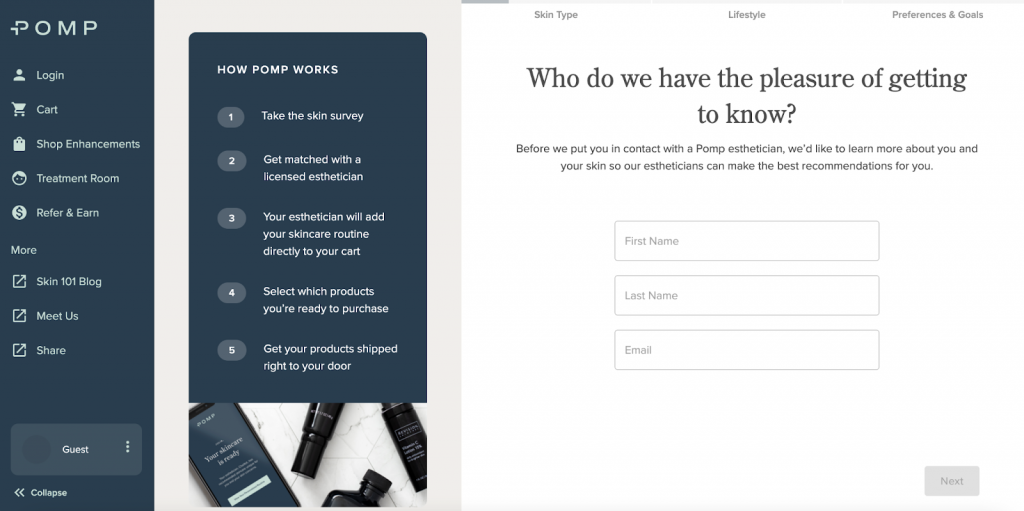
Another example is of the experience they deliver on websites. Brands can also provide personalised experiences on their website. Here is an example by a D2C skincare brand, Pomp. They ask customers to take a survey on their site; this helps them recommend products that are unique to the customer’s needs.
7. Understand How To Grow With The Changing Times
Running a D2C eCommerce brand is beyond manufacturing products and advertising them. Businesses need to understand market fit and look at the possible opportunities to grow and advance.
Brands need to understand the right buyer persona, which isn’t just about identifying the location, gender, and age. It has to be deeper and about purchasing habits and demand. D2C brands can utilise technology to dig deeper into the audience insights available to them through market research.
Let’s explain this with an example. Rimowa is a luxury luggage brand that started in 1898, and in 2020 due to COVID and lack of travel, their brand suffered too. From customer demand, the brand realised that local travel was increasing and luggage was not the only travel item they needed when the world started returning to normalcy. Rimowa launched several other products, such as handbags, sunglasses, iPhone cases, and other travel accessories.

They expanded their marketing efforts and launched NFTs. They launched digital wearables, as seen in the image below, as part of their NFT Campaigns. Furthermore, they also ramped up their presence on social media.
Rimowa CEO Alexandre Arnault says, “Like our product expansions that cater to the full spectrum of traveler experiences, the adjustments we’ve made to our retail spaces have also been to enhance the experience of the brand,”
This brand understood the market and realized they needed to make changes and capitalize on existing opportunities. They gave the brand a more relatable and fun identity, transforming its century long perception. But this can only be possible when your brand is able to proactively monitor and analyze market trends, changes and audience behavior.
Keep Up With Changing Times By Embracing Technology
The rise in Direct to Consumer (D2C) commerce shows the importance of connecting with customers, and technology is a catalyst in this process.
With ecommerce technologies, businesses can understand customers better, decipher purchasing and behavior patterns and fulfill orders better. This leads to strong relationships with customers and improves brand loyalty.
If you are ready to win customers and improve conversions with technology, schedule a call with GoKwik to uncover solutions that leading brands are embracing to scale their business.
What is D2C technology?
D2C technology refers to digital tools and platforms that help direct-to-consumer brands in India sell products online efficiently. It encompasses solutions like GoKwik's AI-backed checkout, RTO protection, and payment orchestration to boost conversion rates and improve the shopping experience for Indian consumers.
What does D2C stand for?
D2C stands for Direct-to-Consumer. This business model allows brands to sell products directly to Indian customers online, bypassing traditional retail channels. It offers greater control over branding, customer experience, and pricing. Leveraging D2C technology is crucial for brands looking to build stronger relationships with their audience and achieve scalable growth in India.

AUTHOR
Atul Bansal
Head of Marketing