How KwikAds helped Shop Unrush boost ROAS by 37% in 3 months
How KwikAds helped Shop Unrush boost ROAS by 37% in 3 months
How KwikAds helped Shop Unrush boost ROAS by 37% in 3 months
How KwikAds helped Shop Unrush boost ROAS by 37% in 3 months
eCommerce
5 Tips On How To Increase ROAS For Your D2C Brand
 05 Feb 2026
 13 Min Read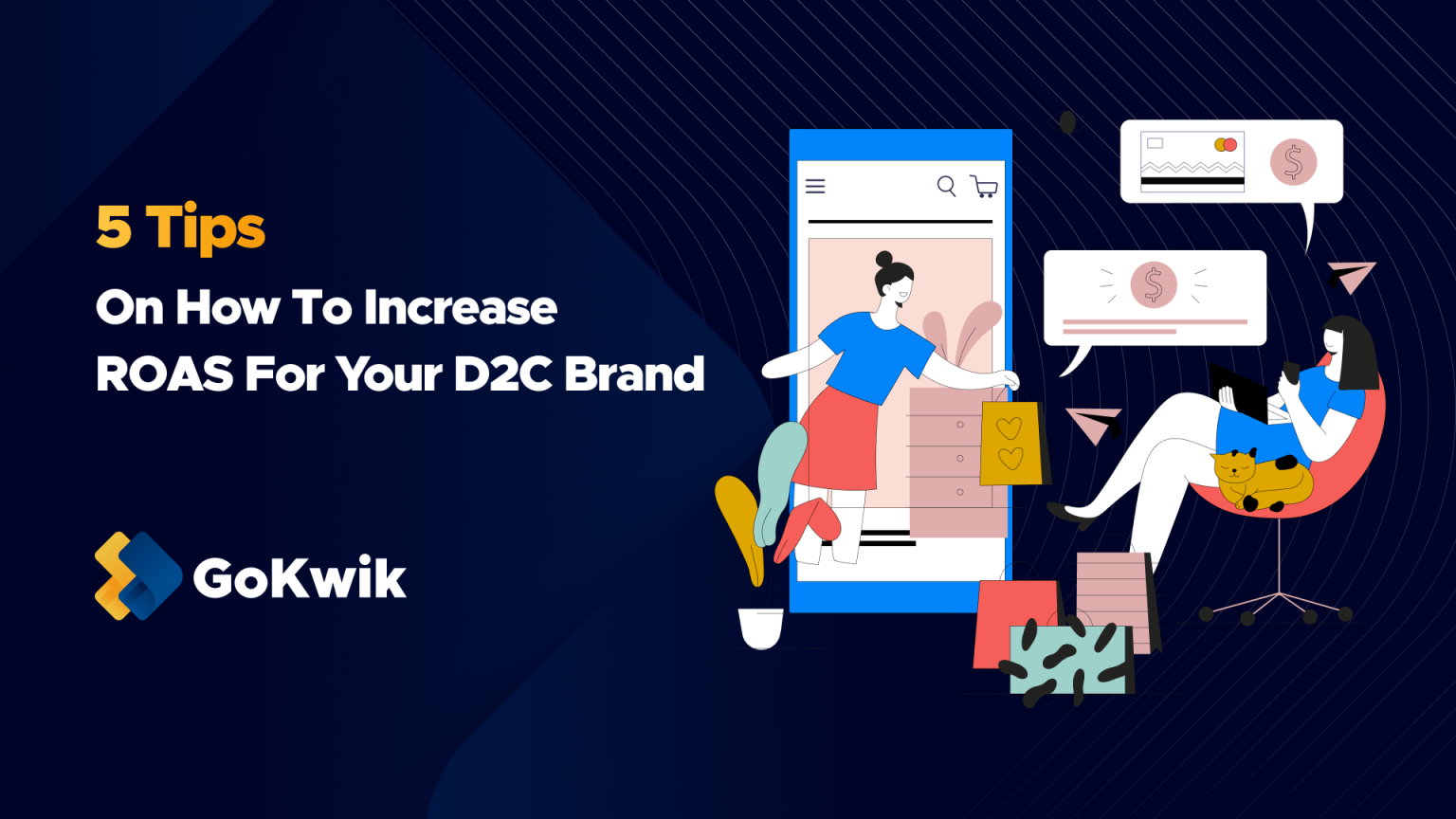
Atul leads marketing at GoKwik, championing D2C brand building, growth strategies, scalable GTM for e-commerce, and data-driven customer acquisition. A former Amazon leader and IIFT MBA alumnus based in Bengaluru, he brings 15+ years scaling business across e-commerce, and fintech.
Read this blog on your favourite platform
What happened when the historic COVID-19 pandemic forced businesses to shut down their stores? They discovered a whole new world of possibilities with the world wide web. Amidst the many industries that saw an economic slowdown during this period, the eCommerce industry boomed exponentially. Many businesses established their own direct to consumer (D2C) websites and are now catering to a broader audience base than before. However, this also meant spending high on online advertising to get new customers and even retain old ones. While the ad spends have increased significantly, marking 32% growth in 2022 and 40% in 2023, there has been a substantial increase in ROAS (return on ad spends) as well.
But what is ROAS? How can D2C brands increase return on ad spends amidst stiff online competition to scale, increase conversions and reduce customer acquisition costs? In this blog, we’ll touchbase on these important aspects.
Let’s get started.
What is Return On Ad Spends (ROAS)?
ROAS, short for return-on-ad-spends, is a means to measure the performance of a paid media campaign. Ideally, ROAS is an excellent technique to measure how efficiently you’re spending your money on a specific channel and whether or not you’re gaining any returns on it. It allows you to track and compare the effectiveness of your ad campaigns such as whether or not you’re,
- Creating the right set of ads and ensuring relevance
- Reaching the right target audience
- Using the right mediums to advertise your brand
Besides these, measuring ROAS data is also helpful because, unlike other marketing techniques, it tracks conversion rather than just counting clicks.

How To Calculate ROAS?
The formula to calculate ROAS is fairly simple – divide the total revenue earned by the total amount spent on advertising.
Return-on-ad-spends (ROAS) = Total revenue earned / Total amount spent on advertising
To give you an example, if you’ve spent INR 20,000/- on a paid campaign and you earned a revenue of INR 60,000/-, your ROAS ratio would be 3:1 This means, for every rupee you spent on the advertising campaign, you earned a revenue of INR 3/-.
Conceptually this seems like a doable thing. But is it so? How to maximise your ROAS in 2023? Let’s take a look.
1. Optimise Your Ad Cost
Textbook logic states, “always spend less on your ads.” But, in today’s scenario, it’s just the opposite. The more spent on advertising, the higher shall be your customer acquisition and conversion chances. To give you an example, D2C beauty brand SUGAR Cosmetics spent almost 32% of the company’s total expenses on online promotions and advertising in 2022. This was nearly 184% higher than what they spent in 2021. Meanwhile, the meat delivery company Licious too spent 70% higher in 2021 than the previous year.
That’s because, the more you spend on online advertising, the higher the chances of your D2C brands’ discoverability in the Indian market. Spreading brand awareness in the market is increasingly becoming the key to generating higher conversions and revenue rates.
However, spending blindly is also not something that you should do. Act smart. Utilise different tactics to keep your hard-earned money from going down the drain. Here are some ways to do so.
A. Target the right audience
When planning to run ad campaigns, the first thing to do is to map out your target audience. The logic is simple, the more targeted your ads are, the higher shall be the return on your ad spends.
To give you an example, if you’re a D2C company that sells beauty products for men, then identify users based on geo-location, devices, demographics, etc. Segment these identified users into different buckets. Once done, create ads and landing pages that resonate with each of these segmented buckets.
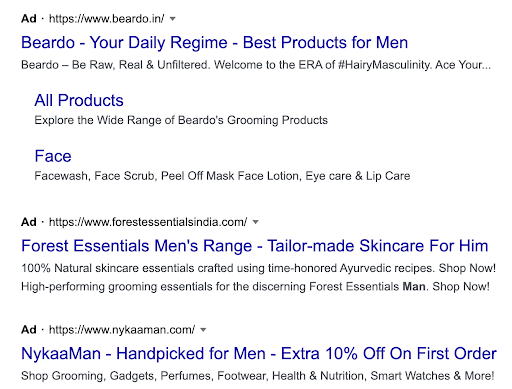
Segmentation helps improve many aspects of your advertising campaigns including
- Google Quality Score
- Click-through rate (CTR)
- A user’s landing page experience
B. Regularly Experiment With Your Bidding Strategy
The odds of you creating a winning advertising strategy in one go are quite low. And, if you do, the chances of that strategy working on different platforms like Facebook, Google, etc. are quite low. Hence, always keep modifying your strategy. Try to align each of them based on your target audience and the platform you’re choosing to run ads on. Keep A/B testing your,
- Ad design
- Ad copy, especially the headline
- Placement of the ad
- Call to action (CTA) buttons
- Your unique value offer(s)
Meanwhile, if you’re running on a tight budget, aim for a lower position in the search results, especially in the case of Google Ads. This is because by even appearing in the third position on SERP, you’ll earn the visibility that you were aiming for. This will cost less, yet be right in front of your targeted eyes.
C. Keywords Matter
Keywords play a very important role in today’s time. The more keyword-optimised your ads are, the better your ad will perform. Meanwhile, find and remove keywords that don’t match your performance standard and ad topics.
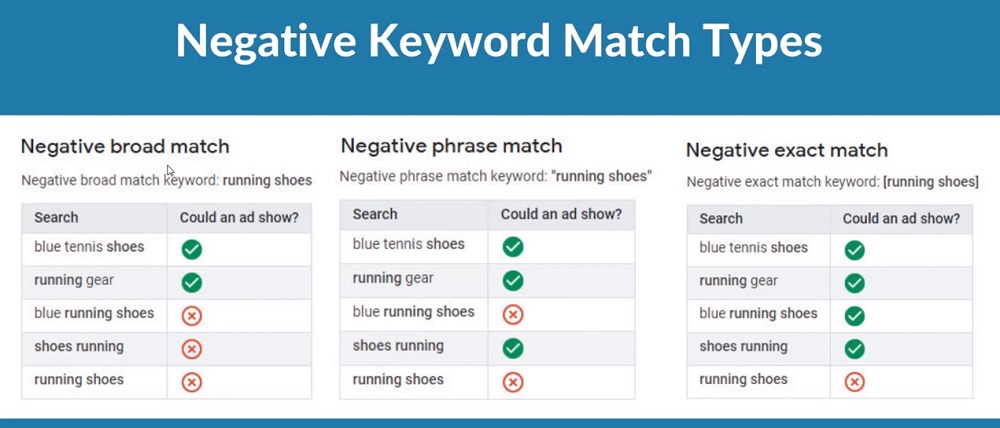
Negative keywords are a type of keywords that can prevent your ads from being triggered by some words or phrases. With negative keywords in your ads, they’re not shown to people who may be searching for that phrase.
Getting rid of these negative keywords will free up your ad spend and lower your cost-per-click as well.
2. Optimise Your Landing Pages
Another tip on how to increase ROAS is by optimising your landing pages.
The entire agenda of running ads on various platforms including Facebook and Google is to bring potential leads to your site and convert them into customers. Landing pages serve as your site’s storefront informing and enlightening prospects about your business’s offerings and giving them a path to connect with you.
If your landing page or storefront is not optimised to answer the basic questions of these prospects, your money spent on running ads will go down the drain. Always remember, your primary objective must be to connect your advertisements to relevant post-click experiences.
Listed below are 3 ways to make your landing page more relevant and impactful to bag conversions.
- Personalise – Personalise your landing pages in a way that not only matches a prospect’s pre-and post-click experience but also appeals to their needs and goals. Doing this will surely increase your return on ad spends.
- Pay Attention To Page Speed – Speed is a very critical factor with respect to a good user experience. If your landing page’s load speed is low, the chances of bounce rate increase exponentially. Your website’s ideal load speed must be 2 seconds or less to ensure high engagement and hence, resulting ROAS.
- Customize Your Checkout Experience – Besides the above-mentioned two factors, focus on offering a seamless checkout and payment experience. To give you an example, boAt offers a smooth checkout flow powered by GoKwik. Quick login and address pre-fill features along with easy discount discoverability and preferred payment options allow buyers to complete their entire purchase within a matter of seconds.
3. Focus On Increasing Customer Lifetime Value
As a known fact, always keep your customers close and intact. Why? Because your best customers are the ones you already have that not only cost less to retain but help get new customers onboard at a way cheaper price. And, since they’ve already bought from your brand once, retargeting them via ads can convert them into brand loyalists as well.
So, as a part of your ‘how to increase ROAS’ strategy, retarget your existing customers to increase customer lifetime value (CLV).
CLV refers to the average revenue a brand generates from a customer throughout the latter’s lifespan.
While creating ads for Facebook, Google or ad platforms, consider the following methods to increase CLV.
- Use Cookies and Meta pixels to track the visitors that left your site without converting into paying customers. Use retargeting methods to win them back
- Run rewards and loyalty programs to encourage customers to make more desired actions
- Opt for upselling and cross-selling. Give your customers bundled products, complimentary gifts, free shipping, or temporary upgrades to encourage more orders. This will help increase average order value, overall revenue and high ROAS
4. Observe Your Competitor’s Strategies
There’s a very famous saying, “If you can’t crack the code, become a copycat.” Meaning, your competitors are also using campaigns and pay-per-click advertising to increase conversions. If you’re sceptical about your strategy, borrow some of their PPC campaign ideas.
Though there’s no way to check ROAS from their campaigns, you can surely study where they’re advertising. Use tools like SimilarWeb, SemRush etc, to find out the networks that your competitors are leveraging. Such tools will surely give you a head start.
Besides, doing so also comes with many benefits. For starters, studying competitor strategy will tell you how they’re approaching their target audience. You can also study their ad copies and get ideas about how you can craft your campaigns more attractively and convincingly.
Meanwhile, you can also check the channels where they’re spending the most. For instance, if you’re looking for ways how to increase ROAS on Facebook, but your competitor is promoting campaigns on Google, then you can explore this channel for your ad campaigns as well.
5. Choose The Highest Converting Ad Platforms
Last (but not least) tip on how to increase ROAS is to choose the highest converting ad platform for your D2C advertising needs.
One thing’s for sure. This is not a one-size-fits-all game. Every business runs on some specific value proposition and has a different target audience, geography, demography, etc. and hence, all ad channels cannot be the right fit. Hence, identifying the right channel that can maximise your ROAS is important.
For instance, if you’re a beauty or fashion brand, running ads on Twitter may not be a very good idea. Meanwhile, using Instagram or Facebook to target your prospects might yield better results.
Listed below are some platforms that have shown good results across various domains. So, here’s a snapshot of the most used ad platforms and when you can or should use them.
1. YouTube | Google Ads
At present, YouTube India is accessed by 467 million users. This platform is ideal for D2C brands who wish to demonstrate their products to their customers. For instance, it’s an excellent platform to advertise your ‘how-to videos,’ ‘DIY videos,’ ‘product discovery videos,‘ and more. It’s also a great platform for you to provide guidance to customers, such as if you’re promoting your courses. YouTube is increasingly becoming the go-to channel for many D2C brands.
As seen over the years, the search intent of YouTube and Google are highly specific and they offer a more targeted approach than other social channels. They also make conversions incredibly easy. Use the right keywords here and you’ll surely reach the right target audience and get more ad clicks from relevant people.
2. Facebook
Even though many other social media channels have proved their worth, Facebook continues to be the place where people build relationships. Using this platform to run ads and connect with your audience can be highly effective and fruitful.
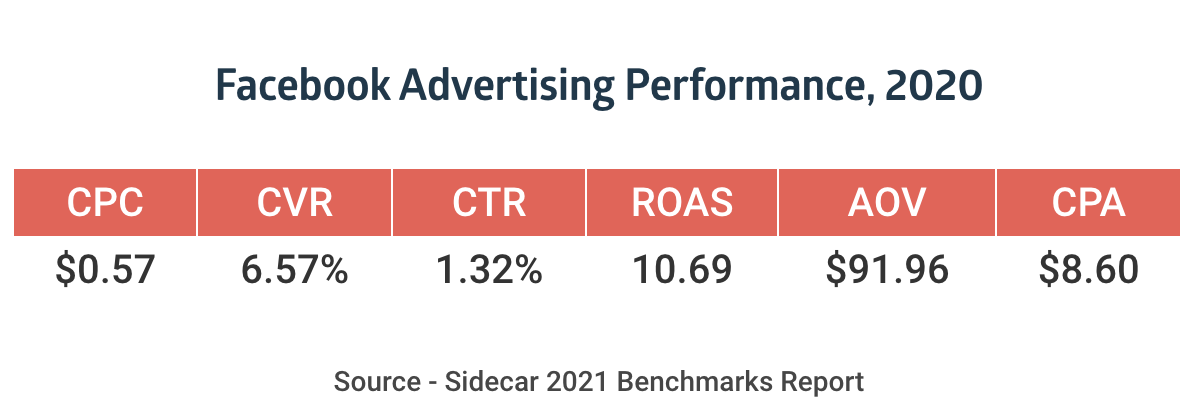
Facebook ads help capitalise on,
- Building consumer relationships
- Brand and product discoverability,
- Building buying interest
- Maximising return on advertising
Meanwhile, Facebook meta pixels further help brands evaluate the success of their campaigns. By simply integrating FB meta pixels on your website, you can track the exact stage where people enter your site, the journey they follow, and even where they drop off.
GoKwik helps D2C brands integrate and fire FB meta pixels on their websites to get deeper insights, understand the lags, and optimise campaigns to achieve better ROAS results.
3. Instagram
At present, India is home to 230.5 million Instagram users. It’s emerging as the youth social platform and an ideal site for advertising tangible things, such as fashion, beauty, health, food, auto, and more. Basically, everything that has to do with visible results.
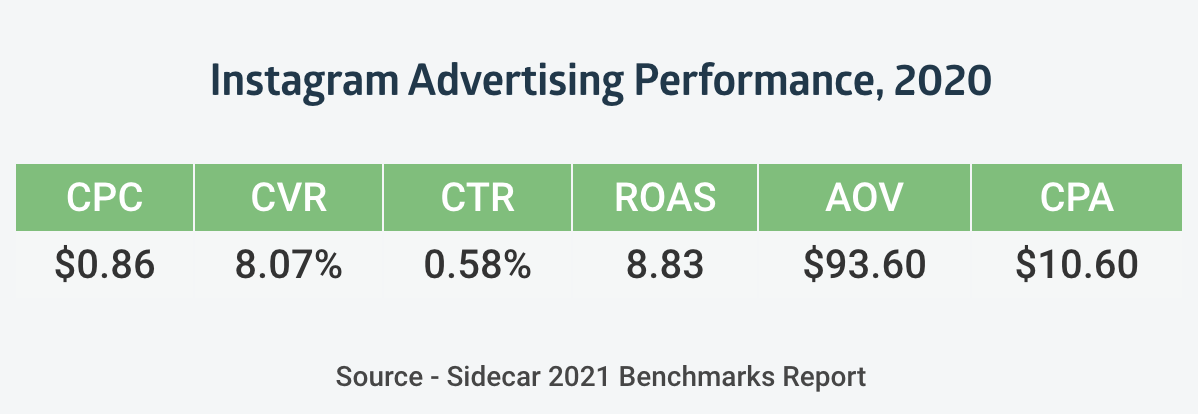
The idea of shot videos with effectiveness is what entices the buyers and increases the chances of conversions as well. In fact, Instagram today is also serving as the go-to place for budding companies to bag maximum orders and generate high revenue.
4. Google Ads
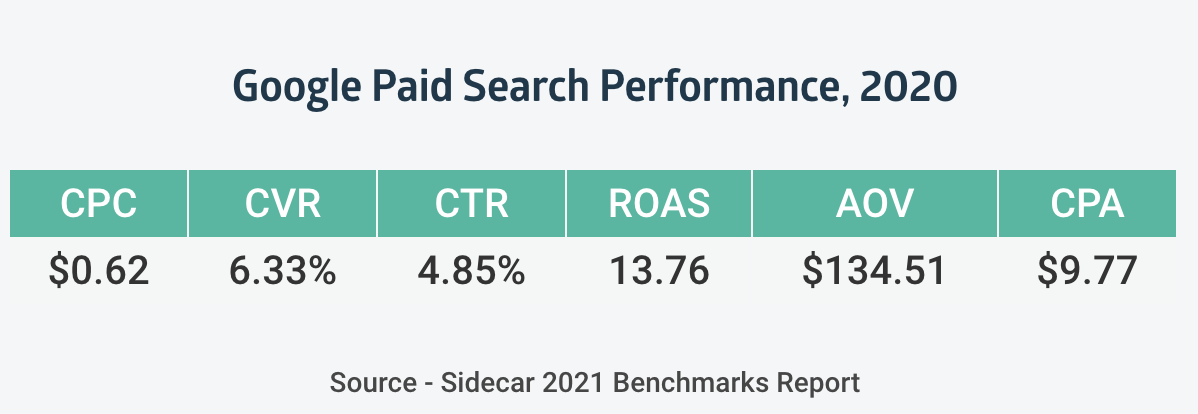
This is practically the most common of all platforms used by all eCommerce brands. Running ad campaigns on Google via its pay-per-click (PPC) model has proved most effective, time and again. Just to give you an example, spending money on high-converting terms than general keywords paid off quite well for the brands in 2020. Meanwhile, conversion rate, click-through rate, and ROAS are all high when the right keyword-infused campaigns are run on Google
Conclusion
ROAS, or return on ad spend, is a very tricky game. While the components involved may seem simple, following the nitty gritty can help your brand bag success. Rigorously following these 5 tips can significantly help to increase your D2C brand’s ROAS, increase conversions and decrease customer acquisition costs exponentially.
Frequently Asked Questions
How is ROAS different from ROI?
ROAS or return on ad spend means the gross revenue a brand generates for every penny they spend on online advertisement activities. Meanwhile, ROI or return on investment refers to the amount of money you earned after deducting all your business expenses.
ROAS = Total revenue earned / Total amount spent on advertising
ROI = [(profits – costs) / costs] x 100
ROAS = Total revenue earned / Total amount spent on advertising
ROI = [(profits – costs) / costs] x 100
What is a good or average ROAS?
ROAS is different for every business and across various industries. However, the average return-on-ad-spend in the eCommerce industry is a 4:1 ratio. Meaning, every INR 1/- spent on ads yielding INR 4/- worth of revenue is termed as good ROAS. The higher the ROAS, the better it is. Meanwhile, if your return on advertising spent dips beyond your budget, it’s time to change your ad strategies.
Is Return On Ad Spend Better Than Click-Through Rate?
Ideally, return on ad spend (ROAS) and click-through rate (CTR) work in tandem. CTR refers to the percentage of people who click on your ad divided by the total number of impressions.
CTR tells you the following things about the performance of your ad.
– Keyword or search term relevance
– How engaging or well-targeted are your ads
– The attractiveness of your ad, especially in the case of display ads
Consider CTR as a troubleshooting metric that helps you find and fix problems, and create better ad campaigns.
CTR tells you the following things about the performance of your ad.
– Keyword or search term relevance
– How engaging or well-targeted are your ads
– The attractiveness of your ad, especially in the case of display ads
Consider CTR as a troubleshooting metric that helps you find and fix problems, and create better ad campaigns.

AUTHOR
Atul Bansal
Head of Marketing