How KwikAds helped Shop Unrush boost ROAS by 37% in 3 months
How KwikAds helped Shop Unrush boost ROAS by 37% in 3 months
How KwikAds helped Shop Unrush boost ROAS by 37% in 3 months
How KwikAds helped Shop Unrush boost ROAS by 37% in 3 months
eCommerce
How Sustainable Commerce Is Shaping The Future of Commerce
 06 Mar 2026
 11 Min Read
Vardhan leads product and growth initiatives at GoKwik, driving D2C e-commerce innovations, conversion optimization, and scalable growth programs for products. An ISB alumnus based in Bengaluru, he brings expertise from Unacademy, Ola, and Mahindra in building high-impact product strategies.
Read this blog on your favourite platform
More and more companies are including sustainability in how they do business, partly because of new rules on reporting environmental, social, and governance (ESG) issues, and because people care more about the environment and society. But what do sustainable commerce and sustainable eCommerce really mean, and why is it important for businesses?
In this article, we'll talk about what is sustainable commerce, why it is good for businesses, and the best ways to do it.
What Is Sustainable Commerce?
We find ourselves in an age where environmental problems are growing. Now, more and more people are in search of sustainability to fight (against) such negative effects on the environment. Sustainable commerce seeks to minimise the negative effects of doing business on the environment.
It considers the life cycle of the entire business activity, such as production and disposal. The aim is to lower the company's carbon footprint. Eco-friendly packaging, better material sourcing, and recycling plans are some practices that are seen in sustainable commerce.
The Growth Of Sustainable Commerce
85% of consumers have already shifted their purchasing behaviour toward more sustainable choices, with 72% globally saying they actively buy more eco-friendly products. Reinforcing this shift, aPwC 2024 Voice of the Consumer Survey found that over 80% of consumers are willing to pay more for sustainably produced goods, with some ready to pay a 9.7% premium.
According to Shorr's 2025 Sustainable Packaging Consumer Report, 90% of consumers are more likely to buy from brands that offer eco-friendly packaging, and 54% of US consumers consciously chose products with sustainable packaging in the past six months. Meanwhile, 43% are now willing to pay a premium specifically for sustainable packaging, a meaningful evolution from earlier years.
A Bain & Company consumer survey found that 64% of consumers in India say their concerns about climate change have intensified over the past two years. Separately, a 2025 study on urban Indian shoppers found that 46% often choose eco-friendly and socially responsible brands, with FMCG leading as the top category where sustainable commerce drives purchase decisions.
- 78% of consumers now consider sustainability important when making purchase decisions, and 55% globally are willing to pay more for brands that actively work to improve their environmental impact.
- Products marketed as sustainable are growing 2.7 times faster than conventional products, with 63% of companies reporting revenue growth after implementing sustainable practices.
- According to a 2025 Specright survey, 80% of consumers are more likely to trust companies that openly share data supporting their sustainability claims, while 40% feel uncomfortable buying from brands not actively pursuing sustainability goals.
- Brands focused on ESG initiatives saw an average of 28% growth, compared to just 20% for those without ESG commitments—a clear commercial case for sustainable commerce.
- Eco-friendly packaging is now a major purchase decision factor, with 61% of shoppers saying it influences their choices, and 90% expressing a preference for brands that offer sustainable packaging.
Key Trends Driving The Growth Of Sustainable Commerce
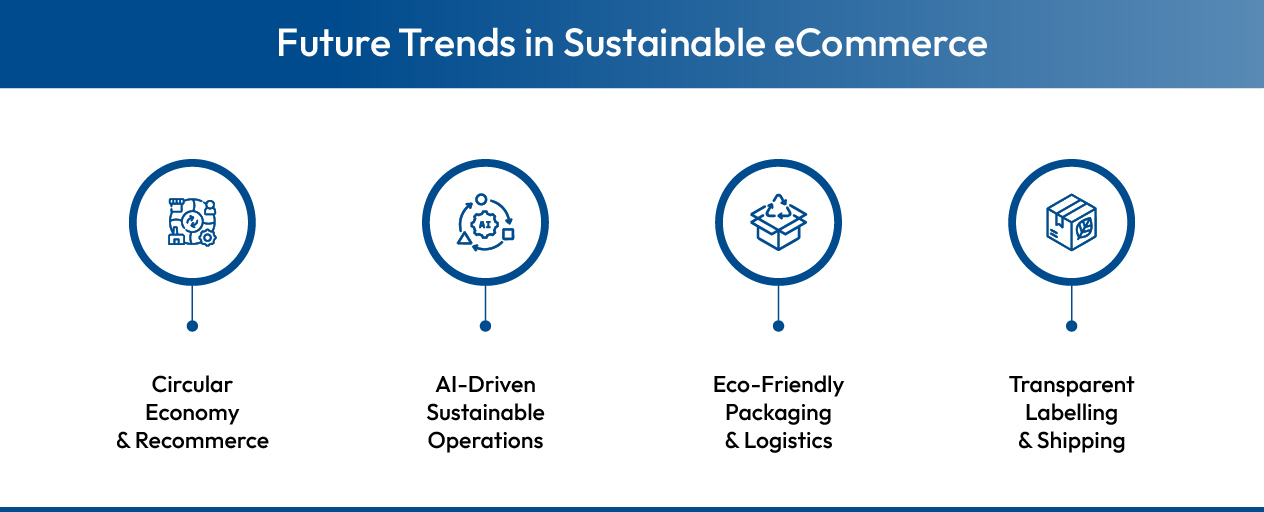
Three powerful movements are accelerating sustainable commerce adoption globally—each reshaping how brands sell, ship, and source.
Recommerce & Resale
The global recommerce market is on track to take 10% of global fashion sales as consumers increasingly choose second-hand and refurbished goods. This shift is driven equally by commerce sustainability values and affordability, making resale a mainstream sales channel. D2C brands that build structured resale and return programmes can reduce waste while unlocking new revenue streams.
Carbon-Neutral Shipping
Last-mile delivery accounts for a significant share of sustainable commerce challenges, with global weighted average last-mile CO₂ emissions from eCommerce deliveries sitting at 204 gCO₂ per parcel. Leading brands are responding with electric vehicle fleets, Amazon alone has deployed 10,000 electric vans. Reducing unnecessary deliveries caused by failed COD orders or RTOs, via tools like GoKwik’s RTO management, is a direct lever for lowering a brand’s shipping carbon footprint.
Transparent Supply Chains
Consumers are demanding radical transparency about where products come from and how they are made. As part of their commerce sustainability strategy, brands are investing in supply chain traceability tools, ethical sourcing certifications, and public ESG reporting. Brands that back sustainability claims with verifiable, publicly shared data earn 80% greater consumer trust, a competitive advantage that directly impacts conversion rates and brand loyalty.
Why Is Sustainable Commerce Important?
Sustainability is about doing things in a way that doesn't use up too many natural resources and helps keep the planet healthy for a long time. It's like making sure we meet our needs now without making it hard for future generations to meet theirs.
Scientists say that the growing trends of consumerism will adversely affect the Earth and might cause big problems like climate change (which may not be reversible). We’ve already begun seeing these “changes” happen in different parts of the world. If we don’t act consciously, the consequences will be disastrous.
So, companies need to take the environmental effects of their business seriously and change how they do business if needed. More and more consumers are concerned about commerce sustainability and protecting the environment when they decide what to buy. So, using sustainable methods can set a business apart from others and bring in customers who care about sustainability. Building and running a sustainable business today helps it grow and makes people think better of the brand. This means sustainability is also good for business.
Examples Of Sustainable eCommerce Companies
Let’s take a look at some online brands that have already started their sustainable journeys and are nailing it.
1. Allbirds
Allbirds is a popular footwear brand. Their sustainable initiatives include:
- Certified as Climate Neutral.
- Transitioning to sourcing 100% of their wool from regenerative sources.
- By 2025, Allbirds aims to have 75% of their materials sustainably sourced, either natural or recycled.
- Their target is to halve their carbon footprint by 2025 and achieve near-zero emissions by 2030.
- Despite sustainability being a competitive advantage, Allbirds has made their carbon footprint calculator freely available to competitors. They also provide a manual on its usage, aiming to encourage broader adoption of sustainable practices within the industry.
2. Estée Lauder
Estée Lauder is a trusted makeup, skincare, and fragrance brand. Their sustainable initiatives include:
- Since 2003, Estée Lauder has ensured that none of its manufacturing and distribution sites in the United States, Canada, United Kingdom, Belgium, and Switzerland contribute to landfills.
- The company aims to transition its entire global corporate vehicle fleet to electric by the end of 2030.
- Estée Lauder has set ambitious targets to reduce absolute Scope 1 and 2 greenhouse gas emissions by 50% and to reduce Scope 3 emissions (from purchased goods and services, upstream transportation and distribution, and business travel) by 60% by the end of 2030.
- By 2025, Estée Lauder aims to make 75-100% of packaging recyclable, refillable, reusable, recycled, or recoverable.
3. Blueland
Blueland is a cleaning and hygiene brand. Their sustainable initiatives include:
- Certified as Climate Neutral.
- Promotes reuse and refill by offering reusable and refillable bottles and product containers.
- Uses recyclable materials for shipping packaging.
- Endorsed for their sustainability and safety by reputable certifiers such as Cradle to Cradle, EPA Safer Choice, EWG Verified, and USDA BioPreferred.
Best Practices To Follow For Sustainable Commerce
There’s so much being spoken about the importance of sustainability but not so much about how businesses can actually contribute to a greener tomorrow. In this section, we’ve listed down some best practices you and your business can adopt to merge eCommerce and commerce sustainability.
- Optimised Product Discovery: When customers are well-informed and happy with their purchases, they're less likely to return them. So, it's important to focus on being transparent, giving accurate info, and offering excellent customer service from the moment they start browsing to when they make a purchase. This could mean providing detailed product descriptions, offering guidance on sizes and fits, showing product videos, and more to address any concerns that might lead to returns.
- Product Lifecycle Management: Making sure products are managed well from the beginning to the end of their life helps them last longer and reduces waste. This might involve refurbishing, repairing, or recycling items to keep them out of landfills.
- Sustainable Packaging: Many online retailers are now using packaging made from recycled materials, cutting down on the need for plastic and unnecessary packaging when shipping items to customers.
- Lower The Return Rate: Between 2020 and 2021, the amount of returned merchandise ending up in landfills almost doubled in the United States. Organizations should aim to have fewer returns. The key is to make sure all the information about your products is accurate, current, and has everything a customer might need to know.
- Donation: Some retailers partner with charities to allow customers to donate returned items to those in need. This not only reduces waste from returns but also supports the community.
- Resale: Retailers can also explore reselling returned items on the secondary market. By giving products a second life, they can reduce waste from returns while generating additional revenue.
- Create Recycling Policies: To be more eco-friendly in business, it's important to set up recycling rules. First, check what materials can be recycled in your products and packaging. Then, make special areas in your workplace just for recycling. Teach your team how to recycle properly and work with recycling centres. Keep an eye on how well it's going and keep finding ways to make it even better.
Role Of Technology In Scaling Sustainability
Scaling sustainable commerce isn't just about policy; it's about using smart tech to reduce waste at the source.
1. Smart Checkout to Cut Waste Before It Ships
- Precision Addressing: Incorrect addresses lead to failed deliveries and doubled carbon emissions from re-attempts. Smart checkout tools auto-correct addresses to ensure first-attempt delivery success.
- Delivery Updates for Less RTO: Real-time communication via WhatsApp and SMS keeps customers informed, significantly reducing "door-step rejections" that cause unnecessary return transit.
- COD Interventions for Less RTO: By offering incentives for prepaid orders or verifying intent via OTP for COD, brands can prevent high-emission return trips before the parcel even leaves the warehouse.
By verifying intent via OTP or offering incentives for prepaid orders, brands prevent high-emission return trips. Learn more in ourguide to reducing RTO.
2. Logistics & AI
- Route Optimization: AI algorithms plan the most fuel-efficient delivery routes, reducing mileage and emissions for last-mile logistics.
- Inventory Intelligence: Predictive analytics help brands stock inventory closer to demand hubs, minimizing long-haul shipping distances.
- Packaging Optimization: AI determines the optimal box size for every order, eliminating "air shipping" and reducing cardboard waste.
- Managing COD Impact: Since COD orders often have higher return rates, managing them effectively is crucial forsustainable growth.
Transition From Fast to Fair with GoKwik!
Sustainable commerce is not just an ethical imperative—it is a strategic growth lever. GoKwik helps D2C brands align profitability with sustainability by reducing the single biggest source of eCommerce waste: failed deliveries. With AI-powered RTO management, every shipment that reaches the right customer the first time is a win for your bottom line and the planet.
GoKwik’s Kwik Checkout ensures precise addressing and frictionless payment for reducing returns, cutting unnecessary logistics trips, and helping brands build commerce sustainability into their operations without adding complexity. For brands building with sustainable commerce in mind, smarter checkout is where the journey begins.
The younger generation is already voting with their wallets for brands that reflect their values. GoKwik gives your brand the tools to meet them there: operationally efficient, conversion-optimised, and aligned with the principles of sustainable commerce that define the future of retail.
Sign up for a demo with GoKwik and start building sustainably today.
What Are The Three Pillars Of Sustainability?
The three pillars of sustainability are the environment, the society, and the economy. The environmental aspect concentrates on sustainable practices within the business, while the societal aspect emphasises relationships with stakeholders and employees and the economic aspect centers on the financial performance of the business.
What Is Green eCommerce?
Green eCommerce refers to online shopping practices that prioritise environmental sustainability, such as using eco-friendly packaging and promoting products with minimal environmental impact.
What Is ESG in eCommerce?
ESG in eCommerce stands for Environmental, Social, and Governance criteria. It refers to evaluating a company's performance and impact in these areas, including its environmental sustainability practices.
What are core principles of sustainable commerce?
The core principles include minimizing environmental impact, promoting social responsibility, and ensuring economic viability. This involves lifecycle thinking, from ethical sourcing and efficient production to waste reduction and responsible disposal, balancing profit with planet and people.
What are the 5 stages of sustainable business?
The 5 stages typically include: 1) Compliance (following laws), 2) Efficiency (cutting waste to save money), 3) Integration (embedding sustainability into core strategy), 4) Transformation (innovating new sustainable models), and 5) System Change (redefining the industry standards).

AUTHOR
Vardhan Jain
Director of Product Program @ GoKwik
Explore Related Blogs

Kwik Engage
8 Best AI Chatbots for E-Commerce in 2026: Features, Pricing and Best Fits
28-Apr-202614 Min Read

Kwik Engage
24 Types of Emails Every D2C E-Commerce Brand Should Send
14-Apr-202614 Min Read

Kwik Engage
What is Promotion Mix and How E-commerce Brands Can One for Maximum Sales?
13-Apr-202614 Min Read