How KwikAds helped Shop Unrush boost ROAS by 37% in 3 months
How KwikAds helped Shop Unrush boost ROAS by 37% in 3 months
How KwikAds helped Shop Unrush boost ROAS by 37% in 3 months
How KwikAds helped Shop Unrush boost ROAS by 37% in 3 months
eCommerce
The Shift From GA to GA4 And Its Impact On eCommerce Brands
 24 Feb 2026
 10 Min Read
Parousia leads product marketing strategies at GoKwik, and she is an expert in driving e-commerce optimisation, conversion growth, and innovative GTM strategies. She crafts compelling messaging and creates content pertaining to D2C commerce.
Read this blog on your favourite platform
Google Analytics (GA) is by far one of the most prominently used web tools by businesses across the globe. It tracks, collects, and presents site owners and marketers with a wealth of valuable data helping them derive meaningful business insights. However, as the world wide web is maturing and more and more businesses are going online, Google had to bring about a much needed change to the standard Universal Analytics tool as well. And hence, Google Analytics 4 or GA4 was born.
Officially launched in October 2020 after a year-long phase of beta testing, the next generation of Google Analytics – GA4, will now come into action starting July 1, 2023.
With this kicking off, GA4 will become the only property on the platform regardless. This means no website activity will be recorded, and all historical data will be gone forever.
However, online businesses will have some buffer time to take a download of their history and other essential data before GA4 comes into force completely.
But some questions still remain unanswered like,
- What exactly is GA4?
- How is it different from GA? And,
- How will online businesses, especially eCommerce get affected by the change?
Let’s find out.

What Is Google Analytics 4 (GA4)?
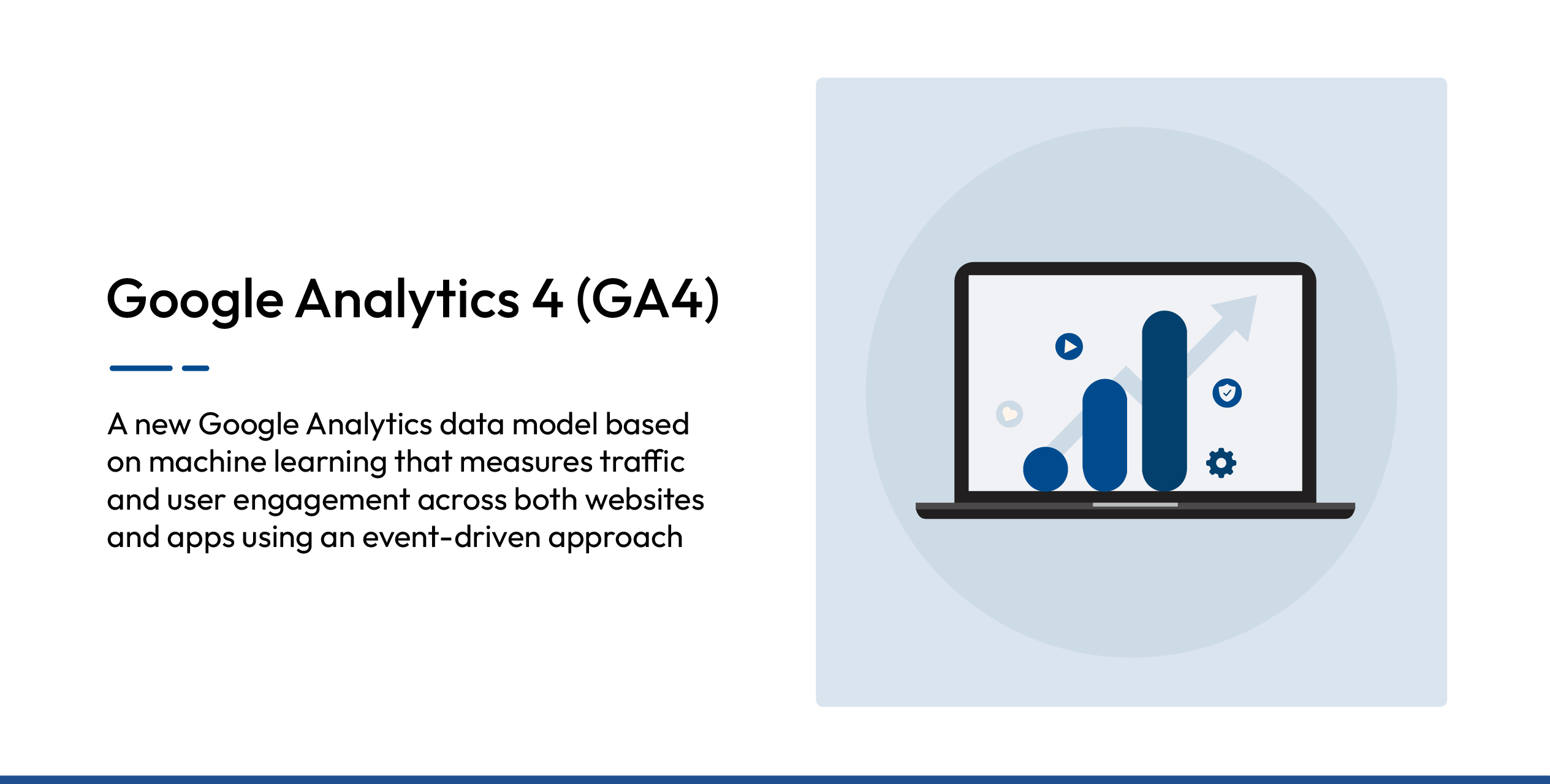
GA4 or Google Analytics 4 is a new data model of Google Analytics that measures traffic engagement across your websites and apps. It is based on machine learning that’s capable of providing reliable data and making predictive analysis. GA4 also offers greater functionality and better insights, making your job easier than before.
It won’t be wrong to say that GA4 is not merely an update, but an entire collection of new data, storage, and filtering models. And, it’s high time for online businesses to be prepared for the change.
Other than that, there are many reasons to start migrating to GA4. Privacy being the top concern, we are entering the cookieless future with no reliance on third-party cookie data. GA4 fits perfectly in that atmosphere, as it uses first-party data to collect users’ information.
GA Vs GA4 – How Are They Different?
Although GA and GA4 are two different versions of the Google Analytics platform itself, the latter dominates the former by length. Here’s a comparative analysis for your understanding.
1. Data Model
The flat data model used in GA has quite a few limitations. Over time, it becomes difficult to measure how users interact with your site. That’s because each interaction on your website is taken as an independent hit. So it’s suitable for simple sites which have less interactions. To track high interactions, one would need additional plugins for support.
However, GA4 has introduced a hierarchical data model that measures user interaction based on events. This means it’s a good fit for all types and sizes of websites, compared to its counterpart.
2. Data Collection
GA4 comes with more features that make data tracking easier and highly accurate.
Talking about GA, it has a centralised server for data collection that sends data via tracking codes. Any glitches or wrong implementation of the code can lead to data loss.
Meanwhile, in the case of GA4, the server continues to collect data, but each tracking code is independently connected to the server. So, in case there’s any downtime on the server, or even if the code is not implemented correctly, only data from the specific implementation will be affected. In other terms, GA4 minimizes the risk of data loss compared to GA.

3. Privacy
GA4 has been designed to keep privacy as the top corner. This new updated version of GA anonymizes collected data and doesn’t collect personally identifiable information (PII).
However, in the case of GA, there exist anonymization features, but you’re required to turn it on by yourself.
If you don’t turn on the feature by default, Google Analytics automatically collects PII like name, email address, and phone number. Hence, indirectly, privacy took a back seat in this version.
4. Event Tracking Set-up And Automation
GA4 event tracking is more flexible than its predecessor. While in Universal Analytics, the tracked events are based on category, action, label, and value schema, it’s quite different in GA4. The 4th edition captures events in four categories
- Automatically collected events
- Enhancement measurement events
- Recommendation events
- Customised events
5. eCommerce Tracking
In terms of eCommerce capabilities, GA is the winner, as it offers a long list of tracking details as compared to the new Google Analytics version. This is because, Google says, GA4 is not ready for commercial consumption as of yet. However, they’re working to develop this capability and it is in their future release pipeline.
6. Engagement Metrics
GA4 has more attributes to its engagement metric including,
- Engaged session
- Engagement session per user
- Engagement rate
- Engagement time
Each of these metrics is very useful in tracking users more accurately in both the websites and apps. But, these metrics are not present in GA. Universal Analytics allows you to track metrics like page views and bounce rate which are not present in GA4.
How Can Shifting To GA4 Impact eCommerce Businesses?
Taking almost 8 years to come up with a new version, it’s quite obvious that Google must have thoroughly thought it through. However, adapting to new changes is always a challenge for businesses using the web app. The sunny side, every new change brings in an array of advantages that businesses must gauge and leverage to their advantage.
Listed below are some ways how shifting to GA4 will impact eCommerce businesses, especially in India.
1. Technical Expertise
Though speculations claim that you’ll need a person specialised in tag management, Data Studio, and Google Analytics to put in place GA4. A nontechnical person may not be able to set it up properly.
However, the best part about using Google is that it provides explainer videos around every product or update it releases. So, even if you’re someone who’s just started using Google Analytics, can easily learn from these explainer videos and even take the help of Google’s team to make the transition.
2. Set Up Time
Setting up GA4 for a website that only has a few forms, some videos and a couple of other lightweight integrations will take very less time to set up. But if you’re looking to make the most out of GA4 for specifically creating custom events, custom dimensions, and using Data Studio a lot, it’s going to take a lot of time.
3. Clear Measurement
What happens in GA is that a single person visiting via different devices is counted as many users by default. As a result, there can be serious inflation in your user counts. It distorts metrics like the number of sessions per user or the amount of revenue per user. And, the situation worsens when your business has mobile apps.
But GA4 gets rid of that problem. It offers customer-centric measurement. It measures, unifies, and de-duplicates the interaction of your users across different devices and platforms. Giving you a clear measurement.
4. Smarter Insights That Drive Marketing Effects
Google’s advanced machine learning (ML) models are integrated directly into GA4. Thus, it offers benefits like,
- Anomaly detection – If there are any anomalies in your insights, you’ll be notified. You can set alerts on your key audience segment if you want to make these even more bespoke.
- Predictive metrics – With the help of predictive metrics like churn profitability, you can spot potential issues and take corrective measures before you lose customers.
How To Prepare Your Business For The Shift?
The GA vs GA4 transition is a critical milestone for your brand’s growth. To protect your store’s historical performance data and ensure a smooth migration, follow this strategic plan designed for eCommerce success:
- Implement Dual-Tagging Immediately: Install the latest version of Google Analytics alongside your current property today. This allows you to collect essential user data for year-over-year comparisons before the old universal analytics properties stop processing data entirely.
- Adopt the Event-Driven Model: Transition your strategy from tracking simple sessions to analyzing deep user behavior. In this new generation of Google Analytics, focus on the engagement rate to see how shoppers interact with your product pages and checkout flow rather than just counting page views.
- Backup Historical Sales Data: Google will delete all legacy data after the transition, so you must export your raw data now. Having a permanent record of past marketing insights ensures you can accurately benchmark your performance against new data streams in GA4.
How GoKwik Bridges the Tracking Gap for Shopify Stores
For many Shopify owners, the GA vs GA4 transition created a "black box" during the final steps of the checkout journey. When shoppers move from your store into a third-party checkout, the tracking session often breaks, causing sales to be incorrectly attributed.
GoKwik solves this by syncing directly with your version of Google Analytics to ensure a continuous data flow:
- Preserve Traffic Sources: Keeps the original Google Ads or social attribution intact so you see exactly what drives sales.
- Capture User Actions: Automatically tracks events like begin_checkout and purchase within your GA4 property.
- Unified User Journey: Connects individual users across your storefront and the checkout for a better understanding of funnel health.
By eliminating these data gaps, you gain the marketing insights needed for effective conversion rate optimization. You can finally stop guessing which campaigns are working and start scaling with raw data you can actually trust.
Final thoughts: Data-Driven eCommerce Growth with GA4
Mastering the shift from GA vs GA4 is no longer optional for Shopify merchants; it is the foundation for scaling in a privacy-first world. By moving to the new generation of Google Analytics, you gain the ability to track the complete user journey with precision.
Integrating GoKwik ensures that your web analytics remain accurate even during the critical checkout phase. With a seamless data flow and reliable attribution for your marketing campaigns, you can stop worrying about missing events and start focusing on conversion rate optimization.
Ready to see how accurate data can transform your store’s performance?
Book a demo with GoKwik today to bridge your tracking gaps and unlock deeper marketing insights.
What is the main difference between Google Analytics and GA4?
The GA vs GA4 comparison highlights a shift from Universal Analytics' session-based tracking to an event-driven new generation of Google Analytics. This version of Google Analytics prioritizes user behavior over simple page hits, utilizing enhanced measurement events to capture user actions like video engagement and outbound clicks automatically.
When did GA4 replace GA?
Google officially transitioned to GA vs GA4 on July 1, 2023, when Universal Analytics properties stopped processing user data. This latest version became the Google marketing platform standard, encouraging brands to move to data streams for a better understanding of customer behavior across app data and web platforms.
What is the difference between GA4 and GA 360?
In the GA vs GA4 enterprise landscape, GA 360 offers higher limits for data retention and custom parameters compared to the standard latest version of Google Analytics. GA 360 users gain advanced data governance and access to raw data via BigQuery, which is essential for complex marketing insights and predictive analytics.
What is the best alternative to GA4?
While GA vs GA4 remains the industry standard, many brands explore marketing tools like Looker Studio or Matomo for deeper data analysis. The good news is that for conversion rate optimization, finding the right place involves balancing user privacy and web analytics needs, often requiring a learning curve to master custom reports.
How does GoKwik integrate with GA4 to help Shopify stores?
GoKwik simplifies GA vs GA4 for Shopify merchants by ensuring a seamless data flow through Google Tag Manager. Our integration tracks individual users to improve the user experience, providing marketing campaigns with additional data to achieve the best results in RTO rate reduction and overall conversion rate optimization.

AUTHOR
Parousia Khan
Senior Product Marketing Manager @GoKwik