How KwikAds helped Shop Unrush boost ROAS by 37% in 3 months
How KwikAds helped Shop Unrush boost ROAS by 37% in 3 months
How KwikAds helped Shop Unrush boost ROAS by 37% in 3 months
How KwikAds helped Shop Unrush boost ROAS by 37% in 3 months
Smart COD Suite
5 Challenges And Solutions To Combat Returns In Return To Origin
 25 Mar 2026
 08 Min Read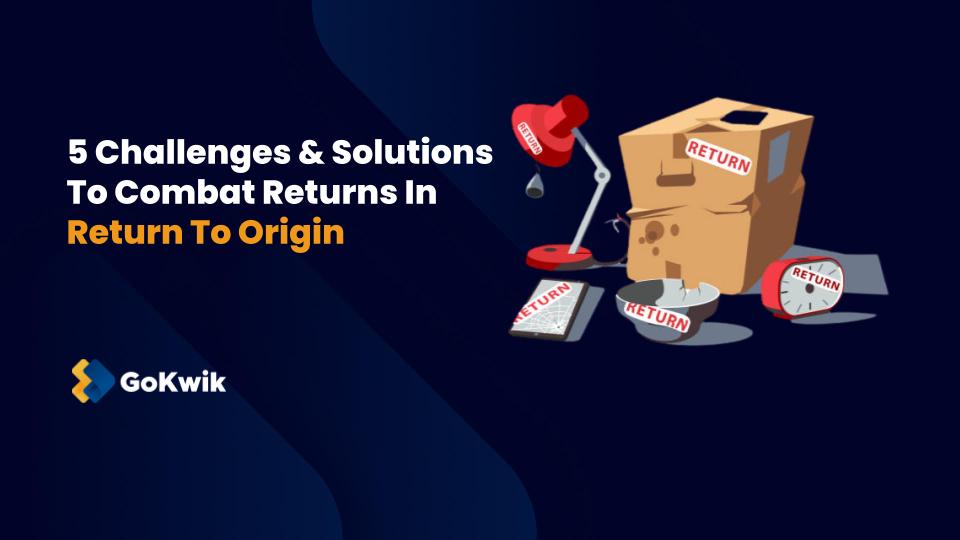
Parousia leads product marketing strategies at GoKwik, and she is an expert in driving e-commerce optimisation, conversion growth, and innovative GTM strategies. She crafts compelling messaging and creates content pertaining to D2C commerce.
Read this blog on your favourite platform
eCommerce has brought about a new revolution in the Indian shopping industry. Besides providing customers with the ease and convenience of shopping from their homes, it’s given many aspiring entrepreneurs a platform to go big and build billion-dollar companies. While we talk highly of how the Indian eCommerce industry has matured in recent years, we often fail to talk about many challenges that persist in the system. One of them is the high return to origin rate.
In this blog, we'll discuss the challenges and solutions to combat return in return to origin (RTO). But, let's start with the basics first.
What Is Return To Origin (RTO)?
Return to origin (RTO) refers to a phenomenon where shoppers cancel or reject orders at the doorstep which they placed as cash-on-delivery (COD). These cancelled or rejected orders are then sent back to the source origin causing the seller to,
- Pay an additional logistics fee
- Manage inventory in books
- Bear the additional operational cost
- Additional quality check and re-packaging cost
- Endure the risk of product loss or damage
- Bear unrealised losses, and more.
Managing returns can be a complex and expensive process, especially in the case of high return to origin rates.
In this blog, we plan to discuss the challenges faced by Indian eCommerce businesses while managing high return to origin rates and the solutions that can help address these challenges.

Challenges #1 – Unnecessary Forwards and Reverse Logistics Cost
Return to origin involves both forward logistics and reverse logistics costs. Where the former means the initial cost borne by a seller to ship an order to the customer, the latter means the cost incurred to return the same shipment to the seller. This results in additional shipping costs.
Solution – Efficient Logistics Strategies
The best way to reduce the add-on expense of reverse logistics is to implement efficient logistics strategies.
- Optimise shipping routes
- Partner with reliable logistics providers
- Use technology to streamline logistics operations
Consolidate return shipments to minimise costs and negotiate favourable shipping rates with logistics partners.
Challenges #2 – High operational costs
Managing returns resulting from RTOis an expensive process. It involves multiple stages, including shipping, quality checks, inventory management, and restocking. The costs associated with these processes can quickly add up, especially when the rate of returns is higher than usual. For smaller retailers, these costs can be exorbitant, making it difficult for them to manage high return rates and keep their profits intact.
Solution – Adopt Technology
Technology can significantly help solve this massive return to origin challenges. It can help automate and streamline the RTO process and even place interventions to minimise the risk of returns from the roots themselves.
For instance, online retailers can use GoKwik’s RTO Protection Suite to identify which shoppers are most likely to cause a return to origin. They can also study a shopper’s buying pattern and history, and place necessary interventions. These could include,
- Block shoppers with low buying intent from placing COD orders
- Enable COD prompts or captcha to ensure only genuine users place orders
- Blacklist shoppers who frequently cause RTOs
- Use communication channels like WhatsApp to reduce customer anxiety at bay
- Give shoppers various options to receive/reschedule deliveries to reduce the risk of RTOs
By leveraging RTO Protection Suite by GoKwik, online retailers can reduce the time and costs associated with RTO management and even improve overall customer experience.
[youtube id="AZ8-QM_nRxs"]
[youtube id="AZ8-QM_nRxs"]
Challenge #3 – Fraudulent Returns
Another challenge faced by the online retailers is the issue of fraudulent returns. Many times, shoppers make dishonest or deceptive returns to gain unauthorised benefits. For instance,
- Returning used or damaged items
- Swapping products
- Falsely claiming non-receipt of goods
These cause financial loss to the eCommerce business.
Solution – Eliminate Fraudulent Returns With Effective Measures
To address the issue of fraudulent returns, eCommerce brands can take necessary measures to prevent and detect fraudulent activity. This includes using fraud detection software and implementing stricter guidelines for returns.
Online retailers can use GoKwik’s intelligence-backed RTO solution to identify fraudulent orders, block them from the source, and ensure no revenue loss.
To give you an example, in September 2022, Lenskart was witnessing a high conversion rate and an even higher RTO rate. This was unusual and the eyewear brand was certain of some mischievous activity. It then used GoKwik powered RTO Protection Suite to analyse the root cause and found that nearly 2000 per day were fraud orders. Using the AI-ML-backed RTO solution, it blocked these users causing RTOs and witnessing a growth in its overall profit margin.
By addressing fraudulent returns, online retailers can significantly reduce losses and improve the overall customer experience.
Challenge #4 – Difficulty in Maintaining Accurate Inventory Levels
Items received under returns to origins can effectively create discrepancies in inventory levels. This further makes it challenging for online businesses to accurately track and manage their stock, and display items for sale on their storefronts.
Solution: Implement A Robust Inventory Management System
To manage this challenge, eCommerce brands must have effective and robust inventory management tools in their arsenal. However, it’s equally important to ensure that the tool provides,
- Real-time visibility into stock levels
- Records of fresh and RTOed inventory
- Reconciles and updates information regarding RTOed items
Such automation can further help expedite the processing of returned items and ensure prompt inspection. This helps quickly separate damaged items from those in good condition and convert returned inventory into saleable products.
In the case of damaged products with minimal defects, online retailers can consider liquidation channels or partnerships with resellers to sell off the blocked/dead inventory and increase working capital.
Challenge #5 – Lack Of Standardised Processes
The lack of standardised processes for return to origin management is also a major challenge for most eCommerce brands.
In India, there are no standardised guidelines for returns management. That’s primarily because of offering customers the ease of returns and keeping their trust intact. However, amidst the process, this is making it difficult for e-retailers to manage the return process efficiently and bear losses.
Solutions – Implement Standardised Processes
To manage returns efficiently, eCommerce companies need to implement a standardised process. This could include,
- Developing a guideline for returns – define a detailed procedure around quality checks. If the item passes the parameters, returns shall be processed, and vice versa
- Implementing return fees – to reduce the risk of returns, brands can implement a nominal return fee against each product. This will make the shoppers more conscious of what they’re buying.
- Implementing fee on COD orders – this feature too can help minimise COD order placements and the resulting RTOs. For instance, add an INR 100/- fee for placing a cash-on-delivery order. This makes the shoppers think twice and take an informed decision
To Conclude,
In a country like India where ease of returns has been massively exploited, it’s time to bring about some changes and offer a breather to eCommerce companies. By solving these persistent challenges with the above-mentioned solution, online retailers can sell their products in a better manner and manage returns, and ensure the least profit leakages.
What is the meaning of return to origin?
Return to Origin (RTO) in e-commerce means an order is undelivered to the customer and sent back to the seller. This common issue for businesses in India causes significant losses from logistics and product handling. Addressing the challenges of return to origin is vital for D2C brands to ensure profitability and customer satisfaction.
What is the difference between RTV and RTO?
RTO (Return to Origin) occurs when a product cannot be delivered to the customer and is sent back to the seller. RTV (Return to Vendor) is when a customer returns a successfully delivered item. Understanding these distinctions is crucial for addressing the challenges of return to origin effectively for e-commerce brands in India, optimizing operations.
How to reduce return to origin?
GoKwik's AI-backed platform helps D2C brands in India significantly reduce return to origin. We tackle the common challenges of return to origin with tools like Kwik Checkout, which verifies orders and minimizes failed deliveries. This approach enhances customer satisfaction, boosts successful deliveries, and ultimately improves your business's profitability.

AUTHOR
Parousia Khan
Senior Product Marketing Manager @GoKwik