Blocking has become far more common than most merchants realize, and the data on whether it actually works is more complicated than "block it and you're safe, allow it and you're exposed."
On adoption: roughly 25% of the top 1,000 websites now block GPTBot, up from just 5% in early 2023, a five-fold increase in under three years. Among top news publishers specifically, one 2026 analysis found 79% block AI training bots via robots.txt and 71% also block AI retrieval bots, with only 14% blocking all AI bots outright and 18% blocking none at all. GPTBot is consistently reported as the single most-blocked AI crawler across these studies, ahead of CCBot, ClaudeBot, and Google-Extended.
On whether blocking actually reduces citation: the evidence cuts against the assumption that it does, cleanly, in one direction. A March 2026 BuzzStream study covering 4 million citations across 3,600 prompts and 10 industries found that among the top 50 news sites blocking ChatGPT's live retrieval bot (ChatGPT-User), 70.6% still appeared in ChatGPT's answers regardless, suggesting retrieval crawlers aren't always the only pathway a system uses to know about a page. A separate July 2026 analysis cross-referencing robots.txt rules against actual citation rates across 1,058 prominent domains found a much starker pattern in the other direction: the median GPTBot-blocking domain earned close to zero ChatGPT citations per Google ranking it held (0.003), compared to 0.417 for domains that allow GPTBot, a roughly 140x difference in citation propensity. The two findings aren't necessarily contradictory, they may reflect different crawler types (training versus live retrieval) behaving differently, which is exactly why distinguishing GPTBot from OAI-SearchBot, and Google-Extended from regular Googlebot, matters as much as this guide emphasizes.
On the cost of blocking: research from Rutgers Business School and The Wharton School, published December 2025, found publishers who blocked AI crawlers via robots.txt saw a 23.1% decline in total monthly traffic and a 13.9% decline in human-only browsing, a real operational cost that isn't always offset by a corresponding citation benefit.
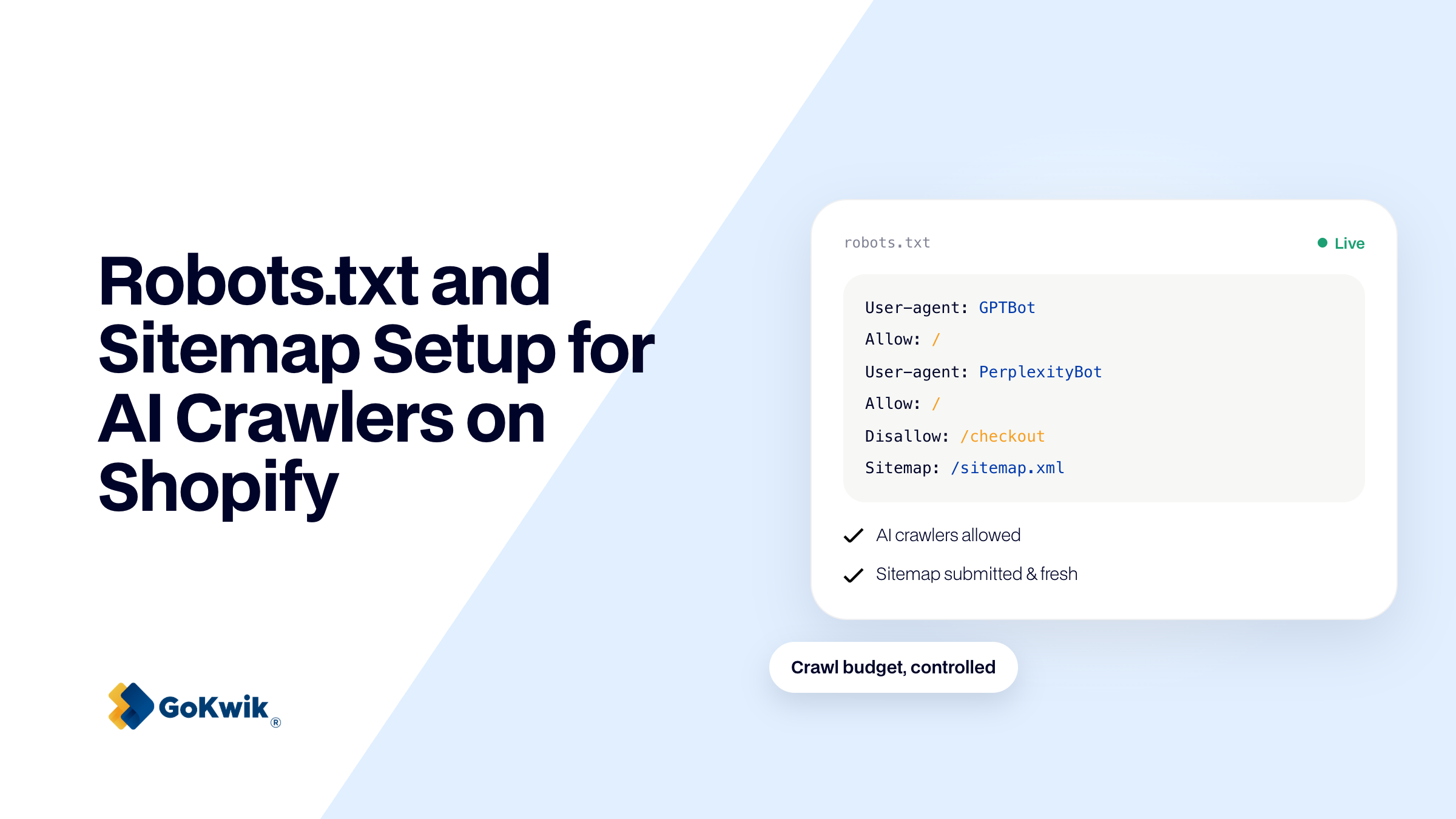
On what most enterprises actually do: roughly 61% of enterprise sites reportedly use a hybrid policy, allowing AI crawlers to access public commercial content while explicitly blocking sensitive paths like account dashboards, checkout flows, and internal search results, which is the approach this guide recommends for most Shopify stores too.



_1790076136.png)