Before tracking improvement, you need a baseline. The process takes one focused session:
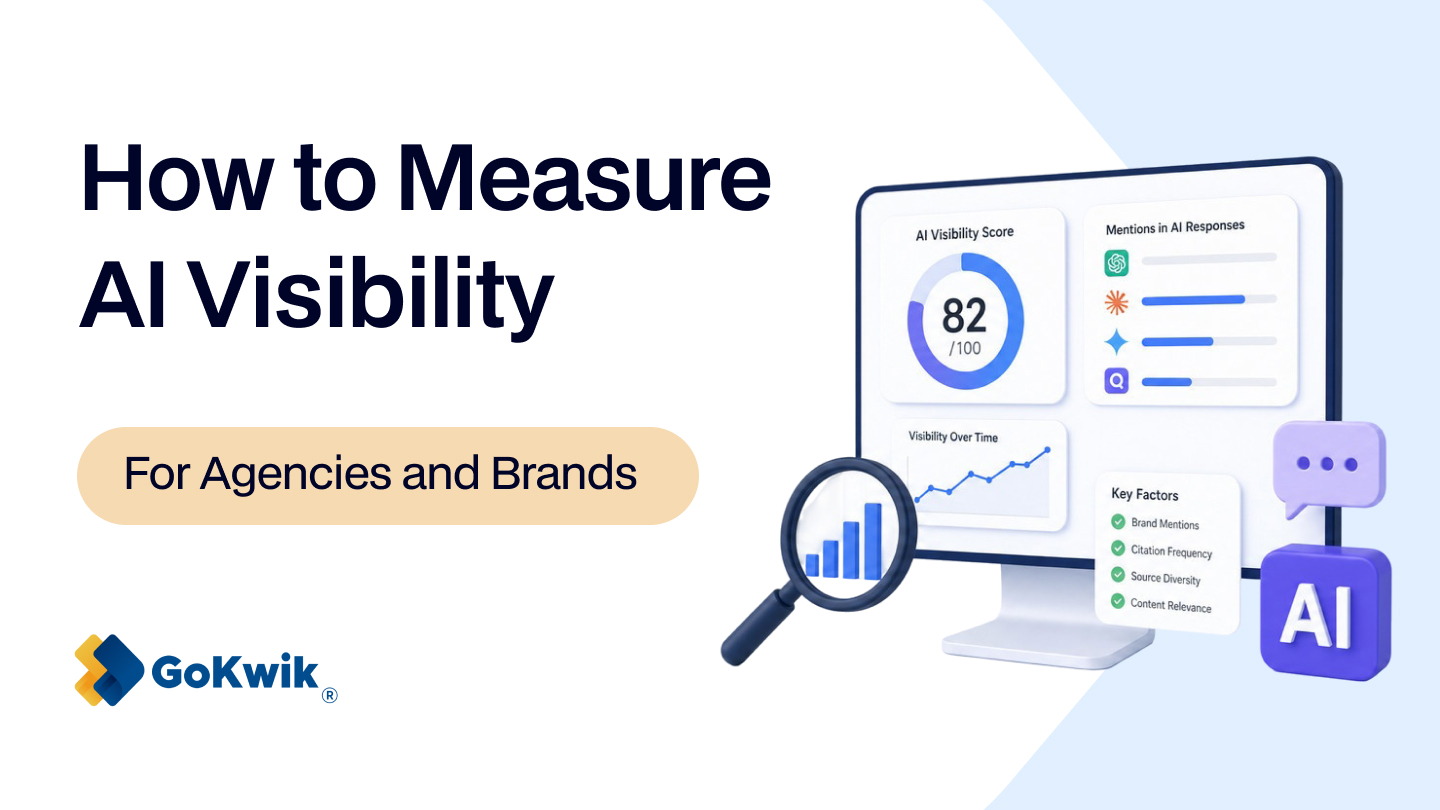
Set up Kwik GEO with your brand, your top 3–5 competitors, and 20–50 target prompts mapped to your highest-value product categories. Configure your topic clusters to match how your customers describe their problems, not how your marketing team describes your products. Enable tracking across ChatGPT, Perplexity, Google AI Overview, and Gemini.
Run your first full report. Your baseline numbers, AI Visibility %, Your Share %, Missing Prompts count, Citation Opportunities gap, are your starting point. Every subsequent report is measured against this baseline.
Set up GA4 AI referral tracking in parallel: create a custom channel group that isolates chatgpt.com, perplexity.ai, gemini.google.com, and claude.ai as separate traffic sources. This gives you the revenue attribution layer that connects Kwik GEO's visibility data to actual business outcomes.
The brands, and the agencies, that establish this measurement infrastructure now will have both the visibility data and the historical trend lines that matter most as AI search continues to grow. Nearly a third of digital marketing leaders now prioritize GEO as essential for 2026 growth, 97% report positive impact from GEO initiatives, and 32% named GEO their top priority for 2026, up from 12% of 2025 digital budgets. The measurement gap is closing fast. The question is whether you're building visibility data before or after your competitors are.
Try Kwik GEO to set up your AI visibility baseline across ChatGPT, Perplexity, Google AI Overview, and Gemini, and see exactly where you stand versus competitors today.
Frequently Asked Questions
Q1. What is the most important metric to track for AI visibility?
AI Visibility % is the headline metric. It measures the percentage of your tracked prompts where your brand appears in AI-generated answers. It is the GEO equivalent of organic traffic share: a single number that tells you whether your brand exists in the AI information ecosystem your customers are searching in. But AI Visibility % alone is incomplete. Your Share % is the metric that reveals whether you are winning or losing ground relative to the category. A brand improving its absolute visibility while a competitor grows faster is still losing the AI search race. Both metrics together give you the full picture.
Q2. Why is AI referral traffic so hard to track in GA4?
Because most AI-driven discovery never generates a referral event. Only about 20% of ChatGPT mentions include a clickable citation link that GA4 can log. The other 80% ie. the brand recommendations, comparisons, and category descriptions that shape purchase decisions, leave no trace in any standard analytics dashboard. A customer who asks ChatGPT for the best barrier repair moisturiser, sees your brand recommended, and visits your Shopify store directly will show up as direct traffic in GA4. The AI touchpoint is invisible. This is why GA4 AI referral tracking needs to be set up as a dedicated custom channel group, and why a GEO visibility platform running in parallel is necessary. GA4 captures what converts, GEO platforms capture what influences.
Q3. How is measuring AI visibility different from measuring SEO performance?
SEO measurement is built around clicks: rankings, impressions, click-through rate, and organic traffic. Every metric assumes someone searched, saw your link, and clicked. AI search breaks every assumption in that model. 93% of AI Mode sessions end without a click to any website, brand visibility inside AI responses is often the only impression you get. Rankings do not exist in AI search. Impressions have no comparable equivalent. Click-through rate is structurally broken because most AI answers resolve without a click. Keyword volume is the wrong unit when the input is a 23-word conversational prompt. GEO measurement requires an entirely different framework built around citation rate, share of voice, prompt-level visibility, and third-party domain authority, none of which appear in any standard SEO tool.
Q4. How do agencies use AI visibility data to demonstrate value to clients?
The metric that retains clients is competitive position movement. Specifically, moving from Position 4 to Position 2 in a category's AI visibility leaderboard over six months, with data showing which prompts moved from missing to active and which citation gaps were closed. Monthly reports should lead with AI Visibility % trend over 90 days, competitive rank, and Answers Mentioned growth. The Citation Opportunities matrix is the deliverable that justifies a retainer: it shows exactly which domains are citing competitors but not the client, with answer counts per gap, turning "we need more citations" into a ranked, evidence-based outreach list. Quarterly reviews add the sentiment layer, flagging emerging negative associations in AI answers before they compound into a brand problem.
Q5. How many prompts should a brand track to get meaningful AI visibility data?
20 to 50 prompts is the right starting range for most D2C and Shopify brands. The key is mapping prompts to your highest-value product categories using the language your customers actually use. Fewer than 20 prompts produces a dataset too small to identify meaningful trends. More than 100 prompts without a clear topic cluster structure generates noise that makes it harder to prioritise action. Configure topic clusters first, then build prompt sets within each cluster, this structure also makes platform-level filtering useful, so you can isolate Perplexity performance or ChatGPT performance for a specific product category independently
 16 Sep 2026
 17 Min Read